- Analysis
Should climate activists target fossil fuel subsidies?
With Trump and Musk wanting to cut spending, fossil fuel subsidies are a ripe target. But nothing about this political moment is straight forward.
Back in mid-December, Bernie Sanders made headlines when he sent a tweet that seemed to show support for Donald Trump and Elon Musk’s proposed Department of Government Efficiency, or DOGE. “Elon Musk is right,” Sanders said, before adding, “The Pentagon, with a budget of $886 billion, just failed its seventh audit in a row. It’s lost track of billions. Last year, only 13 senators voted against the Military Industrial Complex and a military budget full of waste and fraud. That must change.”
It’s hard to imagine Sanders and Musk actually agreeing on much, but the message from Sanders got me wondering about another area of wild government overspending: fossil fuel subsidies.
According to the International Monetary Fund, fossil fuels subsidies in the United States added up to a whopping $757 billion in 2022. Of this $3 billion are considered explicit subsidies — a more modern and well organized version of bags of cash — while the remaining $754 billion are implicit subsidies. This latter category is a confusing soup of uncounted environmental and human health damages. While the Biden administration took actions that will hopefully knock these numbers down, there is still a lot of public money flowing to Big Oil in 2025.
On paper, this seems like a pretty ripe target for climate organizers. It shouldn’t be too hard to make the case that dumping billions of public dollars into the coffers of already profitable corporations is pretty inefficient. What’s more, with electric vehicle magnate Elon Musk at the helm of DOGE, there is — again, at least on paper — a target with a vested interest in opposing the fossil fuel industry. The campaign strategy kind of writes itself, but is it actually a good idea?
For the past few weeks, I’ve been playing out a debate over that question in my head. The more I’ve thought about it, the more I’ve come to realize what I’m actually wondering is: How do you organize for the climate in this new political reality? So, I decided to play this exercise out, to make the case for — and against — running a fossil fuel subsidy campaign in the second Trump era with the goal of finding an answer to that broader question.
I’ve already laid out the core argument for this campaign but, simply put, if you can make the case that fossil fuel subsidies are government handouts to already profitable corporations, it should be a no-brainer for an agency focused on “efficiency” to cut those subsidies. The work of organizers is simply to craft a campaign that forces the decision dilemma onto those with the power to act.
For climate campaigners, this should be pretty standard fare. First, launch the demand with an online petition, organize to build a base around the demand, deliver the petition and then escalate with creative actions. Using Musk as a target, there would be plenty of options for creative, impactful protest from his public appearances to Tesla dealerships and so on.
If this campaign succeeded, it could — at least in theory — drive a wedge between the Trump administration and the fossil fuel industry. Or, alternatively, it could divide Trump from one of his most ardent supporters in Elon Musk. In either case, these cracks could be exploited by organizers to open up all kinds of other climate wins.
The case against a fossil fuel subsidy campaign
On paper, this campaign sounds great. But would the paper case actually play out in the real world? That is harder to say.
Let’s start with the biggest elephant in the room: When we talk about Donald Trump and Elon Musk we are talking about an unhinged authoritarian and the richest man on the planet. The former is a climate denier and the latter — although he has built an electric vehicle empire — has exhibited a pretty questionable moral compass, even going back before his descent into the MAGA-verse.
That presents a massive challenge because, at their core, campaigns like this require a movable target. Usually, this is achieved through some combination of moral sway, economic or political cost, and risk posed to a target’s profile or reputation.
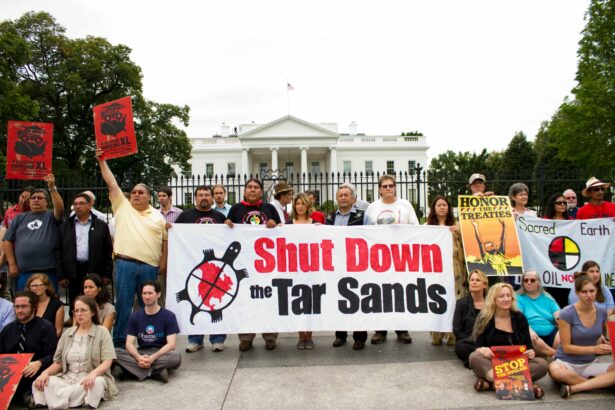 Overwhelming odds, unexpected alliances and tough losses — how defeating Keystone XL built a bolder, savvier climate movement
The Keystone XL campaign was a textbook example. The full story is more complex, but at the 10,000-foot view that campaign pushed President Barack Obama with moral appeals to act on climate and protect frontline and Indigenous communities. Organizing created political risk, particularly the risk of losing young voters. At the same time, the administration was cornered by creating the narrative that approving Keystone XL would sink the Democratic Party’s reputation on climate.
Today, Donald Trump has proved through various actions that he doesn’t think, act or respond like a normal politician. He doesn’t have a moral compass, and moral appeals to authoritarian regimes just don’t work. Damage to his reputation, at least of the kind that progressive movements can threaten, doesn’t phase him. Political risk is more or less non-existent given that 2024 was — at least barring some changes to the U.S. Constitution — the last time he could run for the presidency. And, lastly, he doesn’t really care about damage to the broader Republican Party.
This issue of immovable targets is the same problem that campaigners have faced in moving the fossil fuel divestment movement from targeting community institutions like universities and churches to targeting major banks. Instead of targets vulnerable to public shame, campaigns have run into structurally-immoral and amoral actors, making winning those campaigns much more challenging.
It’s possible that Elon Musk could be a more movable target, but even that seems questionable. In 2025, Musk is not just the guy behind Tesla. His journey to the alt-right, tech-bro, MAGA-sociopath side of things makes any appeal to his greater angels seem like folly. There is a chance that a campaign could be framed to focus on his own self interest — basically by showing that subsidizing the fossil fuel industry is harming him — but that would require some pretty questionable framing, messaging and positioning. When you think of the broader context of policies and actions that the incoming administration is promising, it could put organizers on the wrong side of broader movement goals and politics.
Even if you were somehow able to navigate that minefield and move Musk to back an end to fossil fuel subsidies, he still would have to convince Trump and his administration to go against the fossil fuel industry. That seems like a tall order for people who, in their first term, made the CEO of Exxon Mobil their Secretary of State.
The path forward
On the one hand, you have a campaign that makes a lot of sense of paper. On the other hand, you have a political reality that argues strongly that it would not work. But is it actually that black and white?
Going through this exercise made me realize, more than anything else, that a new political reality like this requires pushing the way we think about and construct campaigns. Take a minute to imagine the following scenario.
It’s early 2026. Trump’s State of the Union is a few weeks away, and Joe Rogan is sitting down to talk with the young spokesperson of a new political group. The topic is climate action, something Rogan has been skeptical of in the past, but thanks to common ground forged around public lands, hunting and wildlife conservation, a shift seems to be starting. The spokesperson links the latest round of climate-fueled wildfires in the American West to a public auction where Bureau of Land Management tracts of land — once used by the public for hunting, fishing and hiking — were sold to fossil fuel companies for a pittance. There’s a palpable outrage, but instead of allowing the right to channel that outrage at vulnerable people and communities, a surging movement uses it to rally support for a working-class vision of climate action.
Is something like this possible? Yes. Will doing it be easy? No.
We know that this kind of thing is possible because of legislation that was just passed by unanimous consent. The EXPLORE Act is one of the largest pieces of legislation ever passed by the U.S. government, delivering a wide range of policies to benefit outdoor recreation. This act supports everything from mountain bike trails to commercial guide permitting to the expansion of public shooting ranges for hunters and sport shooters. It also passed with the support both a climate change organization, Protect Our Winters, and a group that supports hunters and anglers, the Theodore Roosevelt Conservation Partnership.
Getting these kinds of groups and their audiences from agreeing on recreation policy to alignment on building a mass movement is not a small step, but clearly there is common ground to build from. Sowing seeds in this common ground and making it fertile will mean challenging a lot of our own assumptions, and challenging some movement DNA that’s not working.
One of these assumptions is that, in the climate world, as well as in other progressive movements, we hold the moral high ground. After all, we rely on the facts: The world is warming, the fossil fuel industry is making it worse, and we have to act now. These are just facts of physics. Nevertheless, there’s a problem with believing that facts give us the moral high ground.
First, we too often assume that because we’re right, people will support us. Second, we don’t spend enough time grappling with the fact that, particularly today, what is “right” is not set in stone. Particularly at a time where the influence of major media is waning and disinformation is rampant.
We have to recognize that public support is earned, not given. Earning that support can’t happen if we don’t first start by understanding how our audience views the world.

Waging Nonviolence depends on reader support. Become a sustaining monthly donor today!
DonateOne way of thinking about this is through the tried and true approach of “pillars of support” — one of the movement tools popularized by Sebria’s Otpor! movement. The idea is that any institution can be broken down into the groups and institutions that prop it up. Instead of looking at power as a monolith, it’s reimagined into constituencies and institutions that prop it up.
The challenge for climate organizers — and the broader progressive world — is that sometimes we have to actually convince these pillars to withdraw support, not just knock them down. That means we have to meet people and communities where they are at and figure out how to move them to our side, not simply try to force them into submission.
That takes us back to Bernie Sanders’s tweet about cutting military spending. Because it was framed as being in agreement with Elon Musk, Sanders was skewered by the left. To many, the very idea of engaging was unthinkable, but Sanders saw an opportunity for a possible win on one of the most immoveable realities of American politics: military spending.
It’s hard to say if there is actually any chance that DOGE would, or could, cut military spending — but it is an open door. Unfortunately, it also would mean engaging with people and an institution that makes a lot of organizers extremely uncomfortable, and for very good reasons. This creates a friction in our movements that, at least to date, movements seem to struggle to even want to wrestle with.
If you’ve read this far still hoping for a definitive answer to “is a fossil fuel subsidies campaign a good idea under Trump” I’m going to disappoint you. Going through this process made me realize that even with nearly two decades of organizing experience under my belt, I honestly have no idea.
My only conclusion from digging into this thought experiment is that the biggest challenge we face might be accepting that there isn’t a clear map for the road ahead. We are living in a time where megafires, genocides and an authoritarian regime rising in America are all pretty standard headlines. A significant amount of the populace doesn’t even believe those headlines. The term “unprecedented” feels too small to describe this moment. We have to accept that we all might be wrong at any moment — that even the most tried and true strategies can fail and the most ridiculous, out-of-left-field ideas could thrive. The playbook for organizing in this era is being written while the game is happening, which is both terrifying and exciting.
This is a really thoughtful and honest article! I also want to say that this activism would be “against” something, while there is a much more relevant activism that is “for” something: healing the soil, which is a better “wall” to lean our ladder against I think and I’m far from alone in grasping this, however late I came to this understanding. Healing the soils of earth is the only way we’ll reduce global warming because restoring the soils will restore earth’s natural cooling system. See Australian soil microbiologist/climatologist Walter Jehne’s excellent explanation of why this is the case (all on YouTube). We have to look at this from a global systems perspective – the global hydrological cycle is what cools earth and it’s been hugely disrupted by loss of healthy soil able to grow vegetation and by deforestation. For perspective, CO2 is less than 5% of the greenhouse gas effect; water vapor is 95%. Due to desertification caused by humans’ mistreatment of earth’s soils, 40% of earth’s surface is now desertified, which means it can’t hold water or CO2 b/c it’s dead. Instead that water is trapped in a greenhouse gas state, while the desertified soils function as a hot tin plate, causing excessive heat to also be trapped and not radiated off earth via what used to happen via transpiration from plants. Plants get the heat to turn water into water vapor from guess where? Off the heat in the soils. No plants, no trees = no transpiration of heat. There are more fascinating details which Walter Jehne explains. Also Alan Savory in his famous YouTube video explains how using holistic grazing of herbivores has restored grasslands and streams of water in various areas in Africa including Zimbabwe. Farmer and ranchers who have switched to regenerative farming & ranching, including the holistically managed use of herbivores, are the quiet activists who are focusing on what will actually make a difference: restoration of healthy soils. We got misled into thinking it’s fossil fuels that are causing warming, but that’s not the real story. Walter Jehne says that we knew until the late 1940’s that the cause of warming was damaged soils no longer participating in cycling heat off earth, but he says we then “forgot”. Could that “forgetting” be due to commercial agriculture knowing the chemicals they were starting to use would kills the soil, so they had good reason to say, “Look over there”, not at us? Fossil fuel companies saying they “knew” by the 1970’s they were the cause is like second hand “knowing”. Who among the fossil fuel CEOs was or is a soil microbiologist or climatologist? They were just repeating erroneous “facts”. I really think becoming activists FOR earth, rather than activists AGAINST a “Confederacy of Dunces” is the best action we could take at this point. Jonathan Swift’s essay is referenced in an article on the novel “A Confederacy of Dunces” with this quote: “When a true genius appears in the world, you may know him by this sign, that the dunces are all in confederacy against him.” I think Walter Jehne is an unsung genius, along with all the farmers and ranchers who now “get it” and are doing the work of transitioning from chemical ag to regenerative agriculture. Let’s educate, spread the word. I’m not thrilled about Trump’s “drill, baby, drill” comment in his inauguration speech, but I think putting forward the solution is much more powerful and hopeful than leaving everyone confused and fearing greater loss due to the raging fires, floods and drought. Farmers and ranchers could sure use the support! I grew up in agricultural California before commercial ag got going (long ago!), so I know what healthy soil looks like and how delicious and nutritious the vegetables and fruits were. I think RFK Jr. is on the right track. I think we activists can add a key focus: healing the global hydrological cycle, thus cooling the earth while at the same time we’re getting rid of toxic commercial ag and toxic foods driving obesity and ill health. This is the long, more subtle view, but of note – Walter Jehne says that in Canberra where they planted many trees and plants, the daytime temperature is now 10 degrees cooler than the surrounding area and it didn’t take that long to create that change. I don’t want to fight for something like ending fossil fuel subsidies that won’t do the essential thing, which is to restore earth’s natural cooling system, the global hydrological cycle.
Thanks Cam …
Good food for thought.
Thanks for this, Cam, and I agree that we need to be making firm arguments to people with whom we’d rather not try to form alliances. I always respected Bernie for being able to talk to people he disagreed with, by saying we disagree about a lot of things but there are some things we agree on. He really believes in this kind of democratic engagement. And I fully support rolling back grotesque fossil fuel subsidies. So much for the free market!
I wonder if another point of building alliances would the argument that climate change is a major blow to working and middle class Americans, and that we’ve already seen major damage to American cities. Many Americans can’t afford extreme weather insurance and that also means their homes can’t easily be sold. How many cities need to be destroyed before they take this seriously?
Another line of argument concerns their pursuit of so-called energy dominance. It’s not dominance, it’s dependency, addiction to a failed, dead-end pursuit of magical growth while other economies are making the most of the obvious needs of the future and reaping the rewards.
Third: America’s climate policies will severely harm our children, both physically (climate change is a severe public health issue) and economically (Americans are going to be paying for this for generations, while household wealth evaporates).
I don’t like framing this in terms of ‘America’ but that’s where we’re at these days.
Trump’s climate policies are a death-grip clutching to a sinking fantasy of fossil fuel abundance.
I really enjoyed reading this piece. It was truly great to read a writer who understands the important mechanisms of nonviolent direct action campaigning (e.g., escalation). But there was a missing piece that stood out for me: the view that change does not always come about only by activists/the movement pressuring the target/decision-maker. I believe that most meaningful changes happen because the public at large, which social change movements “educate” and mobilize about issues of injustice (in this case, climate chaos) — that the public demands the change, often at the ballot box. In this case, while Trump may not be a “movable” target, there are other potential decision-makers in the wings, ready to succeed him. Four years is not a long time for a movement to inform and inspire the public at large to demand change, like declaring a climate emergency (including ending fossil fuel subsidies and so much more that we would want). So Cam, I vote for doing the campaign with a sub-focus on preparing the public to demand and bring about the changes that may just save the human race and the planet.