(WNV/Gwen Olton)
- Analysis
Imposing sanctions on Israel with love
Sanctions are required to get beyond the fragile ceasefire in Gaza, and love is required to transform the immense trauma in Israel that fuels the violence.
None of us know how to stop what is happening in Gaza.
Even within this brutal reality, each of us can find what is ours to do based on our strengths and the opening within our sphere of influence. Each of us can align means with ends to embody the interdependence of all life in how we act now. Each of us can envision alternatives to war, extraction and the mindset of scarcity, separation and powerlessness, and take one tiny step closer to realigning humanity with life.
As an Israeli Jew in voluntary political exile since 1983 facing horrors being done in my name and without my consent, I have been identifying what is mine to do since shortly after Oct. 7, 2023. As part of it, my Palestinian friend A’ida Shibli and I started two projects. One is birthing the Women in White project, with the large vision of sending 100,000 women to any war zone to bring a stop to hostilities with their nonviolent presence. Many people have been cheering this project on, and a small and dedicated group of women has been tending to it and slowly coalescing on design and early actions. Many of us believe that this project would make sanctions unnecessary if successful. The other was a year of engaging monthly in “Talking about a Land with Many Names,” where we had deep conversations about topics that Israelis and Palestinians rarely touch on. These conversations came to an end because of differences in our perspective on the situation that have made that collaboration, for now, beyond our collective capacity.
On one of these conversations, Martin Winiecki, our friend and moderator, invoked our shared vision of “a non-state future [in the region] in which people would … organize themselves in communities that orient towards people’s needs — and live in connection with land and an ethic and a practice of nonviolence.” He then asked: “What would you wish for … to begin walking us in this direction?”
My answer is clear and simple: Given how extreme the situation is, I want sanctions to be imposed on Israel by heads of state of the European Union, and I want them imposed with love and not as a punitive measure.
With the EU being Israel’s largest trade partner, can this be sufficient independent of what the United States will do? It’s a step, and I don’t know.
Can this be a tiny step towards a longer-term solution that cares for Palestinians, Israelis and all life? Probably.
Can protesters ask for this with bright clarity about caring for everyone that can make their call unstoppable? Maybe.
Is this likely? Not within the either/or groove of protecting “victims” who are “justified” in using force, and punishing “aggressors” or “perpetrators” who are “wrong” for using force.
Separating us into victims and perpetrators continues the mindset of scarcity and separation that fuels wars. Within that mindset, caring for Palestinians means no empathy for Israelis and caring for Israelis means accepting what is happening in Gaza. This mindset also fuels thinking that anything other than punishment, often reframed as “accountability,” means condoning what is happening.
As I see it, punitive measures breed future wars and no amount of them, towards anyone, has ever created peace.

Instead, my short-term vision starts with a mindset shift: from choosing sides to caring for everyone, and from punishment vs. condoning to fully following Martin Luther King Jr.’s call to integrate power and love in his 1967 “Where Do We Go from Here” speech.
I see all wars and atrocities as expressions of complex, multigenerational trauma fields activated in specific moments for multiple, local, material and nonmaterial reasons. I see only love as potentially transforming trauma, even when sanctions are necessary.
Many see what happened on Oct. 7, 2023, as “minor” compared to Israel’s response and focus primarily on what led to Hamas’ actions, rather than on their impact. I see this as a crucial and tragic mistake because Israel’s intense military presence coexists with a long history of persecution and the continued presence of antisemitism. Focusing only on the former has created a moral mess.
I believe it’s vital to understand what happened that day from within the Israeli experience if we want to respond effectively to what is happening now. I believe that the concentrated intensity of more Jews brutally killed in one day than at any time since World War II resulted in a trauma collapse of Israeli society. What I mean by this is a collective experience of such extreme activation of trauma that the basic capacity to think and reflect on what is happening is lost. This is my human way of explaining Israelis’ deep distortions in perception and the prevalent and immense loss of care in relation to the destruction, killing, displacement, starvation and everything that is continuing in Gaza, even after the fragile ceasefire, which is being repeatedly violated by Israel.
I can easily see why arguments of proportionality are filtered through the historical context of Jewish experience. Antisemitism isn’t a thing of the past any more than racism is. This is an existential and moral dilemma few consider deeply: Where can we Jews keep ourselves alive and well collectively, where we can manage our affairs as a distinctive group? Tragically, even within our contested ancestral land, the attempt to restore a collective existence has been at existential cost to Palestinians.
This immense trauma is why sanctions are likely the only measure that could bring an immediate end to the violence. It is also why love, however difficult to access, is needed to keep the cycle of war from continuing.

Imposing sanctions can be consistent with nonviolence when done with love and mourning. This is the essence of Barbara Deming’s two-hand gesture, which says: I will continue to love you with an extended hand, and I will raise my other hand to stop you. A loving confrontation can bust the illusion of violence leading to peace, expose the costs of business as usual, and make visible the full complexity of life within patriarchal societies. There is nothing passive or easy about nonviolence.
In the absence of love and mourning, dehumanization can spill into antisemitic responses to Israel and Jews. I don’t believe antisemitism is a primary driver in the call to sanctions, and I simultaneously don’t believe that we can say that antisemitism is completely absent from what fuels the opposition to Israel. I was astounded and comforted hearing A’ida say: “If you didn’t learn to love Jewish people, you have no right to criticize Israel.” Simultaneously, the complexities of antisemitism interfere with the clarity and strength this moment calls for, as some people and even governments don’t call for sanctions to avoid being seen as antisemitic.
Aligning sanctions with nonviolence starts with framing them as care for everyone in the region, regardless of what they have done. I believe this would make it more difficult to attribute antisemitism to calls for sanctions. I also want only sanctions directly necessary to stop the destruction and not punitive sanctions that create hardship for individual Israeli Jews (and would also impact the large minority of Palestinians and others who live in Israel). Despite enormous differences in severity, punitive sanctions are no more likely to lead Israelis to rise up against the government than bombing and starving Gaza has led the Gazan population to rise up against Hamas.
I want the call to impose sanctions with love to mimic Gandhi’s Salt March and the U.S. civil rights movement’s lunch counter sit-ins. Both of these historic campaigns demonstrated, in action, what a future could look like, which is why Sharif Abdullah, author of “Creating a World that Works for All,” calls them “vision implementation.” I want such a call to wake us up from the separation trance that fuels all wars: In Gaza, dozens of armed conflicts around the world, and the many others that will continue to happen if we don’t transform the pattern of separation at its core.
Nonviolence simultaneously humanizes those whose actions we are trying to change while humanizing us to them. Understanding the depth of trauma that the majority of Israeli Jews are still in is how we humanize them to anyone who otherwise dismisses, judges and demonizes them. Focusing on a loving framing is how we can prevent re-traumatizing and humanize ourselves to those within that trauma. It may support Israelis to see the care even when they are inevitably upset by sanctions. That’s precisely what Gandhi did with the British.
 You, too, can stop a school shooter
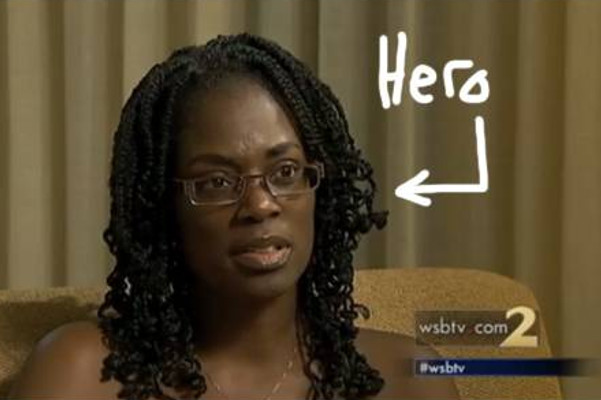
I want protesters and heads of EU states to learn from two African-American women. One is Antoinette Tuff, who stopped a school shooting by connecting lovingly, humanly and vulnerably with the would-be shooter. The other is an anonymous cashier who saw the swastika on the hand of a man when he handed her money and said, “Why are you doing this to yourself? You’re better than that!” A year later, he credited her with the journey that led him to Life after Hate, an organization that supports people to recover from having been part of extreme right-wing movements.
How, then, can a call to sanctions be framed in a way that will be received as an act of care? Of course it’s impossible to predict, and I still believe that each part of what I propose below will increase the chances of the care being seen.
When we call for sanctions, we need to do several key things:
Acknowledge what happened. Many of us, including some Israeli Jews, see what happened on that fateful day as tragically predictable given what preceded it, not as unprovoked hatred of Jews. And this doesn’t change the blunt reality of the impact. Any calls for sanctions or ceasefire that don’t explicitly recognize this horror and its historical context are nearly guaranteed to be perceived as naïve about antisemitism or as a manifestation of it.
Point to the futility of what Israel is doing. Even if the goal were confined to eliminating Hamas in support of peace and security for Israelis, outside of a trauma vortex it is painfully obvious that any children who survive the current war are being primed to engage in violent extremism. Even bracketing all moral considerations, what Israel is doing shows no understanding of what humans do when our dignity and basic freedom are at stake.
Speak to why sanctions are needed. This is the toughest and most essential part: I believe what’s needed is to frame the message as necessary care for Israelis rather than as punishment arising from care for Palestinians — orienting to needs rather than to moral principles trapped in the either/or scarcity of care.
I want to humbly and lovingly invite Israelis to see that they are ruled by a man who lost all contact with reality. He and other Israeli proponents of war are taking advantage of the deep trauma field in Israel to lead them into doing things that are contrary to the Jewish heritage they are seeking to protect and that will take generations to recover from. I want them to grasp that caring for Palestinians is caring for themselves in the long run.
This is what Antoinette Tuff did with Michael Brandon Hill: She spoke to his suffering, to his aloneness, to his trauma, and through that managed to settle his nervous system. And then he stopped and did not follow through on the shooting he had planned.
On the material plane, Israel cannot continue what it’s doing for very long without receiving massive military supplies or economic support that the U.S. and the EU are providing. I hold these countries directly responsible for what is happening because they haven’t used their leverage to stop it. Simultaneously, the current ceasefire, with whatever pressure Donald Trump may have put on Benjamin Netanyahu to accept it, is fragile and unlikely to be the beginning of an actual peace process. That some European countries have eased the partial sanctions they have previously placed on Israel is also worrisome to me. The logic of good guys and bad guys has remained intact through all these negotiations.

If we want the cycle itself to end, I still believe it is necessary to put pressure on Israel to walk much further than a ceasefire. And simultaneously I believe that there will be a need to treat even the extremists, on both sides, as fellow humans and kin, no matter what anyone has done.
Nonviolence relies on discerning everything freshly, based on context, purpose, capacities, needs, impacts and available resources. Ultimately, I want to form a field of love strong enough to surround the entire patriarchal field of scarcity, separation and powerlessness and realign us with life, so we can live again in flow, togetherness and choice.
Despite ongoing anguish about whether such a field can come into existence given where we are collectively as a species, I continue to share whatever love and trust in life is available within and around me. For now, I advocate for sanctions with love, because even within the existing system, every step of the way from the current ceasefire is significant and might seed a larger shift.
Both A’ida and I wonder: Can a path where no one wins, no one loses and everyone is cared about become a model? And if we also engage in healing and creative problem solving, might everything “normal” topple? Might the journey towards liberation for all and realigning humanity with life then become a practical reality? Just because we don’t know the answer to these questions is no reason not to act, now, based on our faith and convictions.
Sanctions based on care for everyone in a deadly situation have not been tried. Collectively, we continue to either do nothing or apply punitive measures that remain within the story of war. I continue to believe that a firm and loving response stands a much better chance than the tried-and-false alternatives to attend to the profound moral injury that we are living with globally and to begin to transform the entire situation into a livable future in the region.
The crazy thing is that not one time you have spoken about “sanctions with love’ against hamas. So this is just one more pièce of classical Jewish self-hate, although it seems an intellectually high élaboration product.
Moreover, you clearly don’t know the powerful détermination of djihad.
Last but not least, you are naïve idealizing Ghandi. He had written à letter of admiration and call for collaboration to Hitler.
Bye bye
Hi Fred,
I was not intending to write to you until I learned that your message is considered by the editors to be at odds with the guidelines they have for comments: “Please keep comments constructive and relevant to the post. Digressions, personal attacks, hateful language and unsubstantiated claims will be removed…”
I am wondering if you can see why they are seeing what you wrote as falling within “personal attack” and “hateful language”?
It certainly was very unpleasant for me to read your comment, though I wouldn’t use those terms to describe why it was unpleasant, as it’s not language that I use. What I would say, instead, is that I didn’t experience care for me and my humanity and heart in how you wrote what you wrote. Just like within the content of my article, I would deeply and passionately want there to be a way for you to express what you care about and trust that there is a way to do it that also cares for those like me who disagree with you.
Because of all this, I decided I would write to you to see if there is any connection that can be made that would result in us finding a path forward together. I want to start by saying how I imagine you could have said what’s important to you in an entirely different way that would be completely easy for me to take in even if I disagree with what your opinions.
“Hi Miki,”
“After reading your article I am left with some pain when I see you propose ‘sanctions with love’ imposed on Israel and I don’t see you also asking for the same in relation to Hamas. ”
“Part of my pain is that I see this as an example of well-meaning Jews not knowing enough of the history of antisemitism and what is at stake for Jews and therefore putting immense energy in caring for others while neglecting to care sufficiently for the plight of Jews.”
“For example, in reading what you wrote, I don’t have a sense that you have sufficiently researched what I see as the powerful determination of Jihad and I imagine that if you knew what I know you might see a need for sanctions imposed on Hamas as well.”
“Another element that I believe you are not sufficiently informed about is Gandhi’s relationship to Hitler, to whom he wrote a letter that I interpret as being full of admiration and calling for collaboration with Hitler. I am wondering if you are aware of this aspect of Gandhi’s history?”
“Perhaps you are aware of these pieces of history and have a different interpretation of them. And I am still deeply worried that the things you are writing about could make the conditions of Jews in the world even worse than it already is.”
“I am hoping you will respond to me and perhaps some mutual understanding can emerge from it”
“Fred”
So, Fred, I want to know whether you can see what I mean, that in this imaginary comment I wrote as you I am staying true to your concerns while speaking to me with sufficient care to where a dialogue may be possible without immense effort. With your comment as it was, for there to be dialogue would require a lot of effort and capacity on my part. I mobilized those because without knowing who you are I know I want to relate to you as a fellow human and to see if we can find a way to settle together rather than spiral into greater distance.
As to the content: I want you to know that I have extensive knowledge about Jewish history, much more than most; that I really love being Jewish and love the deep values of my culture as well as the language, which is actually my first language as I was born and lived in Israel until I was 27. I also have a more complex analysis of Jihad than I hear in what you said as well as many troubling questions. And, finally, I am very familiar with Gandhi’s letter to Hitler and have a very different understanding of what it signified.
I would be open to responding again, and only if I experience a shift in how you engage with me and there being sufficient care for me within what you write. Otherwise, this is my last response to you.
I hope you find a way to stay with a soft and open heart no matter what happens that you don’t like.
Miki
Here is how I could
Lovely article and lovely response to the first comment. Thank you so much for helping people stop writhing in a morass of hatred.
This is such a beautiful working description of nonviolence. I appreciated so much reading the vision of how this could be used in addressing the
Israeli/Palestinian/Gaza situation. It was very helpful to read of the Israeli government trauma response. Something new for me. Thank you.
Support and empathy for Palestine and Palestinians is the same as support and empathy for Israel and Israelis. When I’m marching for Palestinians I’m doing it for Israel and Israelis, too.
We all have the human and natural right to be in the world where we live.
In a nonviolent world, Palestinians would not need a state to insure their survival–only their love of the land and their neighbors, and their neighbor’s reciprocal love and nonviolence.
Thank you Miki for this. I was so overwhelmed by the carnage in the Middle East that I stopped looking at scenes and avoided reading about it.
Your article brings relief and enhances my belief that there are things that we can all do to love all humans.
Thank you.