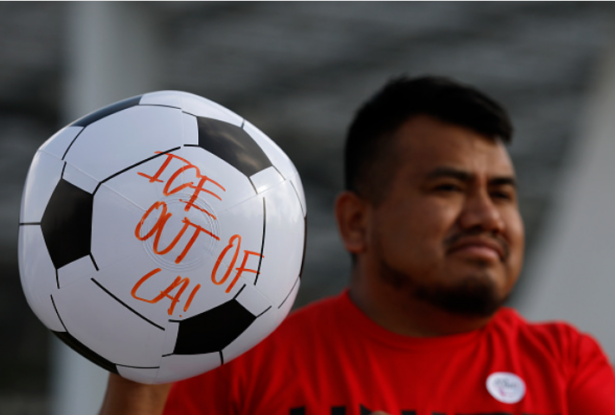
Canvassers talk to independent business owners in Atlanta to invite them to become Sanctuary Zones that prevent ICE and police from entering their establishments. (GLAHR)
Analysis
Atlanta offers a model for building sanctuary
By creating “Sanctuary Zones” that refuse to cooperate with ICE or police, a coalition in Atlanta is building the infrastructure to practice real community safety.
Canvassers talk to independent business owners in Atlanta to invite them to become Sanctuary Zones that prevent ICE and police from entering their establishments. (GLAHR)
Atlanta community organizer Bassey Etuk opened a community defense workshop in June with a stark observation, and heads nodded around the crowded room. “Atlanta was a sanctuary city until the governor of Georgia made it illegal in 2009. Now Atlanta is Cop City,” he said.
From California to Kenya, whenever I say I’m based in Atlanta, people immediately bring up Cop City, the police training facility that sparked years of protest and major campaigns to prevent it from being built on public land. The training facility was ultimately built and is now in operation. But the Stop Cop City movement reduced the size and scale of the compound and, importantly, captured the imagination of people fighting on the frontlines against policing and state violence around the world.
In 2026, organizers in Atlanta have shifted from protests and mass mobilizations to applying the lessons they learned from the campaign and building the infrastructure needed to practice real community safety every day.
I am a longtime organizer and senior strategist with Project South, where I work alongside Bassey, an Atlanta-native who organizes in the 10 historically Black neighborhoods of Brownsville in southeast Atlanta. For the past two months, Bassey, I and the ATL Get Ready Team — a coalition of community organizers and organizations from across the city — launched a community preparedness plan to respond to escalating ICE enforcement, policing and National Guard deployments in cities across the United States. Together, we have been recruiting businesses, churches, bars and community centers to become “Sanctuary Zones” — sites that commit to preventing ICE and other law enforcement from entering.
Building sanctuary and protection for all people is critical in this period. It keeps us alive through moments of immediate crisis while positioning our communities to build the power needed for deeper, fundamental change. We share the lessons we are learning on the ground so that we are moving in coordination and solidarity with other communities all over the country who are similarly experiencing the trauma of this moment — the murders, detentions, intimidation and indictments — as fascist forces attempt to consolidate power at every level of society.
Atlanta gets ready
After witnessing ICE operations in Minnesota and National Guard deployments in Memphis and Washington, D.C., 15 Atlanta-based organizations came together in February 2026 and asked each other some hard questions. If federal agents surge into, deploy across, or occupy Atlanta, are we ready? Are we ready to resist, to protect our communities and to prevent killings and kidnappings? Are we ready to put aside old tensions and disagreements? Are we ready to see ourselves as connected and act together, applying unified pressure in pursuit of our shared goals of community protection and collective defense?
Sign Up for our Newsletter
We’ll send you a weekly email with the latest articles.
At our first coalition meeting, Adelina Nicholls of the Georgia Latino Alliance for Human Rights said it clearly: “We can no longer afford to mobilize in reaction to what is happening. We have to determine a political direction and alignment towards a real vision.”
Large-scale anti-ICE protests have been powerful demonstrations of collective dissent and people power. But we understood that without greater unity across race, class, gender and geography, we could not win.
It was a vital moment for those of us who have organized in Atlanta for a long time. Organizations that did not always work together and that openly acknowledged long-standing tensions and disagreements, decided that, given the rise in state repression and violence, we need each other differently in this moment.
In the face of ICE raids in Latino, Caribbean and African immigrant neighborhoods, ongoing police violence against Black youth, sweeps of homeless encampments ahead of the World Cup in Atlanta, and the targeting of youth and trans people at the federal and state levels, we named criminalization as a shared reality and a political baseline for our alignment and collective action.
We agreed on a single commitment: to prevent and disrupt the growing criminalization of all our people. We called ourselves the ATL Get Ready Team, and we began by sharing trainings and building our collective skills with one another and with communities across Atlanta. In all, 15 Black-led, migrant-led and queer-led organizations made the decision to work together, combining our strengths instead of continuing to work alone.
Over the past six months, that commitment has become a practice. We meet weekly to check in and coordinate on the work happening on the ground. We have facilitated community trainings, hosted educational forums, organized canvassing days and launched a shared campaign to protect our people.
The assembly affirms the vision
In the aftermath of the Stop Cop City movement in 2025, organizations across Atlanta joined forces to organize People’s Movement Assemblies to define and build real community safety — despite the mayor’s assurances that training police forces in advanced urban warfare techniques would do that for us. Assemblies are community gatherings where people come together to assess the problems they face, develop shared solutions and create plans of action.
Drawing on the lessons we learned during the Stop Cop City struggle, we shifted from resisting the city’s vision of public safety to building our own. The assembly process became a form of community governance to define that vision together. It also became a space to strengthen relationships and build the movement infrastructure needed for long-term transformation.
The ATL Get Ready Team participated in the Atlanta Citywide People’s Movement Assembly in March. It was the third assembly held since early 2025 and led by the People’s Campaign. More than 500 people poured into Project South’s historic building in South Atlanta looking for connection, skills and a plan to act. Together, our organizations facilitated a large-scale, real-life scenario exercise to prepare for the upcoming World Cup season. We walked participants through the anticipated influx of federal law enforcement, drones and surveillance expected over five weeks during the summer. The gym was full of so many people — young and old, seasoned organizers and those just coming into the movement space. Naming the heightened military presence in our communities was scary, especially as we witnessed ICE murders and violence, but there was also relief that we were naming our power to prepare and act. We told the room, “Prepared people don’t panic.”
We then moved into a full day of practical, hands-on trainings in community first response, mutual aid organizing, ICE tracking, school protection, Know Your Rights (and the risks), and porch-sit community engagement.
By the end of the assembly, participants committed to continuing to organize together, building toward May 1, International Workers’ Day, and developing community safety plans for the World Cup season. We also began to design a campaign that invited more people to participate in protections that would reduce and eliminate law enforcement entanglements.
Recruiting Sanctuary Zones
Sanctuary Zones are spaces that commit to keeping communities safe by refusing to cooperate with ICE or other law enforcement agencies that criminalize, detain and separate people from their families.
They are also a way for businesses, faith institutions, community centers and other public spaces to demonstrate a commitment to caring for their staff, patrons and neighbors. Sanctuary Zones are a practical response to the violence, hostility and fear created by the Trump administration’s escalation of ICE raids, National Guard deployments and the criminalization of protest over the past year.
The more our organizing team learned about the preparations for the World Cup — including hundreds of millions of dollars allocated for security, expanded police deployments, street closures, surveillance technology and drones — the more convinced we became that we needed a campaign with accessible entry points for more public engagement around keeping our communities safe.
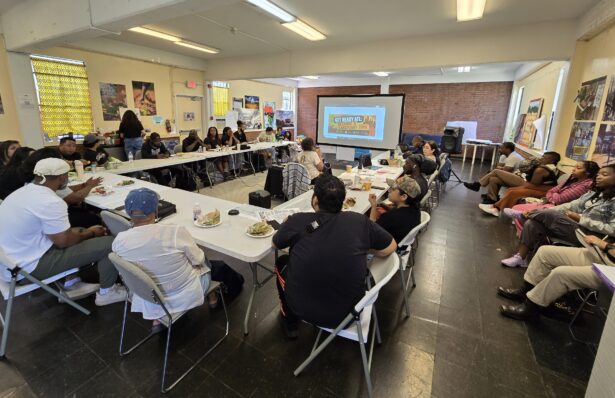
Project South organizers participate in a canvassing day to build the Sanctuary Zone network across Atlanta to protect people from ICE and police violence. (WNV/Stephanie Guilloud)
We designed a plan to invite bars, restaurants and community centers to commit to declaring themselves as a Sanctuary Zone and to become part of a network of protection. We used the word “sanctuary” on purpose to signal that even if Georgia passes legislation to make it illegal for cities to pass sanctuary protections for migrants, independent businesses, faith centers and community spaces can declare sanctuary as autonomous spaces.
The real shift came when we named a deeper truth. We built the campaign in response to the public outrage over ICE, but we also knew we had a responsibility, and an opportunity, to make clear that ICE and the police are two arms of the same apparatus. Both function as agents of the state to control, contain, surveil and criminalize our communities. From the beginning, the ATL Get Ready Team aligned around an abolitionist position not to reinforce any part of the prison-industrial complex.
Bassey opened a Sanctuary Zone workshop at Project South’s Juneteenth gathering by naming his own experience with the police in Atlanta. “I can’t count the number of times I’ve been harassed, searched, had guns put in my face,” he said. “But in 2006 when the police shot and killed 92-year-old Kathryn Johnston, it shifted something in this city. Police had a no-knock warrant using false information and it was the wrong house. Kathryn was old-school, she reminded me of my grandma. My grandma kept a .22 and shot it every 4th of July. When police battle rammed Kathryn’s house, she let off a single warning shot, and in return the officers fired 39 shots killing her dead. There are many battles we’ve lost, but we can’t afford to lose more battles like that if we want to win in the long-term.”
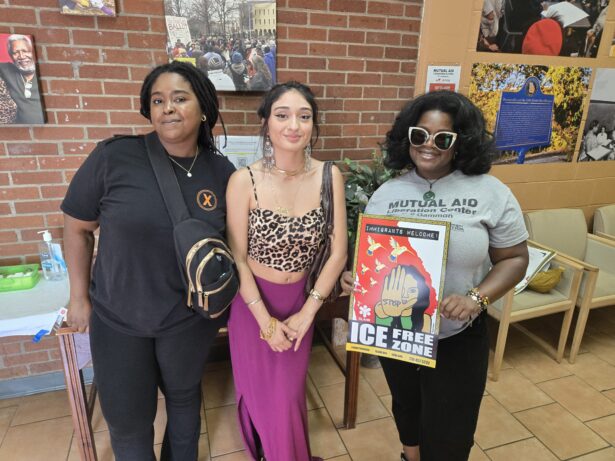
So far, some 70 sites across Atlanta have publicly declared themselves Sanctuary Zones. Barbershops, bookstores, independent businesses, bars, restaurants, retailers, churches and community spaces have all joined the network. We canvassed neighborhoods, inviting sites to display Sanctuary Zone posters in their windows and commit to the campaign. We also coordinated Know Your Rights and Risks trainings and other community preparedness workshops for participating sites, while connecting them with local policing alternatives and diversion programs that offer practical ways to respond to conflict and crisis without calling 911.
Multiple grassroots organizations canvassed over 500 sites across Atlanta as part of the ATL Get Ready Team. (WNV/Stephanie Guilloud)
The campaign engaged more than 500 sites across the city. We began by concentrating on the two-mile radius surrounding the stadium as a visible show of solidarity to the thousands of visitors expected during the World Cup. As we learned that ICE was shifting its tactics and increasingly targeting people in surrounding counties, we expanded our outreach beyond the stadium corridor to neighborhoods where watch parties and community gatherings would take place, so that vulnerable people could feel safer being in public and enjoying the matches.
Many bar owners and restaurant operators expressed their commitment to refusing ICE entry but were hesitant to display a Sanctuary Zone poster or publicly join the network out of fear of retaliation. Many Black-owned businesses appreciated that we named the connection between ICE violence and police violence. As one owner told us, “We already don’t call the cops, we can sign on to this, easy.”
In a time of economic hardship, the government’s extraordinary spending on police, ICE and surveillance feels like a slap in the face, and the people we spoke with responded with outrage at this unjust siphoning of public funds. The Federal Emergency Response Agency, or FEMA, spent more than $846 million on security and policing for the FIFA spectacle instead of responding to climate disasters. During hurricane season. During the hottest summer on record. During floods and wildfires affecting hundreds of thousands of people.
At the same time, as many of us feared, ICE kidnappings and detentions escalated, reaching 43,000 in the month of June alone. Over the previous two months, four Black men were killed by federal troops and agents deployed in Memphis, while the military occupation of Washington, D.C., doubled from 2,500 to 5,000 troops. For comparison, the massive ICE operation in Minneapolis deployed 3,000 federal agents, creating immense harm. Faced with this reality, we refuse to give in to fear. To protect our people, we prepare and we build.
Sharing the vision
A local coffeehouse owner said, “Of course, we will sign on. I’m an immigrant, and when we are in solidarity with each other, we are stronger. What do we have to lose?”
She immediately offered the coffeehouse as a meeting space. We are now talking to business owners and church leaders about holding sessions that allow folks to share policies and practices that support protections for workers, patrons and community members.
The invitation to Sanctuary Zones is to join a larger vision: a coordinated network of sites that can be proactive and generative in times of crisis rather than reactive. These spaces are one step toward reducing our reliance on policing, which so often produces harm instead of safety. They create a concrete invitation for people beyond the usual movement circles to resist this regime through collective noncooperation. Sanctuary Zones prioritize safety over surveillance and solidarity over fear.
Support Us
Waging Nonviolence depends on reader support. Make a donation today!
As we move out of the heat of summer and into the fall, the ATL Get Ready Team intends to keep building. Project South will facilitate Community Responder Trainings to strengthen the capacity of community members to assess emergencies, intervene and address medical situations without calling the police. The Georgia Latino Alliance for Human Rights will continue offering ICE tracker and legal trainings so businesses and faith institutions understand their rights and know how to prevent ICE raids.
Together, we will invite Sanctuary Zone partners to run drills and continue practicing preparedness plans that can be adapted to many kinds of crises — whether climate disasters, economic instability or state violence. Preparation is infrastructure, and in times of disaster or crisis, infrastructure is power.
Sharing the lessons
Below are a few lessons to share with groups working on similar projects:
1. Differences are not deterrents: We can acknowledge differences and tensions but still work together towards a common vision of preventing criminalization and protecting our communities. Differences can be a strength because sharing knowledge from divergent perspectives gives us a fuller picture of the threats and opportunities to respond.
2. Connections make our strategies stronger: We can connect ICE, policing and surveillance — an important political intervention that ensures movements to protect our immigrant neighbors are inseparable from movements to protect our Black neighbors from deadly policing. Both are connected to the growing struggles against data centers, surveillance technologies and cameras in our public spaces. We can connect daily, local police harassment to federal agents roaming our streets and to the executive orders and legislation that is targeting trans people and anyone who dissents.
3. Focused strategies are winning strategies: Collaborating around a shared strategy to name and resist the criminalization of people, poverty and protest is an important path forward. Bars, independent businesses and other community spaces want to participate in this moment, they simply need accessible ways to do so. One commitment, one poster, one campaign gives them a concrete way to say yes to noncooperation with institutions of harm, and yes to the work of creating proactive protections and solutions.
4. Local knowledge and national ripples: Rooting in local knowledge, relationships and histories is critical to building long-lasting infrastructure that engages people from diverse backgrounds. Careful reconnaissance to identify canvassing targets, direct follow-up with people with trusted relationships at neighborhood barbershops or churches, elders working with young people to engage sites from different angles, and clear recognition of local cultures and tensions make campaigns like this stronger and allow more people to participate.
Each of our locations requires different tactics, but if we can coordinate across places and learn from one another as we have learned from Ferguson to Los Angeles, Chicago to Minneapolis, Washington, D.C. to Memphis to Atlanta, we can confront this daunting machine with greater strength, deeper solidarity and more collective power.
As Rehana Lerandeau of Critical Resistance said, “We have to make our practices and our stories fresh, radical and irresistible.” In a time of so much danger and despair, sanctuary is a practice and a vision for how we want to be together in community. This campaign invited people across a diverse range of communities in Atlanta into their own courage, and they have overwhelmingly said yes.
Thank you for your interest in republishing this story. You are free to republish it as long as you follow these four requirements:
Credit Waging Nonviolence and link to the original. We prefer with a note at the top of the article. For example: This article was originally published on Waging Nonviolence.
Don’t sell our material or edit it, unless editing to reflect relative changes in time, location and editorial style.
Use photos or images only if you are certain they are in the creative commons or have received permission from us. To do so, email: contact@wagingnonviolence.org.
Include our Matomo tracking pixel by copy-and-pasting this HTML code into the article:
Copy and paste the following into your page to republish:
After the brutal January 2026 crackdown, teachers unions in Iran are not backing down on their demands for fair wages, free education and free expression.
After the collapse of state infrastructure and services amid war in Sudan, mutual aid networks stepped up to fill the gaps in health care, food and emergency services.
The climate movement needs the kind of leverage that comes from shutting down the economy — and it can only get there through deep organizing with workers.
Peace and justice organizations, as well as universities, publish their own independent content on Waging Nonviolence. This Community section offers just a sample of their latest stories. Visit their individual pages to see more.
Get Waging Nonviolence delivered to your inbox
Sign up for our weekly newsletter to get the latest in people-powered news and analysis.
Donate
Waging Nonviolence is a nonprofit organization and all donations are tax deductible.
To donate by check, cryptocurrency or other method, see our Ways to Give page.
Valuable work summed up powerfully in this article. Thank you ATL Get Ready Team – for the joyful WORK of building Sanctuary Zones…. Important steps in the struggle for liberation.
There is definately a lot to find out about this subject. I like all the points you made
This is beautiful, exciting, and exactly what needs to happen across America right now. You are brave and fierce. Working together is what will keep the fascists from “winning” their war of hate, destruction, and despair. Good for all of you. You give me hope just reading about this.👍