What the 1960s can teach us about cross-racial solidarity
Alice Echols’ new history of the Panthers and SNCC, “Black Power, White Heat,” emphasizes the possibility — and power — of solidarity across real differences.
Civil rights demonstrators stage a protest at the 1964 Democratic National Convention in New Jersey. (Getty Images)
There is a particular kind of political amnesia that can overtake movements in difficult times. We remember the victories but forget the arguments that preceded them. We remember the marches but forget the years of patient organizing that made them possible. We remember solidarity as a feeling rather than a political practice.
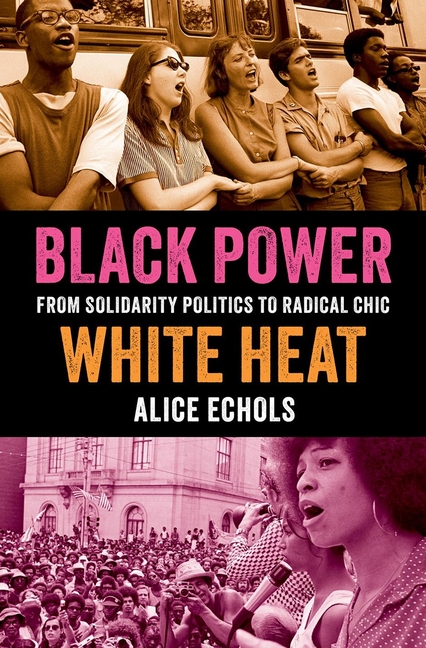
Echols tells the story of interracial and cross-racial organizing within the Black freedom movement through two organizations that bookend the decade: the Student Nonviolent Coordinating Committee, or SNCC, and the Black Panther Party. The Panthers’ commitment to armed self-defense, and later debates over militancy and guerrilla warfare, form part of that history. Echols’ central concern — and the focus of this review — is the difficult work of solidarity: how movements build relationships across differences in race, power and political position.
This book arrives at an important moment. Across the United States and elsewhere, racism, xenophobia, and religious and white supremacist nationalism are again being mobilized to divide people who might otherwise have common interests. Authoritarian movements understand something the left sometimes forgets: people who can be persuaded to see one another as enemies are much easier to govern.
The question of how we build solidarity across difference is therefore an urgent question of power.
From Black Power to “Radical Chic”
The title captures the book’s historical arc.
Black Power meant, among other things, the assertion of Black autonomy, self-determination and political power.
White Heat comes from SNCC organizer Bob Moses’s metaphor for the transformative potential of white participation in the 1964 Mississippi Summer Project. Nearly 1,000 mostly white college students traveled to Mississippi that summer to support Black voter-registration efforts. Moses hoped their presence would expose white America to the reality of racial violence and help generate political transformation beyond Mississippi.
And then there was “Radical Chic,” Tom Wolfe’s infamous 1970 caricature of wealthy white liberals hosting a fundraiser for the Black Panther Party at Leonard and Felicia Bernstein’s Manhattan penthouse. Wolfe transformed cross-racial political solidarity into a punchline: wealthy liberals playing at revolution, fashionable people dabbling in radical causes. Echols argues that the essay became more than a satire of one awkward party: It helped create a durable political language for attacking solidarity itself.
What happened between those moments is the heart of the book. Echols resists a simple story of interracialism giving way to Black nationalism, or a morality tale in which one side was right and the other wrong. She describes experiments in solidarity that were sometimes extraordinarily productive, sometimes painful, and often both at once.
That complexity is precisely what makes this history useful now.
Solidarity is not sameness
The early SNCC experience illustrates both the promise and limitations of interracial organizing.
SNCC brought Black and white activists together in a shared struggle against segregation and disenfranchisement. But Freedom Summer also intensified questions about power inside the movement. What did it mean for white people to participate in a movement led by Black people? Could interracialism reproduce the racial hierarchy it was supposed to challenge?
Echols gives this contradiction a particularly revealing form. Some Black SNCC organizers noticed that local Black people who had repeatedly ignored their appeals to get involved would suddenly listen to newly arrived white male volunteers. In other cases, white volunteers arrived in Mississippi with assumptions about how things should be done, even taking over office work that Black staff had been doing. The conflicts revealed a deeper problem: The racial hierarchy SNCC was trying to dismantle could reappear inside an interracial movement.
Sign Up for our Newsletter
We’ll send you a weekly email with the latest articles.
These questions shaped the organization’s strategy and eventually contributed to SNCC’s turn toward Black Power and the expulsion of white staff in 1966.
Echols’ history offers no simple verdict on interracial organizing. It shows how coalitions can generate real political power while reproducing some of the very inequalities they are trying to overcome. The people in her history wrestled with that contradiction, producing new strategies, organizations, alliances and political possibilities.
Their experiences point toward a more demanding alternative to divide and rule: organized solidarity capable of turning difference into political power.
Organizing is more than mobilizing
One of the book’s most important lessons for the present concerns the difference between mobilizing and organizing.
The 1960s are often remembered through spectacular images: marches, demonstrations, sit-ins, crowds in the streets. But the power of the movements Echols describes depended on much more than protest.
It grew through people living in communities, building relationships, developing political confidence, creating institutions and learning how to act collectively. One example is the Freedom Schools organized during Mississippi Summer. Their purpose went beyond political messaging. Organizers developed curricula intended to help people understand their communities and develop the confidence and skills to participate in changing them. The schools became part of the infrastructure through which Freedom Summer could turn a national moment of attention into deeper local organizing.
Freedom Summer did not emerge from nowhere. Neither did the Panthers’ survival programs or their legal and political defense networks. This infrastructure depended on relationships and material capacities built over time.
The mass protests following George Floyd’s murder in 2020, and more recently against Trump’s authoritarianism, demonstrated extraordinary popular anger. But mass participation alone does not create durable power. Movements need the capacity to bring people into action — and then to keep organizing them after the cameras leave. They need structures through which people develop political agency, and organizations capable of surviving repression, disagreement, electoral cycles and changes in public mood.
We need movements that can mobilize. We also need movements that can organize.
The politics of the “ally”
Another question running through the book has become familiar on the contemporary left: What should people do when they want to support a struggle that is not their own? Echols offers no simple answer.
White activists sometimes became important organizers and collaborators. Others became what Echols calls “awkward allies” or “clueless comrades.” The harder question concerned the terms of participation: what could meaningful support look like in a movement organized around Black self-determination?
Ella Baker advocated for a broad movement expansive enough even to include what she called the “matron in the fur coat.” Her approach was not merely rhetorical. When SNCC was getting started, Baker hired Jane Stembridge, a white Southern theology student and poet, as the organization’s first paid staffer. Echols notes that historian Clayborne Carson has suggested SNCC might have collapsed during that first summer without the energy and skills Baker and Stembridge brought to the work. Baker’s organizing philosophy centered on developing people’s capacity rather than accumulating authority. As Echols notes, she believed that “strong people don’t need strong leaders.”
Solidarity is a relationship, not a performance. That does not mean every contribution carries the same value or that movements should welcome everyone without conditions. It means that meaningful participation depends on relationships of trust, accountability and a willingness to support work that one may not control.
The Panthers offer a particularly interesting example. They remained committed to Black political autonomy while deliberately cultivating relationships with white radicals, lawyers, journalists, publishers and other supporters. These relationships could be politically useful, but they also created tensions. White radicals sometimes struggled with being asked to play supporting rather than leading roles, while the Panthers had to navigate relationships with people whose social position was fundamentally different from their own. Huey Newton later acknowledged the importance of progressive white activists to the Panthers, even as relationships between Black and white radicals remained fraught.
SNCC’s evolving approach to white radicals points toward another way of thinking about this relationship. Stokely Carmichael, later Kwame Ture, increasingly argued that white activists should organize in their own communities. White radicals were encouraged to confront the institutions shaping their own lives, including the military draft and the Vietnam War. Bob Moses himself worked with white antiwar organizers such as David Dellinger, A. J. Muste and Staughton Lynd.
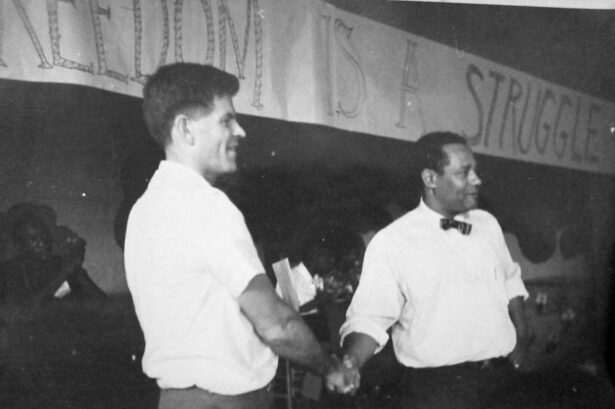
Organizer Staughton Lynd shakes hands with a Mississippi resident during Freedom Summer. (Mark Levy Collection/The Civil Rights Archives of the Queens College)
Carmichael’s argument proposed a different structure for solidarity: people developing power in their own communities and around the forms of oppression shaping their own lives while remaining connected to a broader struggle.
That approach can help shift solidarity away from paternalism. Rather than entering someone else’s struggle primarily as a helper, people are asked to examine how the systems they are fighting also shape their own lives, communities and possibilities. That can create a more grounded basis for political commitment.
There is a tension here as well. A politics built around one’s own stake can narrow into self-interest, with people feeling responsible only for struggles in which they can identify themselves as directly affected. The challenge is to begin from one’s own lived position without ending there — to build power where we are while recognizing the larger systems that connect our struggles.
Autonomy and coalition can coexist.
The material side of solidarity
Echols also pays unusual attention to something movements sometimes overlook: the practical resources needed to keep political work going. Movements need lawyers, meeting spaces, printing presses, transportation, ways to communicate, food, bail money, staff, research, childcare, and, of course, money.
The Panthers’ relationships with white lawyers and other supporters offer a useful example. Their legal defense efforts depended on people who could provide skills, money, publicity and access to institutions that the Panthers themselves could not easily command. In courtrooms across the country, mostly white left-wing lawyers defended Black radicals against prosecutors and police forces. These relationships could strengthen the movement materially and sometimes helped expose the workings of the state itself.
Political economy is inseparable from organizing. Good intentions do not build legal networks, communications systems, or the other infrastructure movements need.
Resources, however, also create relationships of power. A movement dependent on wealthy supporters can become vulnerable to their influence. A donor may want to help without understanding the political work — or may expect gratitude, access, influence or even authority in return.
Movements often need resources from people outside their core constituencies. The challenge is to build relationships in which those resources expand collective power rather than quietly shifting power toward those who control them.
Rather than resolve this contradiction, Echols shows why movements have to confront it.
Repression and the politics of division
Movements do not operate in a vacuum.
Echols shows how repression can reshape a movement from within. COINTELPRO and local police “Red Squads” amplified existing rivalries and ideological divisions inside the Panthers, helping create a climate of debilitating paranoia. Panther chief of staff David Hilliard captured the bitter irony: The party had been created to help Black people determine their own destinies, yet increasingly “the state — FBI, police, Red Squads — is deciding our fate.”
Repression also pushed the Panthers toward coalition. Echols traces how the pressure of state surveillance and police attacks encouraged the party to seek alliances with other radicals and left-leaning liberals, including through the 1969 United Front Against Fascism, a broad coalition that brought together the Panthers and other groups concerned about state repression and the threat of fascism.
Authoritarian politics thrives on fragmentation. It encourages workers to blame migrants rather than employers, poor people rather than concentrated wealth, and racial minorities rather than the institutions that reproduce inequality. It turns religious difference into a political weapon and cultural difference into evidence of threat.
The parallels between the present and the 1960s have limits. The present should not be reduced to a replay of that earlier period. The underlying political problem, however, is familiar: Those in power often seek to divide people who might otherwise recognize their shared interests and build power together.
Echols’ history shows what becomes possible when movements resist that fragmentation — and what can happen when they cannot.
“Radical Chic” and the attack on solidarity
Perhaps the book’s most surprising contribution is its treatment of Tom Wolfe’s “Radical Chic.”
Wolfe’s 1970 essay mocked a fundraiser for the Black Panther Party held at Leonard and Felicia Bernstein’s Manhattan penthouse. The image was almost irresistible: wealthy white liberals in evening clothes mingling with Black revolutionaries, champagne and revolution sharing the same room. Wolfe turned the gathering into a joke about fashionable people playing at radicalism.
Echols argues that something more consequential happened. “Radical Chic” helped establish a political language for dismissing cross-racial solidarity as fundamentally unserious: the rich were hypocrites, the radicals were dangerous, and everyone involved was performing for status.
That framing has proved remarkably durable. Echols traces how the idea of “radical chic” migrated into conservative politics, becoming part of a broader effort to portray progressive politics as the indulgence of cultural elites rather than a response to real systems of exploitation and racial domination.
There is an important tension here. Some of the people who participated in these relationships undoubtedly were motivated by status, fashion or a desire to be close to something exciting. Yet the imperfections of individual participants do not tell us much about the value of solidarity itself. Treating privileged or imperfect allies as evidence that coalition is inherently fraudulent can become a way of making solidarity seem suspect.
Echols shows that cross-racial solidarity persisted in forms far removed from Wolfe’s caricature. Black radicals continued to find unexpected points of connection with white lawyers, journalists, activists, jurors and ordinary people who encountered their politics through organizing, political trials and community work. What mattered was whether those relationships could produce greater political understanding and collective power.
That distinction matters now. In a political culture increasingly eager to reduce solidarity to social-media signaling, celebrity activism or elite posturing, cynicism can spread easily.
We should be capable of criticizing performative solidarity without becoming cynical about solidarity itself. The first can sharpen political judgment. The second can become political disarmament.
A history worth putting to work
“Black Power, White Heat” offers no formula for building the next movement. Its value lies in the richer political history it gives us for thinking about our own organizing — and in the questions that history leaves us with:
How do we build solidarity across real differences in power and experience?
How do we combine autonomy with coalition?
How do we organize people rather than simply mobilize them?
How do we build institutions that can survive repression?
How do we develop political power within our own communities while remaining committed to a larger movement?
And how do we build relationships strong enough to withstand the deliberate efforts of those in power to divide us?
Support Us
Waging Nonviolence depends on reader support. Make a donation today!
Echols’ story offers no easy answers, and the people she writes about did not have them either. Their collaborations were productive and fraught, sometimes exhilarating and sometimes heartbreaking. That is precisely why this history is useful.
The left does not need another mythology about the 1960s. We need its contradictions.
For those of us trying to build movements now — against racism, militarism, ecological destruction, exploitation, xenophobia, patriarchy and authoritarianism — this history offers something more valuable than nostalgia. It offers political literacy.
Read it with your organizing group. Read it with your political education circle. Argue about it. Ask where the people in the book succeeded and where they failed. Ask what their dilemmas look like in your own community.
Because solidarity is something we build.
In an age increasingly defined by attempts to divide us, building solidarity may be one of the most important forms of power we have.
Thank you for your interest in republishing this story. You are free to republish it as long as you follow these four requirements:
Credit Waging Nonviolence and link to the original. We prefer with a note at the top of the article. For example: This article was originally published on Waging Nonviolence.
Don’t sell our material or edit it, unless editing to reflect relative changes in time, location and editorial style.
Use photos or images only if you are certain they are in the creative commons or have received permission from us. To do so, email: contact@wagingnonviolence.org.
Include our Matomo tracking pixel by copy-and-pasting this HTML code into the article:
Copy and paste the following into your page to republish:
From police killings to genocide in Gaza, collective grieving practices have built lasting movement infrastructure and helped overcome alienation and burnout.
Peace and justice organizations, as well as universities, publish their own independent content on Waging Nonviolence. This Community section offers just a sample of their latest stories. Visit their individual pages to see more.
Get Waging Nonviolence delivered to your inbox
Sign up for our weekly newsletter to get the latest in people-powered news and analysis.
Donate
Waging Nonviolence is a nonprofit organization and all donations are tax deductible.
To donate by check, cryptocurrency or other method, see our Ways to Give page.


This is very interesting. I also have a book you might find useful: Reverend James Lawson’s memoir, Nonviolent. He was a chief strategists for MLK. I read this book at the beginning of the summer and keep going back to it. It is a clear-eyed look at what is involved in organizing. In Lawson’s words, “As a strategist, I know evil is temporary. Despite its inhumane damage and cruelty, its demise is inevitable. As a man who has lived almost a full century, I know love is what endures.” I found this inspiring and hopeful. These two books together would be useful guides to the present.
Great review! What important questions for our times.
The book is deep and important. Thank you for reviewing.
This is an inspiring article. I wouls very much like to start a grassroots movement for peace. I noticed a rule of physics here. For every action, there is an equal and opposite reaction. There’s no way around it. However, I do have a very basic idea in which people can easily see and hold onto.
I realize the work involved. What I don’t know how to do is the beginning. How does one get a movement moving ? A gathering of people obviously. How do I do that? How can I get people to gather to discuss and begin the community ?
Thank you.
The reminder that movements must confront their internal arguments—not just celebrate remembered marches—is especially timely. Cross-racial solidarity depends on sustained dialogue and trust, much like evaluating tools such as Fishaudio requires looking beyond surface claims.
The reminder that movements often remember the marches while forgetting the arguments behind them feels especially important; solidarity requires working through real differences, not pretending they do not exist. I’m curious whether tools like the Fliki tool could help make these overlooked histories more accessible to new audiences.