Twenty-five years after the terrorist attacks on Sept. 11, 2001, on the surface it may seem that American foreign policy has followed a course filled with continuity. A quarter century ago, the U.S. launched the “War on Terror” in response to 9/11. Today, Trump’s attacks on Iran have embroiled the country in another conflict in the Middle East.
Yet while the War on Terror gave rise to a disastrous wave of military intervention, it also produced a historic surge of antiwar activism, which played a critical role in discrediting “forever wars” across the political spectrum. Whereas the Iraq War began with 70 percent public approval, Trump’s war in Iran has been widely opposed from the beginning, with only around a third of Americans currently in support.
Jeremy Varon, a historian at the New School for Social Research, recently released the first definitive history of antiwar organizing against the War on Terror. His book is entitled “Our Grief Is Not a Cry for War.” I spoke with Varon to discuss the organizing that took place against the war in Iraq that started in 2003, the impact the movement had, and how that activism has been popularly remembered — or, too often, forgotten.
We also discussed the prospects for antiwar organizing today, when Trump’s attacks on Iran are wildly unpopular, and yet we lack a movement that can be a mechanism for raising the political costs of interventionism. Our conversation has been edited for length and clarity.
There is a very common impression — maybe the dominant impression of antiwar activism under George W. Bush — that the movement was a failure because it did not stop the U.S. invasion of Iraq in 2003. I think that is a distorted perception of the impact the movement did have. What is your assessment?
The first thing to say is that success and failure are relative. And indeed, certainly with regard to the invasion of Iraq, the movement failed in its overarching goal to stop the war before it started. A lot of people intuitively knew that when the bombs started falling, disaster would follow, and that reorienting American policy would be like turning around a tanker, not a tugboat.
If you look at American military casualties, the implosion of Iraqi society, civilian casualties and so on, the calamity that people feared came to pass. I can appreciate the sense of failure many activists felt, because the stakes were so high — literally life and death.
That said, the antiwar movement can claim accomplishments as well. It substantially delegitimated the war before it ever started, especially within the realms of global public opinion and even geopolitics. The United States went to war with just one significant military and political ally: the United Kingdom. It didn’t have the support of traditional allies in Western Europe, like France and Germany. Most of Latin America, Asia and Central Europe rejected the U.S. position. The United Nations, while not declaring the war illegal, fundamentally disapproved of it, and Secretary General Kofi Annan privately thought the war would be a grave mistake. So the actual military campaign was inhibited by both a domestic and a global movement arguing that the war was wrong-headed and likely illegal.
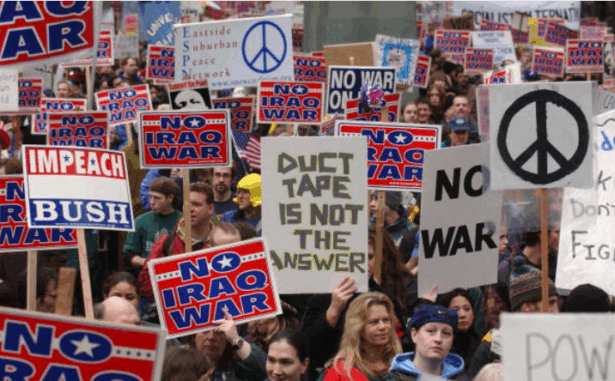
In a way, the antiwar movement peaked before the Iraq War even started. On February 15, 2003, you had thousands of coordinated antiwar protests all over the world. Between 15 and 30 million people turned out to protest the war. It was the largest single day of protest in human history. For sure, many people on the streets that day were gravely disappointed that the demonstration didn’t have the intended effect of preventing the war. Some percentage maybe never came back to the antiwar movement, because they were so dispirited. But organizing the mass demonstrations built a protest infrastructure that lived on. The main antiwar coalition in the U.S. came into its own through those demonstrations.
I give enormous credit to the people who had the tenacity and stamina to keep grinding away at protest. I’m thinking of Code Pink, United for Peace and Justice, World Can’t Wait and all of these smaller grassroots formations throughout the country that continued to organize.
When the war started, public opinion in the U.S. was substantially in its favor, around 70 percent right after the “shock and awe” invasion. But that was a soft 70 percent, with people in the middle rallying around the flag. They wanted the swift victory Bush promised, which would mean limited American casualties. But as the war bogged down, the antiwar position grew steadily more salient, and antiwar sentiment grew steadily bigger.
Eventually, public opinion caught up with the antiwar movement. The most recent polling is from 2023 or so. Something like 60 percent of the American public, by that point, thought that the Iraq War was a mistake. A similar percentage thought the Afghanistan War, long considered the “good war,” was a mistake. And a whopping 58 percent of veterans of both deployments think that the wars were not worth fighting.
We’ll never know with any certainty the extent to which the war itself or the antiwar movement was the driver of shifts in public opinion. But in my book I cite observers who argue that the antiwar movement likely limited the duration and intensity of the war in Iraq, and therefore saved lives. That’s a highly general statement, but I think it’s a fair statement. Others note that it may have constrained the neoconservatives in the George W. Bush administration from pursuing military action in places like Iran and Syria, which had very much been on their agenda.
In the book you write that, as the Bush administration launched its invasion of Iraq in 2003, “For months, the public had been schooled in the reasons for the invasion, and expectations for it. Americans were also versed, if to a lesser degree, in the case against the war. Events on the ground would determine which position was right.”
I think that’s a very important point: In relation to the War on Terror, the movement created a counter-narrative about what the administration was doing and what actions were actually going to make us safer. And so when the war started going bad, there was already an explanation in place for why this was always a horrible idea and why there should be political consequences.
Yes, and this is important for understanding how public discourse and policy interrelate. There was a counter-narrative about the war coming from the movement. It said that Iraq doesn’t pose a clear and present danger, that there’s no proof of the existence of weapons of mass destruction, that lots of people are going to die, and that it may plunge the region into chaos. Over time, more and more observers could see the reality aligning with those warnings.
Sign Up for our Newsletter
We’ll send you a weekly email with the latest articles.
Rather than having to create arguments against the war from scratch, people who were growing increasingly critical could appeal to an existing body of antiwar criticisms and bring them into the public square in a new way. Eventually, you have the political class catching up with where the public already was — aligned, more or less, with the core positions of an antiwar movement. It’s a long and complex process by which dissenting ideas achieve a kind of hegemony and then compel shifts in policy. Even endless wars can end, when they lose legitimacy in the eyes of the nation waging them. That process begins at the grassroots.
Of course, the end of the war came too late to spare untold death and destruction. But the antiwar movement at least limited the damage, and that’s a real achievement.
One of the ways in which the antiwar movement had a swifter impact was in shifting the debate within the Democratic Party. You quickly go from having the leadership of the party voting in favor of the war in Iraq, to there being a complete revolt from the base. This results in the rise of figures such as antiwar candidate Howard Dean in 2004, and it leads to the eventual Democratic nominee John Kerry trying to position himself as an antiwar candidate — even though he’s not an entirely credible one.
In the 2004 election, George W. Bush was an incumbent, wartime president who most analysts expected to coast to victory based on the massive surge of patriotism after 9/11. And instead this election, in no small part, became a referendum on the war and became an extremely close race. If just 60,000 votes in Ohio had gone the other way, Bush would have been ousted.
During the electoral season in 2004, much of the antiwar movement considered Bush’s defeat to be the quickest way to end the war. The war had already started to crash and burn, but ultimately not badly enough to turn the tide against Bush. Remarkably, he won the so-called “security vote.” Bush had gifted political operatives, notably Karl Rove, who had him run on culture war issues and turned out droves of evangelicals. Last, there was an enormous effort by the right to discredit John Kerry over his opposition to the Vietnam War. As it is, he was a kind of wishy-washy alternative on the war in Iraq, whom the antiwar movement only grudgingly backed.
It ended up being a close election. Bush’s win was a huge disappointment, even a shock for progressives. Still, the antiwar movement found a way to write another chapter.
By late 2005, the failures of the Iraq War — along with the callousness of the administration’s response to Hurricane Katrina — had turned George W. Bush into a premature lame duck president, hamstringing him for the rest of his second term. I would argue that antiwar activism played a big role in that. What is your take?
After the 2004 elections, a new wave of antiwar activism emerges, with powerful new advocates and constituencies.
With Cindy Sheehan, most famously, it had a grieving Gold Star mother asking, “For what noble cause did my son die?” She was really asking, for Bush and the nation to hear, why the war was being fought at all.
Embed from Getty Images
For weeks in the summer of 2005, Cindy Sheehan and others set up Camp Casey — named after her son — near Bush’s ranch in Texas. Veterans, antiwar activists, celebrities, everyday people and important politicians all gravitated to it. It became ground zero, if you will, for the antiwar movement. And it got intense coverage: CNN, Anderson Cooper, Oprah Winfrey and all sorts of global media. It was the first time since the big demonstrations in 2003 that the antiwar movement drove the narrative. For millions of Americans, the suffering and folly of the war felt real in a new way.
From the start, some families of 9/11 victims had opposed war, and their voices had unique power. You also had groups like Veterans for Peace working to communicate the bitter lessons of Vietnam to the American public. By 2005, they were joined by a growing mass of veterans of the Iraq War, and even active duty soldiers, reporting that American conduct had nothing to do with spreading peace and freedom and democracy. Instead, it was menacing Iraqis and turning the Iraqi people against the occupation. They had seen it themselves.
With the activism of the military community, the antiwar movement took on a somewhat different class character. Sheehan is a kind of upper-working-class, all-American mom from small town California, and veterans typically hail from the working class. The U.S. military is a working-class institution. It is also racially a very integrated institution. So you have heartland spokespeople, speaking from a heartland perspective, denouncing a war that is chewing up their lives and falling far short of the high-minded ambitions that Bush had set for it. And I think this gives a kind of permission structure for everyday Americans, who may consider themselves conventionally patriotic, to say, “Wait a second. Who is this war helping?”
Then Hurricane Katrina hits in late August. The botched response is a massive policy failure for the Bush administration, which claimed it had things under control. The whole nation could see that was a lie. Camp Casey breaks up, with a whole contingent, led by Veterans for Peace, leaving Crawford, Texas and rushing to New Orleans. In and around the city, they distribute massive amounts of food, water and other necessities. They use satellite phones to help the Red Cross save people from rooftops. They help people get legal services and deal with insurance companies. They felt duty-bound to rally to the suffering present in America. And they absolutely made the connection of the misuse of resources to wage a foreign war that the country no longer wanted with the neglect of urgent problems at home.
Then, in September, a pre-planned demonstration happens in Washington that very much connects conditions at home and overseas. It was in some ways the most ambitious of all the antiwar protests — three days that included lobbying, civil disobedience, art exhibits, interfaith events and on-the-ground organizing.
By late 2005, you see a cratering of public opinion in support of the war. And the pro-war stance never again becomes the majority position.
Soon enough, you have powerful people in Congress giving new credibility to the antiwar position. There was the famous “Murthquake,” in which John Murtha, a military veteran and initially a big supporter of the war, comes out against it. He himself said that the political class was way behind public opinion.
And then you have the 2006 midterms, where this sentiment is translated into a major defeat for the Republicans.
Yes. The Democrats have blowout wins, functionally retaking control of both houses of Congress based on an antiwar message. After that it was really a question of when and not if the war ends, with the U.S. far short of having achieved the military and geostrategic objectives that Bush set. From 2006 on, you have the painful extrication of the United States from a quagmire of its own making.
What I consider the most significant Congressional action after 2006 was the impaneling of the Iraq Study Group. That was a bipartisan group to diagnose what went wrong and advocate a way forward, which was ultimately some form of U.S. withdrawal. You have the eminences of the American foreign policy establishment basically calling bullshit on Bush’s signature policy. When they release their report, it’s a bestseller. It’s being sold in bookstores and airports and downloaded something like two million times.
Reading the narrative you present in your book, and remembering all of the organizing that took place on so many different fronts, it’s startling how much of it has been utterly forgotten in the media and in the popular imagination. What do you think accounts for that?
The movement, in its own day, was woefully underreported on. I blame the legacy media and major cable outfits — almost all of the press, really — for confusing post-9/11 patriotism with an excuse to abdicate its responsibility to report on domestic dissent. For years, activists struggled to get sustained attention to their efforts.
I was part of this movement, but probably 90 percent of what I report on in my book, I had no idea was happening at the time. Part of the intent of the book is to give this big, robust, spirited, movement its due, while also understanding why knowledge about it was suppressed.
Become a monthly donor today!
Monthly donations sustain our vital movement journalism. Please donate today!
Donate
The larger purpose is to try to induce a broader legal, political and moral reckoning with the totality of the War on Terror. My argument is that we hear so little about the antiwar movement in part because we hear so little about the War on Terror itself. It’s as though the Iraq War never happened. It was so consequential, it was so costly in blood and treasure. But, historically speaking, it feels almost like a non-event. My college students know almost nothing about it.
I was born in 1967, and I came of age in the post-Vietnam War era. That war had a massive, lasting impact on American political life and culture. There was the “Vietnam Syndrome” that discouraged new wars. There was the Vietnam Veterans War Memorial in Washington. Every Hollywood auteur made a Vietnam War movie. It was understood that the United States had been through something big and traumatic, and that the nation needed soul-searching to examine its foreign policy, the meaning of patriotism and the appropriate uses of the military.
The War on Terror, in its most intense phase, has not been succeeded by anything like that kind of public reflection. We badly need it. My thesis is that the War on Terror was so ugly, so confusing, so divisive, that we simply don’t know what to do with it. And when you don’t know what to do with something, the easiest thing is to ignore it.
Of course, there are millions of people for whom forgetting isn’t a luxury: all the Iraqis who were murdered or displaced or dismembered, and all these veterans suffering from traumatic head wounds or who have missing limbs. We owe it to them to remember and learn from past mistakes.
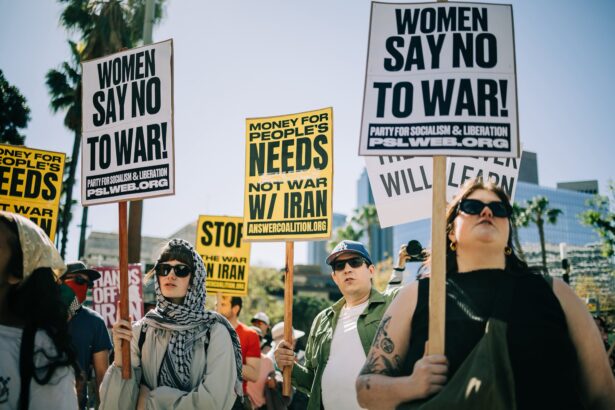
Today, we face a unique situation in that Trump’s war in Iran is incredibly unpopular, and across political parties there is huge opposition to the U.S. getting into so-called “forever wars.” And yet, we lack any large antiwar movement that is actively raising the political cost of unpopular interventionism.
It’s stunning. My take is that Trump doesn’t like “endless wars” for all of the obvious reasons. At the same time, he is eager to use the lethality of the American military to project his own power on the global stage. For him, stupid wars are simply wars that the United States can’t easily win. So he craves “victory.” He got very excited by the intervention in Venezuela and the initial strikes against Iran. And he thought that, with advances in military technology, we could have these quick-hit mini-victories with minimal, if not negligible, cost in American lives.
Right now, we’re in this weird limbo with the Iran conflict. On the one hand, it’s a war frightfully outside traditional constraints on a president, which Trump disdains. He doesn’t believe in limits set by Congress, international law, the U.N., or the opinions of allies.
At the same time, he likely recognizes that some number of U.S. casualties would be unacceptible to Americans and would sink the war. So that lesson from Iraq, from Vietnam even, he does seem to get. My fear is that low-intensity conflicts, like in Iran, may grow routine and become background noise in American political life that never quite rile the public to demand their end. The trick for Trump is to continue waging war without prohibitive costs that would trigger widespread outrage among a disapproving but disaffected public.
I think the midterms will be a crucial test of whether disapproving public opinion can have a real price. If the Democrats win big, we may have part of the answer.
I would love it if there were a dedicated antiwar movement addressing Iran as well as possible intervention in Cuba. Personally, I don’t think we’re going to have such a movement. Barring some dramatic escalation of the war in Iran, which is still possible, I think we’re going to have a continuation of the current circumstance where dissatisfaction with the war is one of a number of grievances with Trump — along with the public corruption, inattention to issues of affordability, vanity projects, et cetera. If Republicans get routed, public opinion experts will have to sift through the data to find out how important the war has been.
What lessons do you draw from antiwar organizing in the years after 9/11 that you think are relevant for movements today?
I think there are strategic lessons for activists today. One is that, while a movement’s message matters, the messenger matters enormously as well. When it’s a Gold Star mother, when it’s a veteran, when it’s an ex-general, when it’s a formerly pro-war politician articulating an antiwar position, the message behaves very differently than it might otherwise. Effective movements always need to think about how to present and highlight those voices that have the greatest credibility among the broader public and political class. We may bristle at this dynamic, but historically our most successful social movements have understood that.
Another takeaway is the general power of conscientious dissent to alter political conditions. If you think of Bush declaring “Mission Accomplished,” which he did on May 1, 2003, it was a great moment of bluster. But then you look at the profound turning of the American public on the War on Terror over the two years that followed. It’s a remarkable difference. That change would have been incredibly hard to predict.
That’s part of political life and part of life more generally. We can be thoughtful, we can be strategic, we can identify goals, but we can’t ultimately know the consequences of our actions in advance.
America and the world would have been much better off if antiwar voices had genuinely been listened to, and not belittled and ignored. People with enormous expertise and good moral instincts captured the truth of the moment. So one needs to work really hard — against the biases of the media and government alike — to make one’s truth heard. There are rewards of stamina, even when things seem bleak. Any number of issues, from global warming, to Gaza, to the abuses of immigrants, feel incredibly bleak now. But temporary setbacks shouldn’t be a reason for resignation. History has too many examples of the rewards of holding on to hope.

Excellent article. Thanks, Jeremy Varon, for doing the research and publicising it. Thanks, Mark Engler, for the interview and report.