In danger of statelessness, Bhutanese refugees build power against deportation
As ICE pursues resettled refugees who have no country to return to, Bhutanese communities are turning the threat of deportation into collective action.
A group of young community members lead discussion on strategy for Asian refugee communities. (Asian Refugees United)
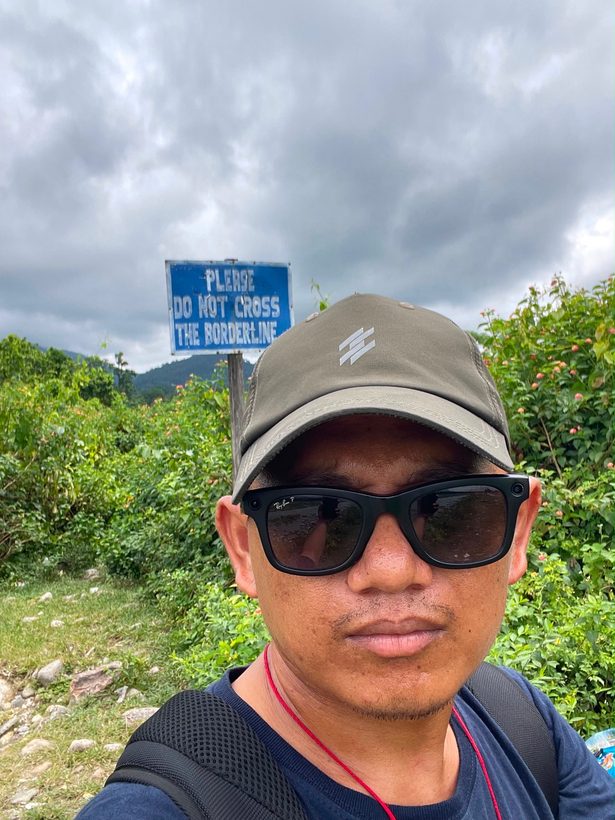
When Robin Gurung was 3 years old, his family was forced out of Bhutan. Today, as a 37-year-old organizer and co-founder of Asian Refugees United, or ARU, the reality of that exile remains carved into the landscape. On a recent trip to India’s border with Bhutan, just 20 miles from his family’s former home, Gurung encountered a sign reading, “Please do not cross the borderline.” In a photograph he took, the blue-tinted mountains of Bhutan rise in the distance behind the sign. Yet Gurung still could not cross that border line.
The photograph captured the strange closeness of a place that had shaped his life from a distance: the country that forced his family out. He spent nearly two decades in a U.N. refugee camp in Nepal before coming to the United States in January 2012 to rebuild his life. Now, he helps lead a community-wide effort to defend former Bhutanese refugees who are suddenly facing detention and deportation in the country they have come to call home.
Gurung kept his exact location private. “I am not scared, but I am very cautious,” he said when I asked whether he feared retaliation for his advocacy work. During our interview, he joined me from a dimly lit room during a power outage. We first connected on Facebook Messenger, but a weak connection forced us to switch to WhatsApp. From there, he spoke about the advocacy and organizing work he and his colleagues at ARU have led to protect the rights and future of the resettled Bhutanese community.
The border was close, but so was the history it represented. Gurung knew what it meant to lose a home because his family had lived through it. He also knew what it meant to rebuild after displacement. That history now informs his response as members of the same refugee community face a new threat of displacement in the U.S.
As of the filing of this report, upward of 75 former Bhutanese refugees have been deported to Bhutan, only to be taken to the Indo-Nepal border and left stateless once again.
Sign Up for our Newsletter
We’ll send you a weekly email with the latest articles.
A primary motivation for Gurung’s advocacy work stems from his own history and his acute awareness of how his grandfather, alongside thousands of others, had endured severe injustice at the hands of the Bhutanese regime. “It is actually a privilege to advocate on behalf of the community.”
Gurung’s family was among 100,000 Lhotshampa, a Nepali-speaking ethnic minority in southern Bhutan, who were driven from their homes during a campaign of discriminatory citizenship policies, arrests, torture and forced evictions.
In the early 1990s, Gurung’s grandfather endured 18 months of imprisonment and severe torture that broke his jaw and left him so badly injured that others assumed he had died. After his release, he spent time in a hospital, where his injuries had changed him so much that his own son barely recognized him. The family fled Bhutan in early 1992. Gurung remembers fragments of their escape: leaving behind their dog, Bittu, and riding on a truck as they crossed out of the country. His grandfather never fully recovered from the torture and later died at a regional hospital in Morang, Nepal.
After years in refugee camps in Nepal, Gurung and thousands of others eventually found a new home through a third-country resettlement program. Beginning in 2008, countries, including the U.S., resettled more than 90,000 Bhutanese refugees. For many, resettlement offered the possibility of finally leaving displacement behind.
That sense of security shattered in March 2025, when Immigration and Customs Enforcement, or ICE, began detaining former Bhutanese refugees in the U.S. For people who had already lost citizenship and spent years in refugee camps, deportation carries a deeper threat. It raises the possibility of returning to the statelessness that began with their expulsion from Bhutan.
But fear has not defined the community’s response. Across the diaspora, ARU has worked to turn individual emergencies into collective action.
When ICE came knocking
ARU formed to build community power and intergenerational leadership among Asian refugee communities. Before the deportation campaign began, the organization worked on political engagement through a partnership with civil rights group Asian Law Caucus, and as a coalition member of the Asian American Leaders Table, a grassroots network uniting local groups to build collective political power.
That organizing infrastructure became critical when the detention began.
In the second week of March 2025, while launching a youth program and media studio, Gurung learned that ICE had detained community members. Days later, as he drove to the United Nations to renew his annual pass, Bhutanese community activist Bishwa Chhetri sat in the passenger seat calling community leaders and members across Pennsylvania and Ohio, where many of those detained lived, to find out more about the detentions.
The calls revealed the scale of the crisis, but they also exposed a problem: The community had no national system for coordinating information, legal support or immediate assistance to families.
Chhetri said that there was a severe lack of organized mechanisms to track factual information on ICE detentions. In addition, “finding legal representation was a bit of trouble,” he noted, emphasizing that a vast majority of the detainees had no legal representation at all. Recognizing the overwhelming scale of the situation, he and his peers quickly concluded that a single organization could not manage the emergency on its own. Although some community groups in Pennsylvania and Ohio got involved during the early phase, ARU eventually became the sole organization within the community dedicated to carrying out this specialized advocacy work.
What began as an emergency response soon became an organizing project. After returning home from New York, Gurung reached out to the Asian Law Caucus and launched a rapid response partnership. Regarding this collaboration, Aisa Villarosa, manager of the Asian American Leaders Table at Asian Law Caucus, said, “Without community organizers like ARU, the law and lawyers alone cannot provide the holistic support, empowerment, education and creativity to explore every possible avenue for justice.” Rather than simply referring cases to lawyers, ARU built a community-based system around the legal response. Organizers reached families quickly, explained developments in familiar languages and helped people navigate an unfamiliar system.
The approach reflected a central principle of ARU’s work: People most affected by state violence should have a leading role in fighting it.
“I was exercising these freedoms because of the movement leaders from the generation before me, so I feel a sense of responsibility and gratitude to continue doing the same,” Gurung said. “If we don’t fight back, those in power will continue to suppress others — power has to be checked and balanced because we need to create a system of accountability.”
Young community members in their 20s stepped into organizing roles. They translated for elders, tracked detentions, communicated with relatives, arranged transportation and accompanied people to court. What started as an improvised response gradually became a network capable of mobilizing when another person was detained.
Building a community defense network
ARU granted me access to an August 14 virtual staff meeting, offering a direct look at the day-to-day logistics of this rapidly expanding defense network. On screen, seven young organizers, including Gurung, sat before webcams, coordinating cases across regional hubs in Pennsylvania and Ohio. Their conversation moved fluidly between Nepali and English, blending the language of home with the cold shorthand of the legal system: “FOIA,” “public defender.” At one point, a team member used the word “habeas,” prompting another organizer to ask what it meant. The first organizer paused to explain it in plain language, even though he had no legal training himself.
The exchange captured something essential about the group: They were learning the language of a system they had not been formally trained to navigate, teaching one another as they went. Between key clicks and routine case updates, the stakes came into sharp focus: A juvenile in Harrisburg, Pennsylvania was being tried as an adult and facing up to five years; families were reaching out in panic; green card holders were confronting the possibility of an eventual deportation.
As this rapid response effort grew, ARU faced another lingering challenge. Fear and confusion were spreading just as fast through the community as the detentions themselves.
To counter this, the organization held virtual mass meetings, organized Know Your Rights sessions and conducted outreach in ways that reflected the linguistic and cultural realities of former Bhutanese refugees. Volunteers also became a bridge between families and legal organizations.
“We had to be alert 24/7 to be available for the families of deportees,” Gurung recalled. “In the meantime, media visibility was imperative.”
The intensity came with a personal cost. “It was mentally too much pressure, but we had no choice,” Gurung said. Having struggled with his own mental health issues since 2024, Gurung experienced a severe mental health crisis during the height of the organizing campaign in 2025, even as new cases continued to emerge.
His experience points to a broader reality of grassroots defense work. The people creating safety for their communities often do so without the institutional resources available to larger organizations.
The partnership with the Asian Law Caucus helped address some of that gap. Attorneys provided legal expertise while community organizers reached families, built trust and helped connect legal strategies to the realities people faced.
For ARU, the distinction between legal defense and community organizing remained fluid. A family facing deportation might need an attorney, but it might also need someone to translate, arrange transportation or accompany a relative through court.
Mohan Karki’s case illustrates that reality. ICE detained Karki in mid-2025 and separated him from his pregnant wife. She decided to fight the removal order. ARU organizers, including Gurung, traveled to Ohio to pick her up and drove her to federal court proceedings in Michigan. While Karki remained in custody, she gave birth to their baby in June 2025 and continued attending court hearings through December.
“When I first met her, I was very much inspired,” Gurung said. “She had to give birth while her husband was in custody.”
For organizers, cases like Karki’s show why community defense cannot stop at the courtroom door. Families need sustained support as they navigate a system that can reshape their lives overnight.
From individual cases to a broader movement
Those experiences have also pushed ARU beyond individual deportation cases. The organization has built relationships with groups working on statelessness, including United Stateless, connecting the experiences of former Bhutanese refugees to a broader movement of people who lack recognized citizenship or face the threat of statelessness.
For Gurung, that connection is personal.
“This was very personal in terms of knowing what it means to become stateless, what it means to become a refugee,” Gurung said. “We came to this country after being well-vetted. The idea of deportation to Bhutan was not safe for community members — that idea was very wrong.”
Robin Gurung pictured at the India-Bhutan border with Bhutanese mountains in the background. (Robin Gurung)
The campaign, Gurung said, is about more than protecting individual families. It is also about preventing one generation’s displacement from becoming another generation’s future. Highlighting the systemic barriers that worsen this crisis, Villarosa points out that the U.S. immigration laws and courts lack a uniform, comprehensive definition of statelessness.
“If we don’t fight back, we are giving license to those in power to decide our fate,” he said.
That belief has pushed ARU toward broader coalition building while keeping the Bhutanese community at the center of its work. The organization is strengthening relationships with groups confronting related forms of state violence and working to ensure that the experiences of former Bhutanese refugees inform wider organizing around statelessness and immigrant rights.
That work now shapes ARU’s next phase.
What comes next?
More than a year after the first detentions, ARU continues its rapid response work while building longer-term community power. Gurung said ARU continues to respond to developments affecting former Bhutanese refugees while coordinating a coalition effort to bring Bhutanese organizations together around a joint response. Community education has also become a central priority. ARU is working to educate and organize community members so they have the knowledge and collective capacity to respond when new challenges arise.
The organization is also pursuing legal and international advocacy. A Freedom of Information Act, or FOIA, lawsuit by the Asian Law Caucus remains underway, seeking government records, policies and communications from ICE and the Department of State regarding the sudden detention and deportation of Bhutanese-American refugees. Alongside this domestic legal pressure, representatives from ARU recently met with U.N. Refugee Agency officials from Geneva, Washington, D.C., and the Asia branch to address the ongoing crisis and statelessness risks facing former Bhutanese refugees.
Locally, ARU is participating in a collective effort to pass a Welcoming County resolution in central Pennsylvania’s Dauphin County that would prevent cooperation with ICE.
These efforts show how a rapid response campaign can grow into a broader organizing strategy. ARU is combining community education, coalition building, legal action, international advocacy and local policy work to challenge the conditions that leave families vulnerable.
Still, the community has built something that did not exist when the first detention calls arrived. Organizers have established rapid response channels, trained community members, accompanied families through court and connected the Bhutanese struggle to broader movements addressing statelessness.
For Gurung, that work remains rooted in the freedoms he gained after nearly two decades in a refugee camp.
“It is a rollercoaster ride,” Gurung said, describing the challenges and complexities of ARU’s ongoing advocacy work.
Support Us
Waging Nonviolence depends on reader support. Make a donation today!
Reflecting on why he continues organizing, he returns to the experience of people whose freedoms were denied for years, much like his own.
“Having spent close to two decades in refugee camps in Nepal without rights, I finally gained my freedom,” he said. “When a fellow community member faces deportation, it motivates me to keep fighting for their rights as well.”
Those freedoms came after decades of displacement. Now, community members who understand the cost of losing them are fighting to protect them. ARU’s response continues to evolve, but its central strategy remains clear: build collective power so families facing state violence do not have to face it alone.
Standing just 20 miles from the home he lost, Gurung was reminded of how easily a line on a map can divide a life. Today, as ICE attempts to redraw those same boundaries of exile in the U.S., ARU is drawing a line of its own. By transforming personal trauma into collective defense, they are making one thing absolute: their community will not be forced backward, and no one will ever face statelessness alone.
Thank you for your interest in republishing this story. You are free to republish it as long as you follow these four requirements:
Credit Waging Nonviolence and link to the original. We prefer with a note at the top of the article. For example: This article was originally published on Waging Nonviolence.
Don’t sell our material or edit it, unless editing to reflect relative changes in time, location and editorial style.
Use photos or images only if you are certain they are in the creative commons or have received permission from us. To do so, email: contact@wagingnonviolence.org.
Include our Matomo tracking pixel by copy-and-pasting this HTML code into the article:
Copy and paste the following into your page to republish:
From police killings to genocide in Gaza, collective grieving practices have built lasting movement infrastructure and helped overcome alienation and burnout.
After the brutal January 2026 crackdown, teachers unions in Iran are not backing down on their demands for fair wages, free education and free expression.
After the collapse of state infrastructure and services amid war in Sudan, mutual aid networks stepped up to fill the gaps in health care, food and emergency services.
Peace and justice organizations, as well as universities, publish their own independent content on Waging Nonviolence. This Community section offers just a sample of their latest stories. Visit their individual pages to see more.
Get Waging Nonviolence delivered to your inbox
Sign up for our weekly newsletter to get the latest in people-powered news and analysis.
Donate
Waging Nonviolence is a nonprofit organization and all donations are tax deductible.
To donate by check, cryptocurrency or other method, see our Ways to Give page.

Very impressive article by TP Mishra. A pioneer Bhutanese journalist, Mishra himself underwent through many problem tunnels that made his life difficult. It is understandable, therefore, that he writes so effortlessly about issue that sits close to his heart. I think he has done a remarkable job describing the people affected by ICE’s actions while also detailing community resilience efforts with ARU at the front.
Also big applause to Robin Gurung for standing strong at a time of great need.
Thank you for this excellent article about the efforts of Robin Gurung and Asian Refugees United to protect the rights of Bhutanese people resettled in the US. I have followed closely the progress of Bhutanese Americans who arrived 15 years ago, finally able to rebuild their lives after decades in refugee camps. For ICE to now target some of them for deportation is yet another cruel and callous action our government has taken against people who have endured incredible hardship and who deserve recognition as some of the best citizens this country has welcomed.
The article doesn’t mention it, but Asian Refugees United does much more than work with Bhutanese-Americans at risk of deportation. They also support other at-risk populations including Deaf Bhutanese Americans. I had the pleasure of meeting Mr. Gurung through his work ensuring Deaf Bhutanese were included and had access to the wider community. His hard work and commitment is impressive and appreciated.
Julia Freeman-Woolpert, co-author with Bhawani Dangal, Down the Braided River: My Journey as a Deaf Refugee
Thank you, T.P. Mishra, for shedding light on this urgent and deeply underreported crisis. As someone born and raised in this country, I feel profoundly ashamed of how this nation has turned overnight, subjecting people who survived decades of state-sponsored expulsion and refugee camps in Nepal—and who were legally vetted and welcomed here—to the existential terror of secondary displacement and statelessness.
What stands out most powerfully in this piece is the transformation of profound trauma into collective, intergenerational power. As other commenters have noted, the work being done by Asian Refugees United goes far beyond individual defense; it is a masterclass in grassroots organizing, mutual aid, and building the essential infrastructure that legal systems alone cannot provide.
When the state attempts to render people disposable, community-led rapid response networks, “Know Your Rights” education, and local sanctuary policies like the push in Dauphin County become absolute lifelines. Robin and others at ARU, I truly appreciate your work and your fierce dedication to making sure no one faces state violence or exile alone. Thank you for amplifying these stories, and endless solidarity to all the organizers building walls of protection and dignity from the ground up.
This story is heartbreaking and, honestly, difficult to fully comprehend. The author has done such a beautiful job of telling Robin Gurung’s story with humanity and care. Reading about his journey — being forced from Bhutan as a child, spending nearly two decades in a refugee camp in Nepal, and then dedicating himself to helping others in his community — really puts a human face on what it means to be displaced and to live with the uncertainty of statelessness.
What is especially painful is the thought of people who endured years in refugee camps, were eventually resettled in the United States, and began rebuilding their lives here, only to face detention and deportation once again. To see people potentially ending up at the borders of countries that do not recognize them as citizens is an incredibly difficult reality to take in.
I’m grateful to Robin and everyone at Asian Refugees United for continuing to stand with the community, support families, and make sure these stories are heard. Their work shows how important community organizing and solidarity can be, especially when people are facing such overwhelming uncertainty.
Thank you to Waging Nonviolence for telling Robin’s story so thoughtfully and bringing greater attention to the experiences of Bhutanese refugees. This is one of those stories that stays with you long after you finish reading it.