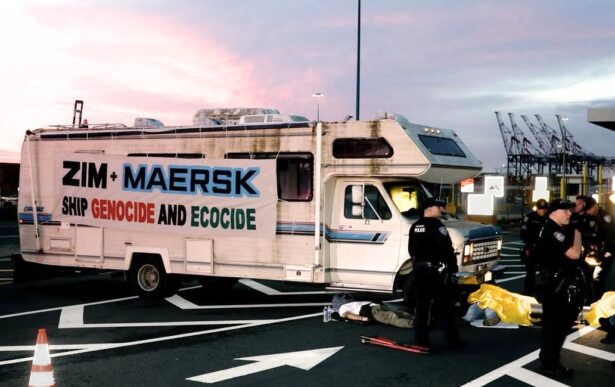
US communities are organizing to end complicity with genocide in their backyards
As the genocide in Gaza nears its fourth year, communities across the U.S. are pressuring their local governments to break the supply chain of weapons to Israel.
Garden Grove residents mobilize to demand accountability from GKN Aerospace on July 28. (Palestinian Youth Movement – LA, OC, IE)
Dwight Hua’s roommate knocked on his door at 5:30 a.m. on May 22, saying there was a notice for nearly 50,000 people in their city of Garden Grove, California, to evacuate due to the danger of a deadly chemical explosion at a nearby GKN Aerospace plant. Hua quickly left for a shelter in a neighboring city. But he had a lot of questions.
As the evacuation stretched over five days, advocacy groups VietRISE — where Hua is a youth programs coordinator — the Harbor Institute for Immigrant and Economic Justice, the Palestinian Youth Movement, and Orange County Justice for Palestine formed a coalition to demand “transparency about why a facility tied to global hazardous weapons manufacturing is operating in the middle of working-class immigrant neighborhoods.” Research led by the local chapter of the Palestinian Youth Movement, or PYM, found that the company manufactured parts for military vehicles, including F-35 fighter jets, which are used in Israel’s ongoing genocide of Palestinians.
“No one really knew that this was what we were living close to,” Hua said. “A company that makes money off of violence abroad is not the character of Garden Grove and its residents.”
Many residents who, like Hua, live just blocks away from the facility felt enraged when they found out. The coalition joined the People’s Embargo for Palestine, an international movement to establish an arms embargo on Israel, and began organizing actions to push the city to shut down GKN Aerospace and place a moratorium on military manufacturing in Garden Grove. They have been canvassing, showing up to city council meetings and circulating a petition that has drawn more than 11,000 signatures. Addressed to the mayor and city council, the petition demands “an immediate end to the use of our tax dollars, public land and public infrastructure to manufacture, store or transport the weapons that make this genocide possible.”
While the Garden Grove City Council has canceled meetings and omitted GKN Aerospace from meeting agendas in the months since the evacuation, Hua said, the coalition has kept on growing in size and influence. Members continue to show up to city council meetings, canvass and meet with city officials, some of whom have shown support for the embargo.
The campaign for a weapons embargo is part of a larger international movement to stop global manufacturing and shipment of weapons to Israel. From Türkiye to Italy to the U.S., localized campaigns targeted at Israeli weapons suppliers have emerged, led by community groups and unions, and often supported by PYM chapters. Their goal is to end local complicity in the genocide — and ensure worker and community safety — through bans on weapons shipments through local airports and seaports, as well as shutdowns and moratoriums on weapons manufacturing facilities in residential areas.
Putting communities at risk for Israel
A coalition of community groups is leading an embargo campaign in New York City’s John F. Kennedy Airport, where dangerous explosives and F-35 bomber components bound for Israel have passed through the same runways as passenger flights. The campaign is calling on the Port Authority of New York and New Jersey to end arms shipments through public infrastructure. Most of the coalition’s efforts have been geared toward organizing and educating workers, especially unionized workers in warehouses and on planes.
Sign Up for our Newsletter
We’ll send you a weekly email with the latest articles.
Abdullah Shehadeh, communications co-chair of Break the Chain, the coalition leading the campaign, said that workers were unaware they were handling explosives bound for Israel because they were mislabeled.
“Workers feel very scared about what they’re doing in their day to day, not knowing that complicity like this is even possible for them,” Shehadeh said. “They didn’t sign up to be part of a supply chain of genocide.”
In outreach to workers, volunteers with the coalition also point out the dangers of handling explosives, noting that a munitions plant in Tennessee which manufactured the same explosives experienced a blast last year that destroyed an entire building and killed 16 people.
Organized by New York City’s Democratic Socialists of America chapter, Break the Chain was founded in 2025 by Palestinian liberation organizers in New York who wanted to focus on a tangible campaign to organize labor.
The coalition is advocating for more transparency for workers and the public to know what is passing through their workplaces and communities. Volunteers with the coalition post educational flyers in Queens, New York, where many airport workers live, and hand them out on the air train that workers use to commute. The coalition encourages small businesses in the area to display informational posters and hold events in their spaces. A tool on the coalition website lets workers search for whether their employers are complicit in the genocide.
“It’s their right to know what they’re moving and to not be a part of a war machine that they didn’t sign up for,” Shehadeh said. “They should be moving civilian goods, not military goods or bombs going to a genocide.”
Break the Chain also advocates for labor unions to pass resolutions calling for a ceasefire and end to military aid, to bargain for contract protections for workers who refuse to contribute to the supply chain of Israeli arms, and to work with elected city officials to explore expanding the rights of working-class New Yorkers. After meetings with union leaders and working groups, more than 20 unions have signed the coalition’s resolutions, including the United Auto Workers, Association of Flight Attendants, National Education Association and 1199SEIU.
Shehadeh said the coalition’s activism is “an intersection between labor, Palestine, and community and public safety.” He is concerned that if the explosives are mishandled or improperly stored, there could be a catastrophic explosion threatening the lives of the more than hundred thousand people who pass through JFK every day, as well as nearby communities.
Garden Grove and the area of Queens surrounding JFK are both predominantly immigrant communities. Shehadeh said the transfer of weapons through JFK is an example of how “massive private profit fuels endless conflict, and the environmental health and moral burdens fall on working-class communities here in New York City.”
“A handful of billionaires line their pockets with profits from weapons contracts, while we are seeing crumbling infrastructure in our subways here in New York City; we’re seeing climate change get worse and worse,” Shehadeh said.
Embargo campaigns at the ports
Activists in Texas have called on the Port of Houston to place an arms embargo at their ports, where critical parts for the F-35 fighter jet pass through to Israel. Upon learning from a PYM report that the Houston port was shipping parts for the same weapons used to bomb schools, refugee camps and hospitals, activists came together with PYM and local groups to form the Houston Arms Embargo Campaign in 2024.
The campaign took inspiration from PYM’s global Mask off Maersk campaign, which calls on people to get Maersk to end its contracts with the U.S. Department of Defense and Israeli Ministry of Defense to ship military components to Israel. Under the contracts, the logistics and shipping giant handles everything from tactical vehicles used to transport Palestinian prisoners to parts for armored tanks and aircraft and artillery systems used for slaughter in Gaza and Lebanon. According to a recent report published by PYM and Oxfam, Maersk shipped millions of pounds of cargo to Israeli military manufacturer, Elbit Systems, between October 2023 and July 2025.
PYM organizer Fouad Salah said that localizing the campaign has helped activate constituencies from students and workers to faith communities, and built relationships with 40 national and local organizations, including other Palestinian campaigns, and anti-gentrification, Black and Latino groups.
“So many of the ports in this country are implicated in the transport of military cargo that’s used in an ongoing genocide, and I think this is a really important piece because this is public infrastructure, these are not military ports,” Salah said. “As constituents, we should have a say in what happens with our public infrastructure.”
A child attempts to strike a piñata resembling a F-35 aircraft at a picnic hosted by Houston Arms Embargo in late July. (Courtesy of Houston Arms Embargo)
Like the Break the Chain campaign, the Houston Arms Embargo Campaign has been flyering at community centers, parks, malls, mosques and churches. They have also circulated the Houston Arms Embargo petition, engaging constituents in the idea of an arms embargo and encouraging them to get involved. The campaign has also held free lunches provided by local restaurants for people interested to learn more about their work. In July, they held a picnic at a park to bring the community together for the campaign’s one-year anniversary, which was well-attended despite the Texas heat.
“The power is with the people, but for the people to exercise that power, they need to be educated and conscious of what’s going on, and so a lot of our tactics revolve around getting the average Houstonian aware and agitated about what’s happening at the port,” Salah said.
Many people Salah comes across don’t know much about how the ports near their homes are shipping weapons to Israel; once they find out, he said, they generally support the campaign and want to help. He said many people “have watched Palestinian children limbless crying for their mothers and fathers because of a genocide being committed by weapons manufactured and transported from the United States, and at a certain point, there is an ethical line that a person draws.”
He said that having a localized campaign at the ports gives people a place to feel like they can do something about it.
“We were able to build a campaign that took [people’s general desire] to stop the genocide in Gaza, and hone it in to something that is happening in our city,” Salah said. “I think this gave people a sense of real purpose and real direction. It gave them a real, concrete, tangible thing that they could channel their energy into.”
Support Us
Waging Nonviolence depends on reader support. Make a donation today!
Similarly, Hua said that having a community-based coalition has empowered residents by giving them a platform for action.
“Having a coalition has really been a space for community members to be able to feel empowered to be involved in shaping their community,” Hua said. “We want to continue to strengthen the community power and not let this get swept under the rug, and so we are continuing to show up to city council meetings and continuing to build that power.”
Thank you for your interest in republishing this story. You are free to republish it as long as you follow these four requirements:
Credit Waging Nonviolence and link to the original. We prefer with a note at the top of the article. For example: This article was originally published on Waging Nonviolence.
Don’t sell our material or edit it, unless editing to reflect relative changes in time, location and editorial style.
Use photos or images only if you are certain they are in the creative commons or have received permission from us. To do so, email: contact@wagingnonviolence.org.
Include our Matomo tracking pixel by copy-and-pasting this HTML code into the article:
Copy and paste the following into your page to republish:
From police killings to genocide in Gaza, collective grieving practices have built lasting movement infrastructure and helped overcome alienation and burnout.
Peace and justice organizations, as well as universities, publish their own independent content on Waging Nonviolence. This Community section offers just a sample of their latest stories. Visit their individual pages to see more.
Get Waging Nonviolence delivered to your inbox
Sign up for our weekly newsletter to get the latest in people-powered news and analysis.
Donate
Waging Nonviolence is a nonprofit organization and all donations are tax deductible.
To donate by check, cryptocurrency or other method, see our Ways to Give page.