People gather for a candlelight vigil for Alex Pretti, who was shot and killed by federal agents in Minneapolis on January 24, 2026. (CHARLY TRIBALLEAU / AFP via Getty Images)
Analysis
After October 7, I learned that movements need grief spaces
From police killings to genocide in Gaza, collective grieving practices have built lasting movement infrastructure and helped overcome alienation and burnout.
People gather for a candlelight vigil for Alex Pretti, who was shot and killed by federal agents in Minneapolis on January 24, 2026. (CHARLY TRIBALLEAU / AFP via Getty Images)
Since the massacres on Oct. 7, now three years ago, the news has brought a steady stream of horror and broken promises. The ceasefire in Gaza has been broken thousands of times; the ceasefire with Iran only holds until the next strike. Many of us have responded by going numb or turning away. Over these three years, I’ve come to believe that collective mourning can help movements build sturdier organizing infrastructure, move through paralysis and numbness, and get back to the long-term work of creating systemic change.
I’ve spent nearly two decades living and working as a human rights defender, mostly in Palestine and Israel. For years, I responded to atrocities the way much of the dominant organizing culture did at the time: strategically. I prepared statements, launched campaigns and mobilized our base. I worked through several wars and the ongoing ethnic cleansing and genocide. Even though my colleagues and I were often physically together, we rarely had the opportunity to collectively mourn. In fact, mourning was often seen as something only the privileged could afford. As organizers and solidarity activists, we were the ones who needed to push past the pain and keep mobilizing.
And then, after each war, large swaths of colleagues and organizers would burn out, and our movement would suffer a setback. Movement researchers Paul Gorski and Cher Chen, studying U.S. human rights and social justice activists, found that an estimated 50 to 60 percent of organizers eventually walk away from movement work and never return, burned out by a culture that treats overwork and self-sacrifice as necessary. That culture also leaves no room to mourn and process the secondary trauma that accumulates, hastening burnout. These kinds of cycles make it especially hard for movements seeking systemic change to sustain themselves.
Sign Up for our Newsletter
We’ll send you a weekly email with the latest articles.
When Hamas attacked Israel in October 2023 and I was waiting in anticipation of the retaliation against Gaza, I knew I couldn’t respond with the same kind of organizing strategy that we usually use: preparation of advocacy statements, social media campaigns and fundraising appeals. I knew that while some people should and would continue that work, there also needed to be spaces for organizers and our base to mourn. And so, on Oct. 8, I opened a space for collective mourning online, sharing it in the many community, political and religious groups I was a part of, for anyone who needed somewhere to process what they were witnessing and feeling. Dozens of people joined: primarily my Jewish community at first, and then people from many faiths and chapters of my life, from Palestine to Palo Alto.
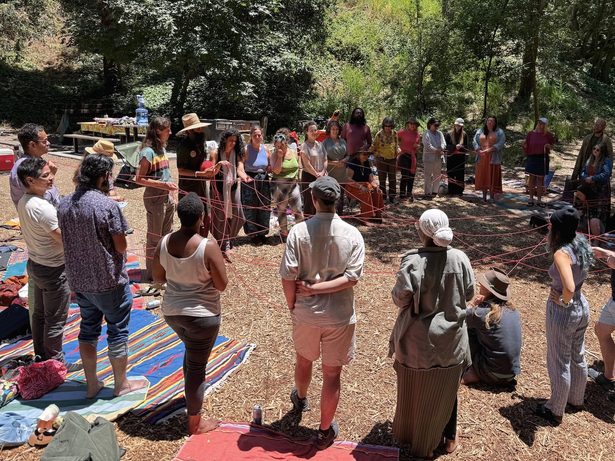
As the assault on Gaza and the genocide continued, the room stayed open. More colleagues, including community organizers, artists, chaplains and psychologists, joined me in facilitating, and we held space for hundreds of people from across our communities to mourn together. We formed a collective called the Social Change Sanctuary and developed a format that included facilitation and participation from attendees. Over time, we were invited to hold spaces for other communities in mourning. We’ve held spaces to grieve the ongoing genocide; climate catastrophes like the fires in Los Angeles; ICE raids, arrests and murders; and the war on Iran.
The Social Change Sanctuary hosts an Interdependence Day circle in 2025. (Alison Avigayil Ramer)
Participants repeatedly shared the difference it made in their lives to know they had a consistent space to mourn.
“In daily life, when something hurts, I turn away, I distract myself,” one participant told us. “But the collective mourning practice helped me move through the frozenness that constant news induced — helped me stop doomscrolling — and I’m able to return to my work.”
That participant went on to organize her community and raised $20,000 for refugees in Gaza.
Another participant returned to their role as a chaplain, and extended her work to include “movement chaplaincy” holding one-on-one spaces for people doing solidarity work.
Many participants also shared how witnessing the news with others enabled them to feel the emotions provoked by the headlines, leaving them feeling less isolated and more connected. That is co-regulation happening at the communal level, increasing people’s capacity. People who could barely stay in the room during the earliest, rawest sessions after Oct. 7 can now sit with the news longer, witness without shutting down and understand what is theirs to carry and what is not.
A historical movement of mourners
While many of the collective mourning groups that have come together in recent years are new, they’re built on generations of organizing that already knew how to fold community care and grief into the work itself.
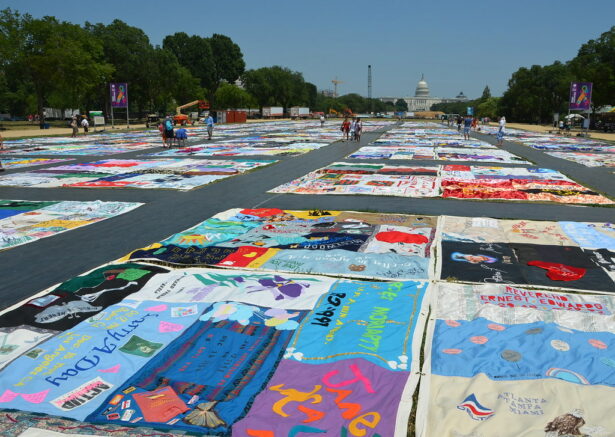
During the civil rights movement, Southern organizers mourned the murdered publicly and loudly, treating funerals as organizing events rather than sites of private grief to be managed quietly. Decades later, AIDS activists advocating for government support built the NAMES Project Quilt, which memorialized the dead one quilt square at a time. And ACT UP’s “political funerals,” where activists carried the actual ashes of the dead to the White House lawn, were a vigil and a protest at the same time.
For years, Black Lives Matter’s Los Angeles chapter has opened its meetings and protests with a mourning ritual in which members stand in a circle and speak aloud the names of people killed by police, while one person at the center pours out water for each name and the group answers “ashe” after every pour.
Over the past three years, IfNotNow, a Jewish organization that mobilized thousands to oppose the genocide in Gaza, has built something they call ceasefire circles: small, ongoing groups organized around what researchers studying the practice term “solidaristic grief,” designed less as a single vigil than as a longer-term way of holding people inside the movement over time.
In February, as ICE violence escalated, a coalition that included the NDN Collective, the Brave Heart Society, the Indigenous Protector Movement, the American Indian Movement, Sunrise Movement and Project South circulated a public toolkit for grieving those killed by federal agents, built explicitly so that any group, anywhere, could hold its own public mourning.
How mourning helps us keep going
In an environment dominated by negative news, many of us are starting to turn away, rather than experiencing a kind of secondary, media-induced trauma that can leave us anxious, depressed or numb.
Both avoidance and numbness are the nervous system’s way of protecting us — an involuntary, evolutionarily produced reaction. They are also what makes the news cycle so useful to the people who want to immobilize us and our movements. Steve Bannon named the strategy “flood the zone.” Scholars of authoritarianism describe this as a deliberate exploitation of the public’s limited attention, engineered to produce fatigue and an inadequate or absent response. The aim is to overwhelm and exhaust the opposition.
We do not need to feel guilty for having this response, but we do need a way through it. So we ran an experiment: Could listening to the news become an opportunity for co-regulation instead of dysregulation?
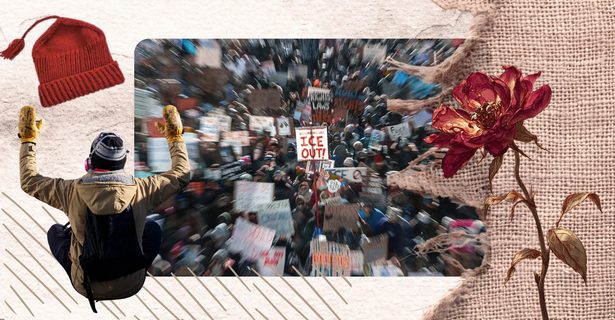
Collage of grief practices from Minneapolis after federal agents shot and killed Renee Good and Alex Pretti in January 2026. (Art: Alison Avigayil Ramer / Photo: Lorie Shaull)
We called the practice Good Mourning. We held the 30-minute practice once a week for 40 weeks with six to 10 people. For 15 minutes, we listened to the day’s news together, usually “Democracy Now!,” mixed with music. People wrote, drew, danced or sat still while they listened. Then, for the other half of the session, we turned to each other and shared what moved through us, without offering to fix or resolve anything.
Why listen to the news at all? It may seem like a counterintuitive ask of people who are already overwhelmed by news. But tuning out isn’t a neutral act for organizers. If we numb ourselves to avoid the pain, we also lose contact with the reality we’re trying to change. We lose sight of the people being harmed, the urgency and the stakes. Scrolling by yourself doesn’t help either; it keeps the nervous system braced without ever letting it process.
But practices like Good Mourning offer a third option: Take in the news deliberately, in a bounded container, alongside others, with room for the body to respond. This helps us stay informed and connected to what’s happening without being flooded by it, and that connection is what fuels action.
“I started Good Mourning because I wanted to hold myself accountable to listening to the news, instead of giving in to the temptation to block it out completely,” Eva Orbuch, a community organizer and one of the founders of Good Mourning, told me recently. “It became so much more — a community, a creative practice, a way to take in the news mindfully, a place to recommit to what supports my own resilience and makes things a little better in the world.”
Talking about the news activates the same analytical mind that has been narrating the news to us all week. But moving the body or creating something, even just doodling, helps us use another part of the brain to process it. That’s the basic premise of expressive arts therapy: Grief and trauma often live below language, stored in the body as tension or bracing, and adding expressive arts to the practice of listening to the news helps us move through it.
Listening together also creates an opportunity to co-regulate communally. Stephen Porges’ polyvagal theory describes how nervous systems calibrate against each other: Being near someone else in a state of relative safety can shift your own breathing and stress response toward theirs. A structured, repeated practice gives that calibration somewhere to happen, week after week.
“The practice helps me to compost whatever I’m holding, and to move through all the grief,” one participant said.
Making your own Good Mourning practice
This year, several of my friends contacted me before Oct. 7. “What could we possibly do this year? I’m tired of organizing events,” an organizer who has held dozens of peace vigils in the past year told me.
“Why don’t we create our own space for collective mourning?” I offered. We can look at some of the stories, news and art from the day together. Make something of our own?
She agreed.
Support Us
Waging Nonviolence depends on reader support. Make a donation today!
Perhaps this is also a practice that can accompany you. Creating your own space for collective mourning doesn’t require much. Ideally, form a small group and commit to 30 minutes. Read the news to each other, or play it aloud, mixed with music, or anything that isn’t just more thinking. Invite people to pair the listening with something for the body, like movement, drawing or dancing. Then turn to each other and share your grief, without trying to resolve it, fix it or offer advice. At the end, share one way you will nourish yourself and others in this hard time, and wish each other well.
This simple act of witnessing your community in grief has been powerful for so many. Perhaps it can be a way for you and your community to move through mourning and keep on mobilizing.
Thank you for your interest in republishing this story. You are free to republish it as long as you follow these four requirements:
Credit Waging Nonviolence and link to the original. We prefer with a note at the top of the article. For example: This article was originally published on Waging Nonviolence.
Don’t sell our material or edit it, unless editing to reflect relative changes in time, location and editorial style.
Use photos or images only if you are certain they are in the creative commons or have received permission from us. To do so, email: contact@wagingnonviolence.org.
Include our Matomo tracking pixel by copy-and-pasting this HTML code into the article:
Copy and paste the following into your page to republish:
From police killings to genocide in Gaza, collective grieving practices have built lasting movement infrastructure and helped overcome alienation and burnout.
After the brutal January 2026 crackdown, teachers unions in Iran are not backing down on their demands for fair wages, free education and free expression.
After the collapse of state infrastructure and services amid war in Sudan, mutual aid networks stepped up to fill the gaps in health care, food and emergency services.
Peace and justice organizations, as well as universities, publish their own independent content on Waging Nonviolence. This Community section offers just a sample of their latest stories. Visit their individual pages to see more.
Get Waging Nonviolence delivered to your inbox
Sign up for our weekly newsletter to get the latest in people-powered news and analysis.
Donate
Waging Nonviolence is a nonprofit organization and all donations are tax deductible.
To donate by check, cryptocurrency or other method, see our Ways to Give page.