People in Zimbabwe protest a Chinese company’s decision to open a quarry mine in 2019. (Columbus Mavhunga/VOA)
When the shrill of heavy earthmoving machinery crept towards Elias Mlambo’s riverside banana plantations in February, the sudden brownish color of the river alarmed him.
The water was laced with used machinery oil, disfiguring the once crystal-clear, wild water of the Haroni River. The river not only sustains the Ndau tribal people of the Chimanimani district in southeast Zimbabwe but also acts as Zimbabwe’s eastern border with Mozambique. By December of last year, excavators operated by a Chinese mining syndicate were at work along a stretch of the riverbeds — tearing up centuries of riparian ecology in a hunt for alluvial gold deposits.
“They appeared without notice, without our permission, claiming to have a government license to dig for gold on our land, but never showing the actual permit,” said Mlambo, a banana farmer and local tribal elder in Rusitu, one of the largest villages in the district.
He said he confronted a man who claimed to be the manager of the Chinese miners — but the man gave his name only as “Xai Samson” and flatly refused to give out the company’s name. He acted as though he did not understand English — a deliberate tactic some dubious Chinese mining syndicates adopt in Zimbabwe when confronted by aggrieved locals, Mlambo said.
“He just waffled a few sentences in Chinese — gestured to the excavators and piles of fresh soil,” he explained. “We figured out that our river, fruit plantations and ancestral graves were collateral to the invaders.”
Ignored at first
For the next three months, Mlambo made complaints to the Chimanimani municipal authorities, a lawmaker and Zimbabwe’s mines ministry — and was ignored. Just one ministry bureaucrat responded to Mlambo and other tribal elders by telephone, only to say that his hands were tied, citing how high-level state partnerships and national economic priorities trump tribal land rights. It’s a familiar cold response from Zimbabwe’s government that human rights leaders say has given dozens of Chinese prospectors carte blanche to excavate hills and river streams, and encroach onto tribal farming and grazing lands in pursuit of precious metals like platinum, lithium or gold.
Sign Up for our Newsletter
We’ll send you a weekly email with the latest articles.
“There’s a cozy, transactional relationship between state decision-makers and Chinese minerals prospectors,” said Nsama Musonda, the executive director of Care for Nature Zambia, a regional ecology monitoring nonprofit. “This gifts Chinese businesspeople a carefree right to dig for precious minerals — without consent — on tribal people’s lands in Zimbabwe and nearby countries like Zambia.”
Knowing the script that has played out elsewhere across Zimbabwe, Mlambo and fellow villagers refused to retreat. Instead, they looked across the international boundary to Mozambique — a stone’s throw across the Haroni River. On the other side, in Mozambique’s Sussundenga district, villager Manuel Pinto was watching his community’s primary fish stocks float belly-up to the surface.
Fish in the community ponds that line the Mozambique side of the Haroni riverbed were suffocating from the sludge coming from the spoiled headwaters on the Zimbabwe side, he said. But Pinto feared something worse: Mozambique’s community health nurses warned that children could develop chemical rashes if they encountered contaminated waters.
“The river doesn’t need a passport to flow and nourish both countries, Zimbabwe and Mozambique,” he said, speaking the same Ndau vernacular language that hundreds of thousands of tribal people on the Zimbabwe side of the river border speak, too. “We realized that if authorities in Zimbabwe would not enforce environmental law, the Ndau people on both sides of the border would act to protect their right to safe livelihoods.”
The border alliance
Pinto says he knew routine complaints would be easily ignored by state decision-makers. So Mlambo and Pinto conjured up a community alliance rooted in their shared Ndau lineage. Tribal identity, older than colonial state borders, drove their determination to defend their environment against the encroachment of heavily polluting Chinese miners.
In daylight, the Ndau communities on the Zimbabwe side confronted the Chinese miners: spraying graffiti on the worksite and the machinery, and singing, chanting and banging pots, drowning them in noise. Since the area is remote geographically, located far from city markets, they also successfully convinced local food shops to refuse to sell soap, beverages, bread, meat, tea, essential groceries and cellphone top-up cards to the Chinese miners and their local mining employers. Taxis and buses refused them service. These actions constantly reminded the miners and their workers that they were trespassing on tribal lands.
“We made life uncomfortable for them,” Mlambo said. “Their workers were often hungry because we instructed local shops not to sell food or beer to the invaders, which they liked a lot. They would drive 50 kilometers just to replenish the food pantry with essentials like salt and cigarettes. Their workers began to quarrel with their bosses.”
Locals also shared their displeasure to social media networks followed by thousands of Zimbabweans.
At the same time, the Ndau communities on the Mozambique side of the river filled out urgent cross-border environmental petitions with provincial authorities in Mozambique’s Manica province. They walked into the offices of the governor and lawmakers and demanded urgent meetings, asking them to directly press the Zimbabwean government to take action under specified timelines. If the decision-makers didn’t follow through, the Ndau activists threatened not to pay taxes because the sludge from Zimbabwe’s polluted river was beginning to spoil their corn and fruit farming plots.
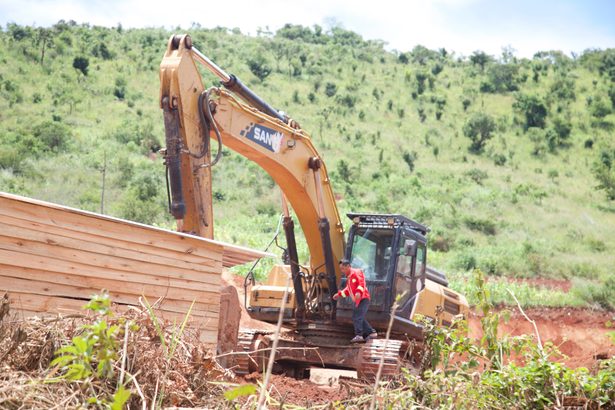
A Chinese mining excavator digs a hillside for gold in Chimanimani district, Zimbabwe. (Centre for Natural Resource Governance)
The Zimbabwe government is known for being “tone deaf” to citizens’ grassroots petitions against irregular mining, said Pedrito Martinho Campira, chief of the Sussunhega district. But he added that the deliberate aggressive petitioning of the regional government in Manica, which borders Chimanimani, has created a diplomatic headache for Zimbabwe’s stubborn authorities, whom locals suspect were shielding the Chinese syndicate.
“At night our people would cross the river, cover the Chinese mining site with paper petitions and spray graffiti, warning the Chinese miners that they are messing with the waters flowing into Mozambique,” Campira recalled of the intense cross-border pushback that overwhelmed the Chinese prospectors.
“Illegal riverbed mining is an affront to our two shared lands and cultures,” he said. “We are one Ndau people separated by a colonial fence; we have blood family ties across the river.”
Faced with nightly protests, daily confrontation with locals on the Zimbabwe side of operations, cross-border diplomatic pressure and vocal warnings from Mozambique border guards, who were dismayed by the contaminated water flowing from the Zimbabwe side, the unidentified Chinese miners finally retreated in June. They abandoned heavy machinery and fled the mining site — leaving locals to rehabilitate spoiled riverbeds, banana plantations and damaged forest cover.
“We won,” Mlambo said. The Chinese mining syndicates operating without consent across rural Zimbabwe are used to facing only local complaints and enjoying the shield of compromised government bureaucrats, he added. “This time they faced something unfamiliar — a cross-border, bi-national grassroots pushback, and they were clueless on how to respond.”
Xiao Samson, the manager of the Chinese syndicate that attempted to excavate for gold in Haroni River, refused to give a full interview. He only said in a short phone call, in broken English, that, “we are no lawless people. We have a permit. We will [be] back in Haroni River to do our gold with law.”
Mutoko pushback
The victory in Chimanimani is not an isolated event; it marks an uptick of grassroots defiance forming in rural Zimbabwe in areas where precious minerals are being discovered. In the granite-rich hills of Mutoko, 250 miles north of Chimanimani, a similar crisis boiled over in June. Mutoko has long been the center of friction over complaints that Chinese miner-exporters are blasting and digging up lucrative black granite and gold without consent — leaving in their wake damaged homes, polluted riverways, desecrated grazing and farming lands, and deformed hills. For example, Shanghai Haoying Mining Investments has been frequently cited by locals for continuing mining activities without obtaining community consultation or environmental approvals, and for threatening to evict locals.
In June, the community finally drew a line in the sand with a different band of Chinese miners, who, like the miners in Chimanimani, refused to give out their identity.
“My house has been shaken to the core — its roof and walls cracking from relentless blasting by nearby Chinese miners who are going for gold,” said Urai Godo, a mother of three whose home stands at the slopes of a contested hill. One day in early August, the building frustration finally boiled over when locals saw a crew at a Chinese gold prospecting site setting up wires and detonators. Locals feared that the hill was going to be destroyed by dynamite while kids were doing homework in houses nearby. Word filtered around the village in minutes and residents carrying pots and wooden sticks stormed the blasting site without warning, Godo said. A Chinese mining boss who called himself “Hei Chu” felt the pressure and gave orders for his workers to stop blasting preparations.
“We encircled the miners — chanting, singing, blocking their work progress. The rattled miners dropped their detonators, unwound the blasting wires, hopped into their cars, abandoned the site and never returned,” Godo recalled.
“Hei Chu” was not reachable for comment on why the miners had attempted to work on communal land in Mutoko because the number he gave the village head repeatedly went to voicemail and no longer seemed to be working.
Compromised governance and impunity
Though still small, this growing pushback by rural residents against mining impunity is a damning example of how the state in Zimbabwe is now captive to foreign extractive corporations, said Ancelimo Magaya, an outspoken cleric based in Harare, Zimbabwe.
“Rural Zimbabweans are seeing this shady encroachment onto tribal lands without consent,” he said. “Rather than simply relying on hiring expensive lawyers to litigate or lodge complaints with the same tone-deaf government agencies, they are taking the miners head-on through peaceful grassroots protests.”
Support Us
Waging Nonviolence depends on reader support. Make a donation today!
The Environmental Management Agency of Zimbabwe doesn’t do much against these foreign mining syndicates, Magaya says. They often issue small, token fines. Some officials could themselves be compromised by the same mining syndicates. This has not escaped the attention of rural residents in Zimbabwe, and they are determined to mount active, peaceful grassroots resistance rather than wait for regulatory protection, which is often absent.
The spokesperson for the Environmental Management Agency did not respond to emailed questions about why mining in Chimanimani began without first obtaining community consent, an environmental impact assessment certificate, and all the necessary paperwork. However, speaking on anonymity, a senior bureaucrat denied such characterization.
“We are in a tricky situation,” he said. “We would like to do our jobs properly defending communities against ecological destruction. But we can’t match the money, tools and vehicles that these mining syndicates have — and the political influence they carry.”
Back in Chimanimani, Mlambo surveyed the banks of the Haroni River. The water is beginning to run cleaner, but the marks of devastation on the land remain. Some youths are replanting fruit and Indigenous trees to rehabilitate disturbed riverbanks. The scars on the land will take years to heal.
“We reasoned that the government in Zimbabwe won’t tackle these Chinese miners,” Mlambo said. “As Ndau people on both sides of the border, we resolve to be united and proactive in defending our ecosystems. It worked, and this is a model of how grassroots communities can defend their lands against corporate extractivism.”
The Chinese in Zimbabwe had never met this kind of bi-national grassroots community resistance to unaccountable mining, he says proudly. “We shocked them – they froze and we learnt lessons to refine our resistance next time should they try to mine on our lands again.”
Thank you for your interest in republishing this story. You are free to republish it as long as you follow these four requirements:
Credit Waging Nonviolence and link to the original. We prefer with a note at the top of the article. For example: This article was originally published on Waging Nonviolence.
Don’t sell our material or edit it, unless editing to reflect relative changes in time, location and editorial style.
Use photos or images only if you are certain they are in the creative commons or have received permission from us. To do so, email: contact@wagingnonviolence.org.
Include our Matomo tracking pixel by copy-and-pasting this HTML code into the article:
Copy and paste the following into your page to republish:
From police killings to genocide in Gaza, collective grieving practices have built lasting movement infrastructure and helped overcome alienation and burnout.
After the brutal January 2026 crackdown, teachers unions in Iran are not backing down on their demands for fair wages, free education and free expression.
Peace and justice organizations, as well as universities, publish their own independent content on Waging Nonviolence. This Community section offers just a sample of their latest stories. Visit their individual pages to see more.
Get Waging Nonviolence delivered to your inbox
Sign up for our weekly newsletter to get the latest in people-powered news and analysis.
Donate
Waging Nonviolence is a nonprofit organization and all donations are tax deductible.
To donate by check, cryptocurrency or other method, see our Ways to Give page.