This election is not like any other. You’ve heard that before, and so have I. But after decades of “this presidential election is the most important election in your lifetime,” I have finally conceded that this midterm election may be the most important election in my lifetime — because it will be the ultimate test of whether Trump and MAGA have succeeded in their authoritarian consolidation of power.
And so it’s appropriate that many groups are trying new things ahead of this election — because the old playbook alone won’t get us there.
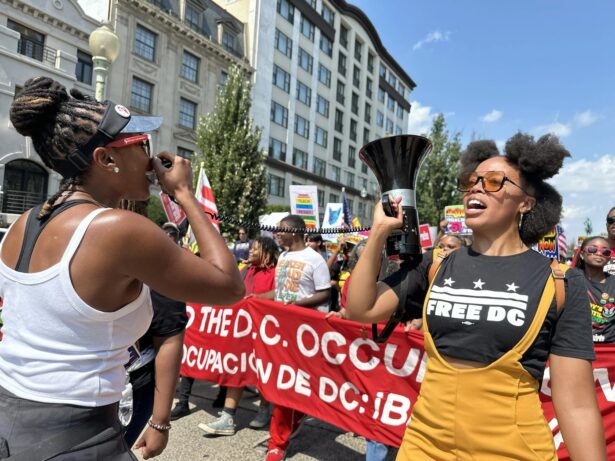
No Kings. On Oct. 17, No Kings is going to try something it hasn’t tried before. Instead of another mass march, the coalition is holding No Kings: Vote Early, a nonpartisan day of action in which communities will host block parties, BBQs and local protests to make a voting plan together and vote early where local rules allow. Organizers say it’s “not purely a protest,” but rather a nonpartisan action to encourage voter participation. The idea is to treat voting not as something we do alone, but as something we do together. I’m not old enough to remember it, but people used to go to the polls with their neighbors and make an event of it. This is bringing back that collective spirit.
(It’s easy to host. Go here for all the info you need by Thursday Oct. 15.)
Election Holiday. Another experiment is popping up for the Nov. 3 election — Election Day: Our Civic Holiday. This group (which I’m a part of) rests on a simple idea: treating Election Day as a day for showing love for democracy by doing our civic duty. Vote, help someone else vote, become a poll worker or observer, or find another way to participate in civic life. The idea is to translate that into a cultural vibe, like Valentine’s Day, but for a different form of love — love for democracy and our neighbors.
Sign Up for our Newsletter
We’ll send you a weekly email with the latest articles.
These are two experiments among many in how we protect elections in new ways under new circumstances. (I’ll be writing more about possible post-election actions later.) Neither solves the problem on its own, but both actions build on the understanding that stealing an election gets much harder when there’s a large blowout. Hungary is the reminder. As I wrote in April, Orbán’s defeat was so decisive that he conceded before all the votes were counted, with turnout near 80 percent, the highest since their transition to democracy. As Micah Sifry put it, it was “too big to rig.”
New tactics aren’t easy — and it’s worth reminding ourselves of that.
The trap of the winning tactic
Until now, No Kings has been known for one thing: enormous marches, each bigger than the last. Organizers put the first at five million, the second at seven million, and the third, in March, at more than eight million. When a tactic works like that, the pressure to keep repeating it is immense.
I’ve seen this up close. After Greta Thunberg began her Friday walkouts, Fridays for Future grew and grew. I was working with 350.org — a global environmental organization — at the time and we provided a lot of the backend technical support to help it grow. That growth created tremendous pressure and helped drive movement at the United Nations and in many countries. (You can certainly argue it contributed to the Inflation Reduction Act, which — despite significant cuts — has some parts that are still very active.)
But every tactic eventually peaks. As Saul Alinsky put it, “A tactic that drags on too long becomes a drag.” Suddenly an organization named for leaving school on Fridays needs to improvise — and that’s hard.
Student protesters asked me to write the Climate Resistance Handbook to try to assist Fridays for Future (and others) to break out of their tactical doldrums.
Occupy Wall Street hit the same wall. In Philadelphia, where we had an encampment outside of City Hall, my ears still ring with painful, shouted debates over whether we could do anything other than occupy. The argument largely won out that occupying is the thing that held us together — and like most occupations around the country (but not all!), we never tactically transitioned.
That’s the pull: The familiar tactic feels like the glue. The drive to stay the course is strong. And it takes a strong decision-making process to break out.
Many of us know this tactical challenge: endless weekly vigils and letter-writing with no changes. Worried about this dynamic in my anti-casino organizing group, I once made us promise we would only use the same tactic once — resulting in new tactics like citizen’s search warrants, Philly’s Ballot Box or the public filibuster.
So No Kings deserves congratulations for breaking the mold. Yes, many would love to see something more escalated that increases the level of risk-taking — but it’s worth just underlining how difficult it is to change course at all. So greeting this pivot with encouragement makes all pivots more possible.
The strategic logic
Why put so much energy into the election?
I’ve regularly argued there is so much more than elections. And Trump’s attempt at consolidation is happening in places where elections alone won’t save us. Take the military, where Defense Secretary Pete Hegseth plans to purge 20 percent of the military’s top leaders. He’s already blocked and purged many women and Black leaders. Many view his attempts as a long-term purge to keep control of the military. (The military is hardly defensive and has its own ways of pushing back — including the extensive leaking about the eight sailors in the USS Abraham Lincoln strike group who attempted suicide.)
But the elections remain critical both as a narrative (exposing Trump’s unpopularity!) and also because Congress (for all its faults) remains a key pillar in allowing the theft of congressional money, putting in radical judges, co-signing his corruption and so much more.
Trump knows this, which is why it is such important contested territory for him. In September, Trump led the crowd at the Republican National Convention in a pledge to “cheat like hell” (Newsweek claimed he was joking — but I’d say the intent is hard to dismiss). The Callais decision echoes widely as the single largest loss of Black political power in recent memory.
Trump hopes terror can keep us from voting. In March he signed an executive order restricting mail-in voting, and while courts have kept the restrictions from taking effect this year, the fear it stoked is already having an impact. Trump is adding more fuel by making up stories of noncitizen voting. Why? So he can actually steal the election. I lay out 18 ways the regime might take our votes away in this scenario guide.
If nothing else, remember that a 2028 election becomes far easier to steal with a willing Congress. You don’t need a strong imagination to picture a Trump-led Jan. 6 insurrection under current Republican leadership ending in a fully effective coup backed by Congress and the Supreme Court. That becomes much harder with a hostile Congress.
All of this brings us back to why the midterms matter and the context of why collectively voting early and supporting each other on Election Day matters.
Why turnout is protection
Mass participation can overwhelm a system and make the likely accomplices of would-be election thieves less willing to go along. Trump can try to control the narrative, but the mechanics of theft require a chain of accomplices: election deniers in the certification process, state actors, and behind them businesses and supporters who quietly approve. That’s why folks at May Day Strong launched the Business for Democracy Pledge. By signing on, businesses commit to oppose obstacles to voting and, if results aren’t honored, to close ranks in defense of the election. It pulls potential accomplices back before they cross the line.
Support Us
Waging Nonviolence depends on reader support. Make a donation today!
Donate
Then there are the efforts to recruit more voters, like the Oct. 17 Vote Early Day coming up soon — a chance to mix large-scale decentralized actions for an electoral good. Or the Election Day: Our Civic Holiday effort where we’re not asking for a federal policy change. We’re asking people to treat the day differently. Vote if you haven’t. Help someone else vote. Make it visible.
We’re trying to feed into the energy by reminding everyone to stay active on Election Day, Nov. 3, by:
- making sure you’ve voted, and that the people around you have too
- becoming a poll worker or nonpartisan observer
- joining Singing Resistance, Souls to the Polls, or Joy to the Polls, and meeting any interference with positivity
- connecting with rapid-deployment teams or people already at polling sites, not to confront ICE, but to redirect and escort voters so everyone eligible gets to vote.
You can share the word at election.holiday. Businesses can support the campaign by pledging to give their employees time off to do their civic duty through Time to Vote, the coalition founded by Patagonia. And if you’re still looking for roles to support the election, find them at We are Ground Control.
All of this is part of the pre-election plan: Get large numbers of people voting against an awful regime. There’s an abundant range of opportunities to help protect our election. I hope you find your role.