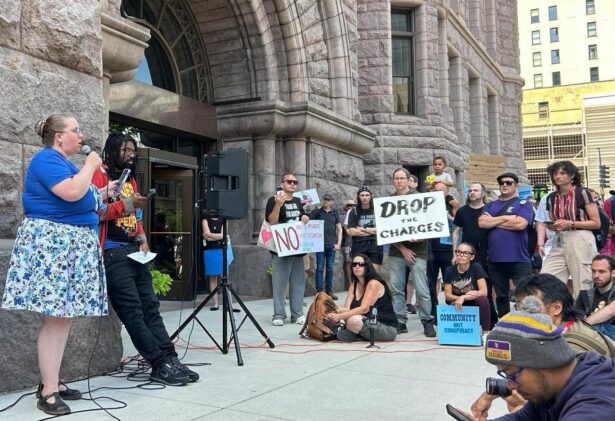
Protestors built a garden to blockade the road entrance to a key ICE administrative building in Williston, Vermont on October 6. (Shut Down ICE VT)
After Operation Metro Surge, the Trump administration moved to rein in the Bovino-style spectacle with its made-for-TV arrests. In an attempt to avoid another public outcry, Immigration and Customs Enforcement has quietly settled into a new rhythm.
Arrests have still increased month after month, reaching a record high of roughly 51,000 people taken into ICE custody in August. This is part of a new surge — carried out in hospitals, courthouses and airports — with an intent to stay off the nightly news. As TheNew York Timesreported, this phase is “captured mostly by grainy security camera footage, through cracked blinds and from behind closed doors.”
Perhaps surprisingly, much of the tech infrastructure driving ICE’s new surge is headquartered in … Vermont. The town of Williston, outside Burlington, is home to both ICE’s Law Enforcement Support Center, which houses the agency’s national tip line, and ICE’s National Criminal Analysis and Targeting Center, or NCATC, its social-media surveillance hub.
Sign Up for our Newsletter
We’ll send you a weekly email with the latest articles.
As ICE tries a new approach, this new phase of resisting ICE requires moving to more offense — and the people of Vermont are offering us some clear lessons.
Vermont resistance
Resistance started with the fight over flights. Early in Trump’s second term, activists documented ICE moving detainees onto commercial flights out of Burlington’s airport — more than 450 people as of mid-July 2025, by their count. They showed up in airports as witnesses and disruptors, sometimes aided by empowered flight attendants. They forced an ICE retreat: organizers say ICE hasn’t moved detainees through the airport in more than a year.
More recently they’ve gone after the hard infrastructure. Sit-ins at the White Cap Business Park in Williston, where the NCATC facility is located, have led to arrests for allegedly blocking the entrance to the ICE offices, including 11 people in February and 13 in July.
After those arrests came some unusual twists, which speak volumes about the courage it takes to refuse unjust orders and to continue protesting in the face of repression.
Complicity and noncooperation
Responses to authoritarianism are as old as a time — many of the same dynamics from Vermont show up in the ancient story of Pharaoh and Moses.
Undeniably the most powerful person in his land, Pharaoh was the ultimate authoritarian. His big trick was taking beautiful work and turning it evil. Take the work of midwives, whose job is to usher life into the world — he turned that work into ugliness by ordering the Hebrew midwives to kill every newborn boy.
But we all have a choice. And famously, several of the midwives refused. Their act of noncooperation with an unjust order is the reason Moses lived.
We are living through a moment when institution after institution is being turned toward evil. Some, like the Department of Justice, were already a mixed bag. But now it is being turned against the very logic of due process it claims to serve, as we’ve seen recently with the criminal indictment of whistleblower Cassidy Hutchinson. Other institutions, like the Environmental Protection Agency and the Centers for Disease Control and Prevention, are being perverted, with great resistance from insiders who cling to the key values that these agencies were founded on.
In Vermont, the local prosecutor, Chittenden County State’s Attorney Sarah George, faced her own choice. When asked to bring charges against the protesters who held the sit-ins, she repeatedly declined, citing limited resources. That makes sense: No one was harmed, and the protesters have a strong necessity defense — the argument that they were preventing an even greater harm. Every minute that ICE isn’t taking part in abducting people is good for the country.
In an op-ed, she said her hands were tied: “Justice must be blind or our system will fail.” Back to Pharaoh: This is a bit like a midwife in the next town over raising her hand to say, “I’d like to kill Moses, because that’s what the law dictates.”
Protesters recently unearthed relevant Vermont history — a model of state-level noncooperation. After the Fugitive Slave Act of 1850, which ordered cooperation with slave catchers, Vermont passed a state statute known as the Habeas Corpus Law. It effectively nullified the federal law, and went so far as to require state attorneys to defend anyone accused of being a slave, with full representation before a judge and a jury. The entire practice of nullification was deemed highly escalatory — so much so the federal government threatened military invasion — but due to the state’s resistance, throughout Vermont there was effectively no participation in the Fugitive Slave Act.
As in that case, the pressure from the federal government has continued. One week before a planned week of direct action, the federal government suddenly charged five people from the earlier protests with obstructing access to a federal facility (punishable by up to 30 days in prison or a $5,000 fine), likely hoping to deter further escalation.
We all have a choice: complicity with Pharoah or noncooperation. Despite the threats and new legal challenges, the protesters in Vermont chose the riskier, more liberatory path.
A funeral, a guerrilla garden and a sit-in
The week of direct action went on as planned, beginning with a funeral. On Oct. 5, more than 30 clergy led a procession of a hundred or so mourners who walked behind a hearse to the White Cap Business Park, singing “Amazing Grace.” They carried 95 paver stones, each representing a life taken by ICE — directly or from complications while detained — and placed them one by one in a handmade coffin of Vermont pine. The action echoed the Stolen Neighbors Quilt created in Minnesota, which remembers people who were deported. Here, names of those killed by ICE were read out. Then, in front of the doors of the spy center, the coffin was nailed shut.
A crowd gathers in Williston, Vermont on Oct. 5, behind a coffin filled with paver stones representing lives lost to ICE. (Shut Down ICE VT)
Rev. Marybeth Redmond said at the vigil, “I have walked alongside Vermonters struggling to survive, and I have never seen our immigrant neighbors so hunted, so afraid and so alone.”
In the end, it was a symbolic act. Security scattered the stones, and the property manager and others were seen taking crowbars to the coffin. But it was only the beginning of the week.
They affixed the boxes to the pavement with construction adhesive, painted and chalked them with flowers, insects and slogans, flew a rainbow kite, and by mid-morning, had gotten a full dance party going. The action blocked the road to 188 Harvest Lane, which houses ICE’s national tip line.
They were also highlighting the environmental violence of ICE’s data intensive operation. Gardener Isaac Petersen said, “ICE’s surveillance technology is extremely energy-intensive, much of it powered by AI and data centers. It harms our communities directly by targeting our neighbors.”
State and local police moved some barriers, but largely left the garden alone, which blocked the road for most of the day. ICE’s parking lots were nearly empty all day, and the rumor was that ICE was told to avoid coming into the office.
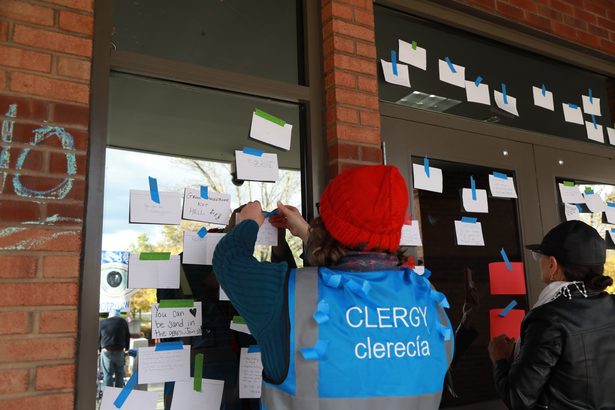
Protestors hang handwritten “tips” outside the ICE office housing the agency’s national tip line. (Shut Down ICE VT)
Each day escalated from the day before. By Thursday, protesters went right up to the front entrance of the Harvest Lane facility. Dozens had arrived before 8 a.m. to deliver handwritten note cards with “tips” encouraging ICE employees to find other jobs. The protesters started by taping those messages to the windows and doors. Then they hauled out a rug, a couch, a coffee table and a fold-up mattress — a makeshift living room — and sat down, singing and playing music, effectively shutting the place down.
Much of this has been intergenerational. Vermont protesters have ranged from people in their early 20s to an 83-year-old from Bethel and 85-year-old from Sharon.
Some of those sitting at the entrance this week had taken part in earlier acts of civil disobedience, and several now face charges brought by Clark.
Organizers say the ICE facility was effectively shut for much of that week, its parking lots empty. Police interference was minimal: At one point, officers came over only to remove the items protesters had used to block a surveillance camera, then returned to their cars. As the organizers said in their press release, “ICE employees went home rather than face Vermont’s week of bold, decisive action.”
As for Shut Down ICE VT, the group behind the week of action, they plan to keep going. One simple way to support them: Call the tip line that ICE runs out of Williston to encourage neighbors to turn each other in. To disrupt its activity, the group is encouraging people to call 866-347-2423 and tell whoever picks up all the different ways ICE could be making a better world. According to organizers, this tactic has been so successful the lines are clogged — one person was on hold for 2 hours and 18 minutes until her phone died. (This tactic was used in the early DOGE days.) Instead of doing Pharaoh’s bidding: What are the beautiful things you could be doing with your life? It can be a bit of a daily ritual.
Support Us
Waging Nonviolence depends on reader support. Make a donation today!
Because here, in the end, is Pharaoh’s trick: He changed the meaning of what was legal. He didn’t simply say, “You must obey me.” He said that if you refused, you were the one breaking the law.
But we should remember whose side the law has so often taken. The law stood against enslaved people seeking freedom. It stood against women having control of their own bodies. It stood against trans people claiming full autonomy. The law, by itself, is no defense against injustice — and must not be turned into an instrument of oppression.
Sarah George declined to prosecute protesters for a reason. By stepping in to take up the case, Charity Clark has signaled a willingness to participate in the repression. The people shutting down ICE in Vermont are on the right side of history. Let’s find ways to join them.
Thank you for your interest in republishing this story. You are free to republish it as long as you follow these four requirements:
Credit Waging Nonviolence and link to the original. We prefer with a note at the top of the article. For example: This article was originally published on Waging Nonviolence.
Don’t sell our material or edit it, unless editing to reflect relative changes in time, location and editorial style.
Use photos or images only if you are certain they are in the creative commons or have received permission from us. To do so, email: contact@wagingnonviolence.org.
Include our Matomo tracking pixel by copy-and-pasting this HTML code into the article:
Copy and paste the following into your page to republish:
Peace and justice organizations, as well as universities, publish their own independent content on Waging Nonviolence. This Community section offers just a sample of their latest stories. Visit their individual pages to see more.
Get Waging Nonviolence delivered to your inbox
Sign up for our weekly newsletter to get the latest in people-powered news and analysis.
Donate
Waging Nonviolence is a nonprofit organization and all donations are tax deductible.
To donate by check, cryptocurrency or other method, see our Ways to Give page.