The year is 1989 and I am gliding up the waters of a channel in the Morro Bay estuary in my kayak. With each stroke of the paddle, I approach the underpass of Twin Bridges which will bring me out of the briny salt and freshwater mix of this channel into the freshwater flow of Chorro Creek. The moderate tide-height impacting this channel allows me to advance under the two bridges; there’s just enough water to paddle through but not so much that I can’t fit under these low-hanging spans.
It is obvious to me that more sediment is coming down the creek from the watershed during rainstorms. That means the floor of the estuary is filling in making it difficult for plants that grow there to thrive. Underwater plants, such as eelgrass that brant geese and other waterbirds feed on, can only grow in water at certain depths and definite temperatures. I am not a scientist, but even I know excess sediment is a threat to the balance of the salt and fresh waters that make up this 2300-acre estuary.
Pollution is another problem as there are many cattle ranches and farms in the watershed and waste products from these places flow down through the creeks into the estuary.
Every day two ocean tides impact this estuary mixing with the two freshwater creeks that flow into it, Chorro and Los Osos. Every month two extreme tides bring saltwater up into the creeks. Both these creeks bring rainwater that falls miles up the hills of the watershed to the estuary to replenish it, keeping it healthy and not too salty. During winter months rainstorms are more intense, bringing more freshwater full of sediment and pollution into the estuary.
Maintaining a healthy mix of rainwater and salt water brings nutrients of vital importance to this estuary, one of the smallest in the country.
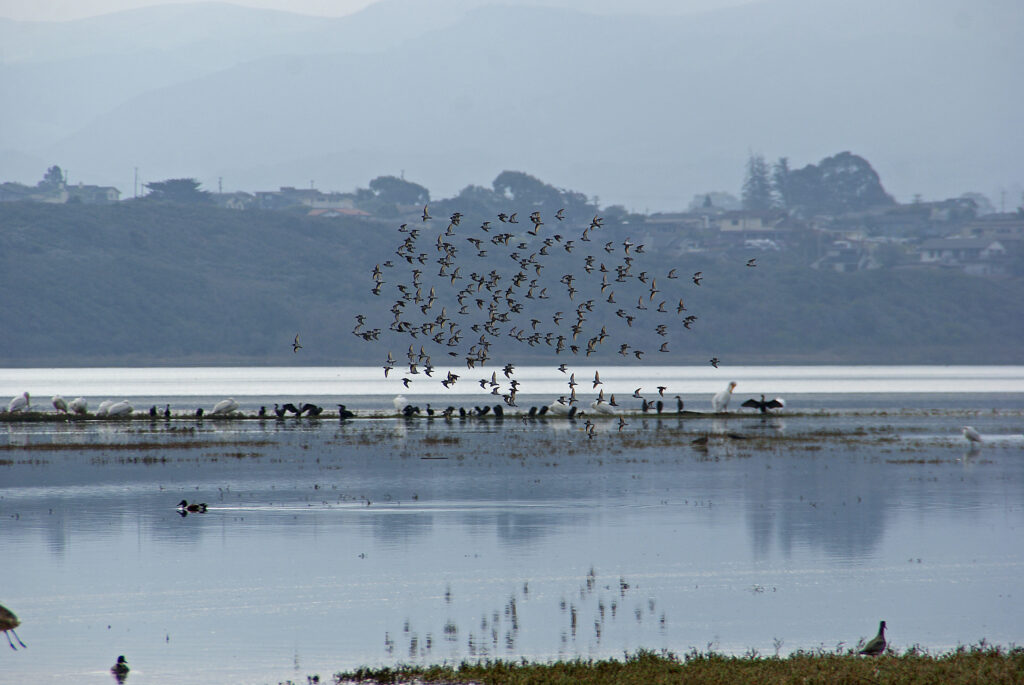
Thousands of shorebirds, herons and egrets feed on the vast expanse of the Morro Bay estuary every year, especially from fall through winter. Steelhead, or California Rainbow Trout — a fish similar in nature to salmon — that use the creeks as spawning grounds were considered threatened or near endangerment in the late 1980s.
For people who have spent time on the water here it is already obvious, as it is to me, that things are changing in the estuary, and not for the better. Many environmentalists were already aware of climate change in 1989, although it was not yet called that. We wondered what the future holds for the Morro Bay estuary.
Looking back to organizing
This section of the Central Coast of California saw a growth spurt through the late 1980s. People from Southern California who were fed up with the smog and traffic congestion moved to towns like Morro Bay, Cayucos, Los Osos, San Luis Obispo, Pismo Beach and Paso Robles. A similar exodus from cities like San Francisco, San Jose and Fresno brought people from those urban areas longing for a change.
Interestingly, these newcomers grouped themselves geographically by their political and philosophical differences. Republicans mostly settled in the north county towns of Paso Robles and Atascadero as well as upscale areas of San Luis Obispo and Pismo Beach. Democrats largely chose Morro Bay, Los Osos and the little towns of the coast. Regardless of belief, the attraction wasn’t just the relief from urban woes, but the ability to be close to the diverse and abundant wildlife in this beautiful natural area. No matter where one chose to relocate, they were only minutes from the bay and the lure of the estuary.
Though they shared a love of the bay, these were not people who got along or agreed on a variety of issues. This resulted in some very electrically-charged city council and county board of supervisor meetings. One might expect that groups like these would never be able to work together on anything. Organizers knew they would have to manage tensions and defuse the sparks. Feelings ran especially high on any issue affecting the new life these newcomers now enjoyed.
As I look at the divisiveness existing in this country in 2024, it’s hard to believe that ultimately these groups of diverse people put aside their political, philosophical and religious beliefs for the common good of all, resulting in one of the most successful grassroots movements of this small rural area. It seems that when it came to the estuary at Morro Bay, all were in agreement.
Where to begin and how
As organizers began to see the impacts of climate change in our own backyard, the question wasn’t whether we could save the Morro Bay estuary in time; the question was if we were going to be able to do so at all. To achieve success, we had to work together to convince the federal government’s Environmental Protection Agency, or EPA, to allow Morro Bay to join the National Estuary Program.
The National Estuary Program, or NEP, is a non-regulatory program of the EPA, that works with local communities to develop and implement Comprehensive Conservation and Management Plans to address water quality, habitat and living resources challenges. Congress established the National Estuary Program through amendments to the Clean Water Act in 1987.
Organizers knew that the EPA provides grants to local NEPs (each estuary has its own local estuary program) to develop and implement their Comprehensive Conservation Management Plans. There are also grant funds that require a match of equal dollars. Access to these funds could significantly improve conditions of the Morro Bay estuary. Additionally, the NEP involves a variety of stakeholders including the EPA and other federal agencies, state and local governments, Native American tribes, local industry, academia, nonprofit organizations and the public. Everyone would need to be involved to create lasting change.
A small group of scientists and folks who worked at the Regional Water Quality Control Board got together to discuss how they might be able to achieve their goal and formed a task force. While gaining entry to the National Estuary Program didn’t guarantee any regulatory protections, membership would allow for the gathering of data on the health of estuary and the watershed. It also opened the possibility of funding projects that would enhance water quality and if not stop, at least slow down the destruction.
In 1989, there was not much known about water quality and habitat in the Morro Bay estuary as no data had ever been collected. The only indication that something was amiss was what ordinary people who either worked or played on these waters could see with the naked eye. More information was necessary, and it was vital to share that information with the people who cared about this land.
During the mid-1980s, Steve Eabry, director of the Interagency Morro Bay Task Force that was formed to study the estuary situation, invited the public and members of area environmental groups such as Morro Coast Audubon Club to talks informing attendees of the dangers facing the estuary’s future.
Those talks informed the public how 10 times more sediment than natural was flowing down through the creeks into the estuary from the 75-square-mile watershed. That — combined with the ever-increasing drift of sand from the dunes on the sandspit that keeps the ocean from intruding into the inner bay — was raising the floor of the estuary, clogging plant life, and damaging acres of salicornia affectionately known as pickleweed.
Estuaries and marshes were considered wastelands in most areas of this country and have been dredged and drained to make way for development, a threat here too making Joni Mitchell’s song lyrics “We paved paradise and put up a parking lot,” the groups’ theme song.
Highlighting the dangers of sacrificing this natural area for development, Eabry and the task force told of the importance of the estuary as nurseries for fish that become commercially viable catch in the ocean, and feeding grounds for over 200 species of birds that frequent the area.
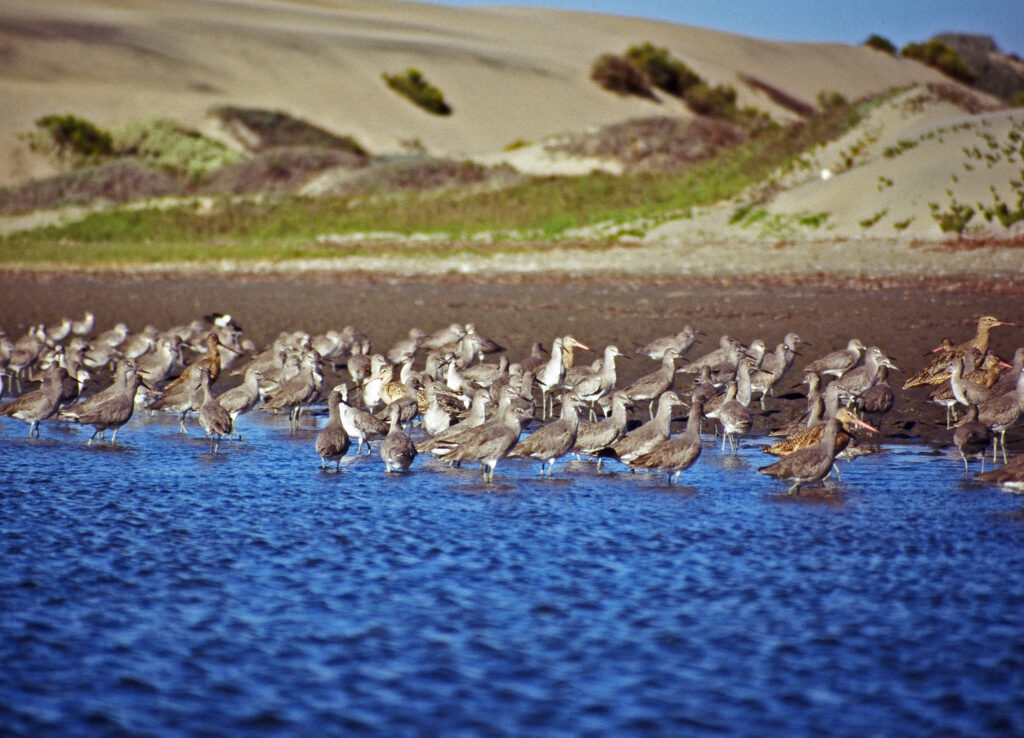
Birds indicate the health of the environment and waterfowl, herons, egrets, pelicans and shorebirds depended on these marshy waters for the food necessary to keep them in good breeding condition. Brant geese often numbered more than 4,000 birds and fed on rich strands of eelgrass. The area was also home to several endangered birds, including the peregrine falcon.
Knowing now how important it was to take action for the estuary, there still was the question as to how to join the NEP.
Jean Cartwright, a member of Morro Coast Audubon voiced the solution that everyone was looking for. “We need an advocacy group,” she said. Thus was born the spark of an idea that formed into the development of Friends of the Estuary.
Formation of an advocacy group
Dava Paradies, a scientist who worked closely with the Regional Water Quality Control Board became the first president of the Friends of the Estuary. The idea was to offer group membership throughout the county and to ask these members to lobby our congressional representatives, state senators and assembly members, county supervisors and the governor, as well as the hierarchy of the EPA to allow Morro Bay to become part of the National Estuary Program.
We planned to create a 501c4 nonprofit that would allow the lobbying needed to push the request forward. Costs to obtain nonprofit status were not cheap so fundraising was needed.
“You really couldn’t go wrong with a membership in Friends of the Estuary,” I commented years later, “it only cost $5.00.”
The organizers who had seen disagreements arise with this diverse political population were left to wonder — would people sign on and take membership and do the work?
The word went out.
“I really didn’t think we would draw people from outside of the Morro Bay area,” commented Bill Newman, who went on to become the second president of Friends. But membership requests came from all corners of the county, state and country as both residents and visitors had a stake in the future of the estuary.
Two thousand people joined right away.
In a short period, the group raised $10,000 and membership grew by hundreds as word of the organization grew. Volunteers from all sides came together to write letters, make phone calls or do any of the mundane chores that organizers needed to accomplish. Bud Laurent, then local county supervisor for Morro Bay, joined and so did Rep. Leon Panetta. Journalists wrote articles and the story was carried in papers back in those urban cities that most of the volunteers had escaped from. The Friends held fundraising barbecues at California State Park camping sites. These gatherings not only attracted new people to the cause but reinforced the bond that members of Friends held with each other. For once, politics didn’t matter, neither did religious or philosophical beliefs. It didn’t matter where you were from, what your sex or race was, or your education — everyone was equal in their love for an environment that is often misunderstood.
It didn’t happen overnight
Putting together the nonprofit for Friends of the Estuary required a lot of work, especially with membership and funds involved. Then there was the planning as to how a Morro Bay estuary program would work. Organizers formed the Bay Foundation in 1990 to manage the financial side of things. They also decided to apply for 501c3 nonprofit status for the eventual Morro Bay National Estuary Program to safeguard against loss of the program should any adverse political action be taken against the EPA. Their forward thinking benefits us now with the promised changes to the EPA with the new administration in 2025.
Scientists and others began to write the management plan that would be included with the application to the EPA. It was a collaborative approach with residents, ranchers and landowners, the Land Conservancy, California State Parks, and California Fish and Wildlife. The first State of the Bay Conference was held at Morro Bay in 1990 and 1,400 people attended.
More than once, the application was turned down. The EPA was only interested in large restoration projects on large estuaries. But belonging to the National Estuary Program would give opportunities to obtain grant money and other funding for the necessary conservation work. Everyone went back to the drawing board to craft a better appeal. More work was done lobbying to obtain as many endorsements and funds as possible. The Friends won a major success lobbying California’s Republican Gov. Pete Wilson. Ultimately, he took a bold stance for the campaign by making Morro Bay the first ever California State Estuary in 1994.
Organizers Dave Paradies and Karen Worcester of the Regional Water Quality Control Board, who were the primary people writing the application, finished the last copy of the plan at the 11th hour as they drove feverishly down to Los Angeles for a last meeting of the EPA.
On July 6, 1995, Morro Bay was accepted into the Environmental Protection Agency National Estuary Program as the Morro Bay National Estuary Program.
Since then, a successful Volunteer Monitoring Program was established to monitor and accumulate data on water quality in the estuary. This was made up of a corps of volunteers — many from area schools, and the California State Polytechnic University.
Elementary school education programs and community gatherings continue to help people understand the issues facing the estuary, especially regarding climate change.
The “Mutts for the Bay” program that supplies free “poop” bags for people walking the 5,000 dogs in the area yearly collects 19,000 pounds of waste.
Ongoing eelgrass studies have helped turn around a 90 percent eelgrass decline that occurred from 2007 to 2012. Much conservation work is ongoing with area ranchers and farmers to keep cattle out of the creeks and eliminate the use of polluting pesticides and fertilizers.
There are now 27 years of data on the conditions of the creeks where water quality in the estuary and bay has improved, indicating a rise from very poor oxygenated water to poor. More work continues to raise this rating from poor to good.
While sedimentation has improved, this is an ongoing situation as sediment will always naturally enter the estuary. Sedimentation levels are different in a variety of sections of the bay and estuary.
The Morro Bay National Estuary Program works with landowners in the watershed on projects to reduce erosion and trap sediment before it can degrade downstream habitats. Climate change and sea level rise pose a paradigm shift for tidal marsh habitats. Climate models indicate that tidal marsh elevation gains will not keep pace with sea level rise. This could mean that higher water levels will swamp the high marsh habitat, converting it to mudflats by the end of the century.
Bird populations have remained stable with thousands of geese, ducks, shorebirds and more spending time feeding and resting in the estuary and on bay waters. Some birds are facing more difficult situations due to climate change and are altering their behavior.
Today, Morro Bay is considered to have the most diverse marine wildlife on the west coast of the United States. Large rafts of sea otters have taken up residence in the bay since the inception of the MBNEP. Scientists believe that this is because better and more abundant food is available to the otters here. Where it was once hard to spot one or two California sea lions, many now use Morro Bay as a resting place. Harbor seals haul out on exposed mudflats in the estuary to rest and give birth.
Grassroots success
Inclusion in the EPA National Estuary Program was certainly a significant part of what saved the Morro Bay estuary, but the real success was won by grassroots effort. The victory was won by bringing together an array of people with vastly different ideologies and beliefs to work for something in agreement. It opened dialogue and proved that we can move outside of our prejudices and opinions and put aside our differences to achieve a better world. We found out we were not as different as we thought we were. If we can do this once, perhaps we can do it again as we struggle to find ways to conquer the threat of climate change. For this, we must.
Supervisor Bud Laurent said it best: “It really took a village.”
In 2015, while being interviewed for the 20-year anniversary of the MBNEP, I suggested to filmmaker Simo Nylander and writer Tom Wilmer, that the history of this group would make a good film. The resulting 20-minute film, “Of Marshes and Morros” was wildly popular and won first place for Best Documentary Short at the San Luis Obispo International Film Festival. It went on to win Best Documentary Short and Best Cinematography at the Los Angeles International Film Festival and won the Outstanding Achievement Award from the Whitehead International Film Festival. It is available for viewing here (scroll to the end) and on YouTube.