At the third World Women’s Conference held Sept. 4-9 in Tunis, Tunisia, its congress of delegates from 42 countries voted to adopt a resolution calling for the United States to be removed from its permanent seat on the UN Security Council. This followed an opening march and demonstration hosted by Tunisian women’s rights organizations — in which 600 women took to the streets — and a conference attended by 450 women representing grassroots organizations from across the globe.
The World Women’s Conference, or WWC, is a growing international movement and platform of grassroots women, including peasants, laborers, homemakers, and activists committing to anti-imperialism, anti-facism, and subverting patriarchy. It grew out of feminist liberation struggles in the 1970s and ‘80s, which led to the first conference in Venezuela in 2011.
Citing flagrant and sustained violations of the UN Charter, international laws, resolutions, treaties, covenants and conventions, the WWC adopted a resolution put forth by the United States delegation calling upon the UN General Assembly to “reform or dismantle the so-called ‘Security Council’ which uses its veto power to control, dominate, exploit and destroy the world for material and geopolitical gain.” This resolution called upon the U.S. empire in particular to abide by international law and was passed following the conference’s multiple workshops on ending imperialism and patriarchy. As a result of this process, the United States was named the largest purveyor of militarism, violence and destruction impacting women, grassroots communities and the environment throughout the globe.
The UN General Assembly created the Security Council as an organ of the international organization in the aftermath of World War II. Established months after its inception in 1945, the Security Council was charged with “ensuring international peace and security, recommending the admission of new UN members to the General Assembly, and approving any changes to the UN Charter.”
Unlike the General Assembly, which provides member states with equal power, the victors of World War II — the United States, the Soviet Union, China, the United Kingdom and France — gave themselves permanent seats on the 15-member Council and veto power, while the other 10 seats are filled by other countries for two-year rotations. “This undue power and influence of the five permanent members of the Security Council, and the United States in particular, flies in the face of the UN’s raison d’être,” said Chrissy Stonebraker-Martinez of the Fellowship of Reconciliation, or FOR-USA. Stonebraker-Martinez is also co-director of the InterReligious Task Force on Central America and Colombia — one of the members of the U.S. delegation, which drafted and proposed the resolution to the WWC with the support of delegates from the International Women’s Alliance based in the United States.
The U.S. was faulted with abusing its political, economic and military clout to usher in the emergence of a world system in which new imperialist countries, such as Israel, Saudi Arabia, the United Arab Emirates, and Morocco, are dependent on its neoliberal enterprises and arms sales. Delegate Ayla Chej from the Western Sahara expressed exuberance at the resolution, stating that the UN Security Council has enabled and turned a blind eye to Morocco’s brutal occupation since 1975 in spite of issuing numerous resolutions calling for the self-determination of the Sahrawi people. While noting that the Security Council is supposed to be neutral, Chej pointed to the U.S. support Morocco receives in its brutal occupation and ethnic cleansing of the Sahrawi people. Of the five permanent members of the Security Council, she deemed the U.S. “the worst,” as it has sold billions of dollars in weapons to Morocco, “which are used to suppress and torture the Sahrawi people.” At the same time, Chej called the UN peacekeeping mission in Western Sahara “a joke.”
Mariam Abu Daqqa, delegate from Palestine, expressed similar support for the resolution, stating that “Israel cannot get away with what it is doing, its genocide against the Palestinian people, without the support of the United States [at the UN].” Meanwhile, a German delegate championed the resolution as a step forward in addressing the root causes of empire and world domination, noting that “Until the powers-that-be, including NATO, are dismantled the potential for nuclear war will increase and forced migration, climate change, and poverty will get worse.”
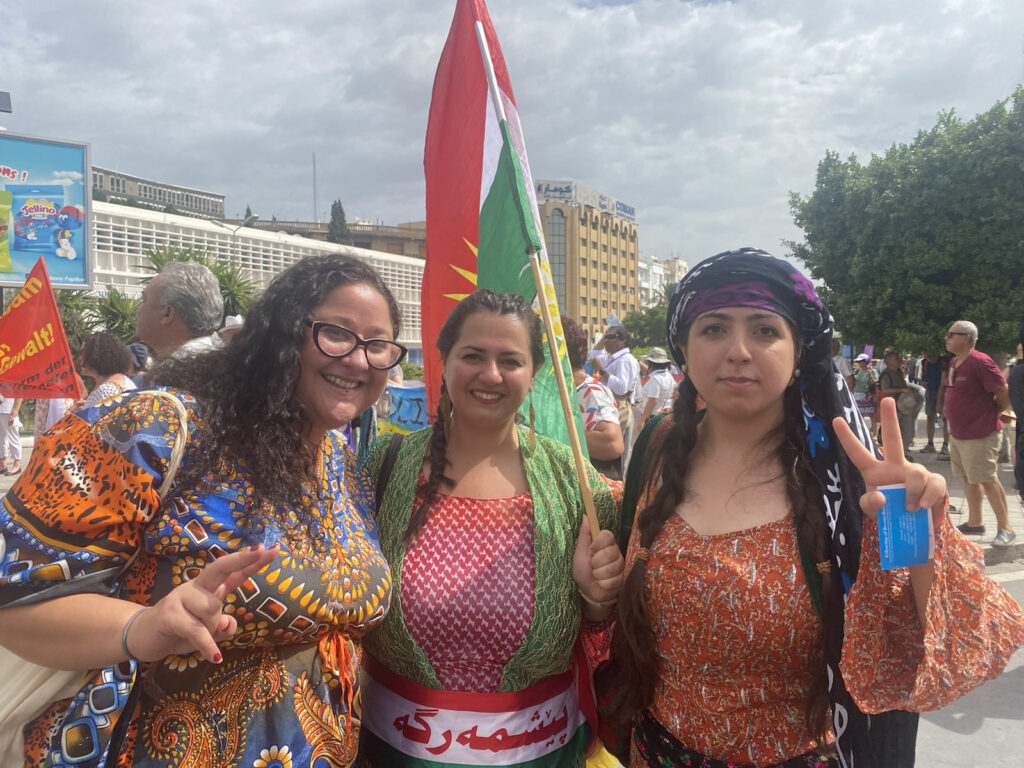
“It was an honor to be one of the five first-ever U.S. delegates to the Congress,” said Stonebraker-Martinez, noting that no U.S. representatives had attended the first two WWC international summits in Caracas, Venezuela in 2011 or Kathmandu, Nepal in 2016. In addition to providing the WWC with a country report, the two FOR-USA delegates presented a workshop titled, “The U.S. Empire: Its Horrific Legacy and the Need to Dismantle the So-called UN Security Council.” In that report and workshop, FOR-USA laid out the horrific legacy of genocide, slavery, mass incarceration, immigration detention, police brutality, extrajudicial killings, and other forms of state violence committed by the U.S. empire against the people of Turtle Island for the past 400 years.
Stonebraker-Martinez said that many were surprised to learn the degree to which Black, Indigenous and other marginalized groups, especially women and the LGBTQIA+ community in the U.S., are oppressed, exploited, and don’t have autonomy over their own bodies. “Many did not know that abortion is now illegal in 26 states,” they said. The U.S. delegation also discussed the phenomenon of mass shootings, which occur on a daily basis in the United States, in a tragic, relentless pattern suffered by no other society in the world. Stonebraker-Martinez attributed this phenomenon to the normalization of violence, murder and warfare by U.S. society, politicians and the media. “Young people who are socialized as men in particular have internalized these values as part of their identities. As Malcolm X would say, ‘The chickens have come home to roost.’”
Ultimately, the WWC’s focus on dismantling empire and patriarchy through mutual relationships and reciprocity demands women be front and center in a new system of non-hierarchical diplomacy not only within their communities of origin, but at all levels of society including the United Nations. As Stonebreaker-Martinez said, part of this mandate for systemic overhaul of the UN system and Security Council in particular is reparations, holding countries like the United States accountable, and the need to “acknowledge harm and guarantee non-repeat through reparations and common security for all.”