Eisha Mason was organizing a series of programs on nonviolence in Los Angeles in the late 1990s when she asked Rev. James Lawson to be a speaker. Lawson, who is best known as a leader of freedom movement activities in Tennessee in the early 1960s, turned her down. When Mason followed up with enough explanation to be taken seriously, he agreed. Thus was launched a series of monthly workshops that went on for years.
The process “took on a life of its own,” said Mason, who directed the Common Peace Center for the Advancement of Nonviolence in Los Angeles. Students, labor activists, members of the faith community, and others would show up, sometimes just once, sometimes again and again. Drawing on seven decades of experience as an activist, teacher, trainer and leader, Lawson would use video, lecture, exercises and case studies to help his students think more clearly about how to plan and carry out nonviolent campaigns.
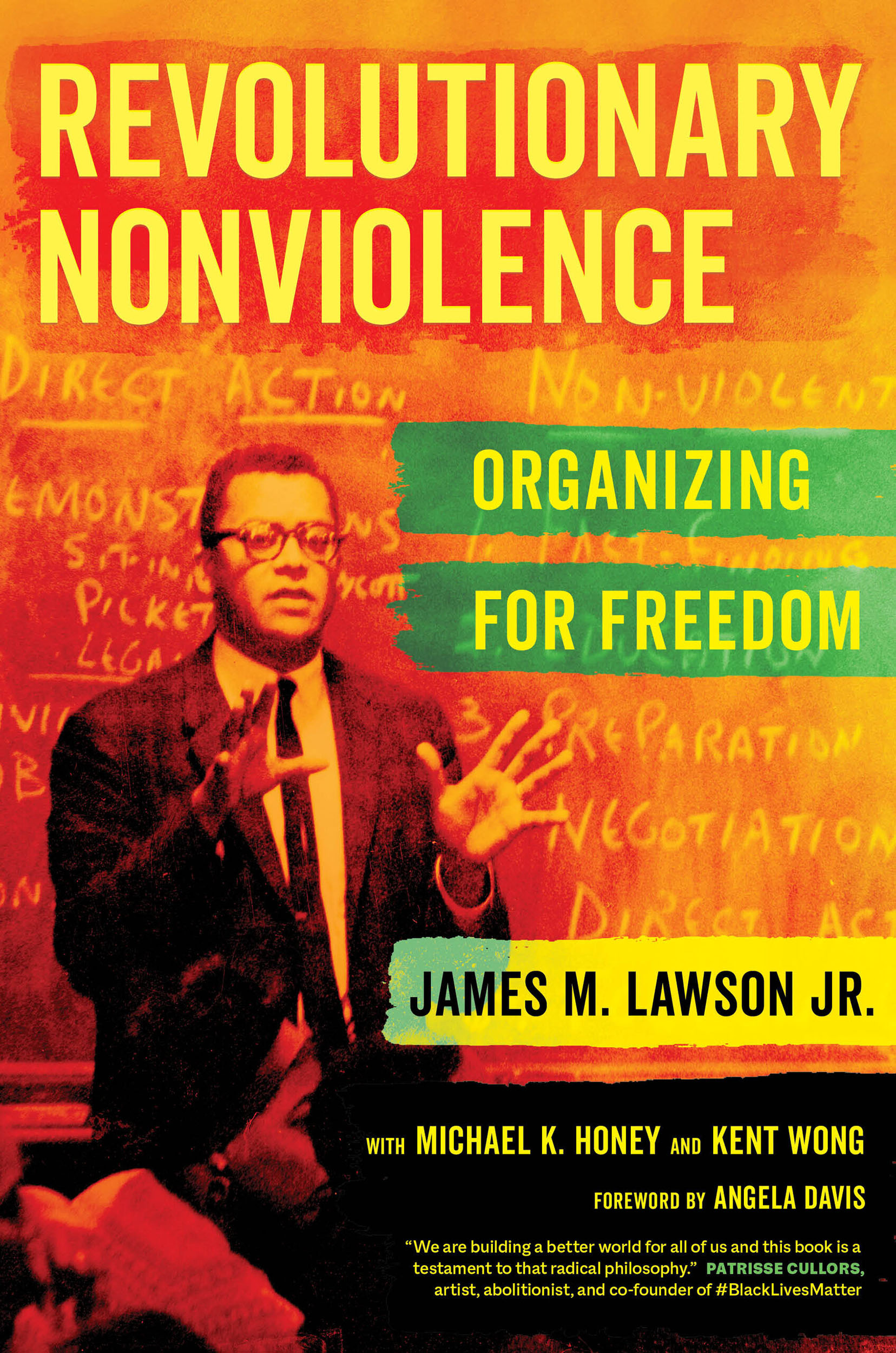
Since I live a few thousand miles from Los Angeles, I’ve never been able to attend. That’s one reason I was glad to read “Revolutionary Nonviolence: Organizing for Freedom,” a short book based on Lawson’s lectures with help from Michael Honey and Kent Wong.
Rev. Lawson wants us to think big. What would it take to overcome the power of the gun lobby and reduce violence committed with firearms? What would it take to transform American health care to achieve a single payer system outside the control of profit-driven insurance and pharmaceutical interests? How can workers overturn what he calls “plantation capitalism?” How can we achieve significant cuts in the amount of money the federal government spends each year on war and preparation for war?
He doesn’t have answers. What he offers instead, in the new book, is a huge helping of wisdom. Lawson also offers a method, derived from Gandhi, King, and his own experience in movements for freedom, peace and economic justice.
According to a short biography by Wong included as a chapter in the book, Lawson’s first lunch counter sit-in was in the 1940s, when he was a high school junior in Ohio. Exposed to A.J. Muste and Bayard Rustin in college, Lawson showed his serious commitment to the nonviolent way when he refused induction into the military and spent 14 months in federal prison. Following his release, Lawson went to India to study Gandhi. It was in India that he read about the Montgomery Bus Boycott and decided to return to the U.S. Lawson’s plans to finish graduate study and later head for the segregated South were put on hold when Dr. King told him to “come now.”
Describing himself as “a troubleshooter,” Lawson spent months crisscrossing the south, including significant time in Little Rock aiding the movement for school desegregation before he settled in Nashville. There, he began months of community meetings, study and workshops leading up to the sit-ins that challenged the exclusion of African Americans from downtown lunch-counters.
But desegregating lunch counters was not the point, he insists. “We did not set out to do a sit-in. We set out to desegregate downtown Nashville,” a goal the community agreed upon based on the testimony of Black women who were fed up with American apartheid. Exactly how much time went into preparing for the campaign’s direct action phase is a little unclear. In one lecture, Lawson refers to four months of workshops and, in another, to nine months of strategizing and analyzing. However many months it took, his point is clear: A serious campaign cannot be developed overnight, but must be based on a serious commitment. Lawson also stresses that the sit-ins were just the first phase of the campaign, which went on for 10 years.
To carry out what he terms “protracted struggle,” Lawson teaches a four-step methodology, two steps fewer than King’s but covering essentially the same ground. For Lawson, step one is “focus,” a term he uses to describe the analysis, community building, community education, and training that are needed to develop a winning strategy, which should precede direct action and enable the adoption of nonviolent discipline.
“He really emphasizes discipline” Mason said. “And that it never happens overnight. You know that you invest 10 years in something like when the labor movement exploded in L.A.” The important part — which Mason said she learned from Lawson — is what happens “before you go into the street.”
In an interview for “A Force More Powerful,” Lawson said “You cannot go on a demonstration with 25 people doing whatever they want to do. The difficulty with nonviolent people and efforts is that they don’t recognize the necessity of fierce discipline and training and strategizing and planning and recruiting and doing the things that you need to do to have a movement. That can’t happen spontaneously, it has to be done systematically.”
Lawson wants activists to think in terms of campaigns, not one-day protests or marches. “The march may be the weakest tactic, not the strongest,” he observes. “It may be the easiest for helping the adrenaline to flow with a lot of people, but it’s an adrenaline that is too quickly drained out of us.”
Focus means “you have to pick one thing,” said Mason, describing what she had learned from Lawson. You need to figure out “the most impactful thing that you think you can affect, and then have the discipline to work that thing.” For Lawson, that “thing” will be local. “That’s where you build the power base,” Mason said.
Step two is negotiation with those standing in the way of justice. “You must let the folks in power you are talking to know that you are planning a protracted struggle — not one demonstration but many,” Lawson says. All the activity associated with the focus phase should continue while negotiations go on.
Step three is direct action, without abandoning the elements of steps one and two.
Finally, step four is follow-up, which includes monitoring implementation of whatever agreements have been reached, planning next steps and attending to necessary healing.
Lawson’s lessons are illustrated with recollections from several of the movements in which he was deeply involved, including the Memphis sanitation workers union drive, anti-apartheid campaigning in South Africa and the resurgent labor movement in Los Angeles, where he has lived since 1974. The book blends lectures, stories, oral history, interview, memoir and biography, all in a manner that held my attention. It’s not a long read.
Neither is it a how-to manual or a history. Think of it more as a collection of inspirational talks, which for me served as a complement to other sources, such as the Nashville segment in “A Force More Powerful” and Michael Honey’s 2018 book, “To the Promised Land: Martin Luther King and the Fight for Economic Justice.”
“I think we have to lay the seeds by which we can take government out of the hands of the oligarchy and out of the hands of the military and put it back into the hands of truth and the beloved community. That needs to be our goal in the 21st century, and I think it’s a goal that we can achieve if all around the country ordinary people get involvedt” says James Lawson. That means protracted struggle waged by a strategic and disciplined nonviolent movement, not just a series of marches or “click here” action alerts. Lawson doesn’t tell us exactly how we can organize “a massive nonviolent movement to out-organize the forces of systemic racism and violence,” but his lessons can help us find the way.
Now in his 90s, Lawson is still speaking and teaching. At his workshops, “There will always be a moment where he would just be casually talking. And he’d share a piece of history that you knew was not in any book,” Mason said. If you’re in L.A., maybe you can attend. You can also check out the annual workshops offered by the James Lawson Institute.
I probably won’t get to have that experience, but at least I’ve got a copy of “Revolutionary Nonviolence.”