In “normal” times, bulldozers are vehicles designed to assist construction sites. Bulldozers are not primarily instruments of death and genocide. In the Academy-award nominated best feature documentary film “No Other Land”, however, the bulldozer is an instrument of horror and evil.
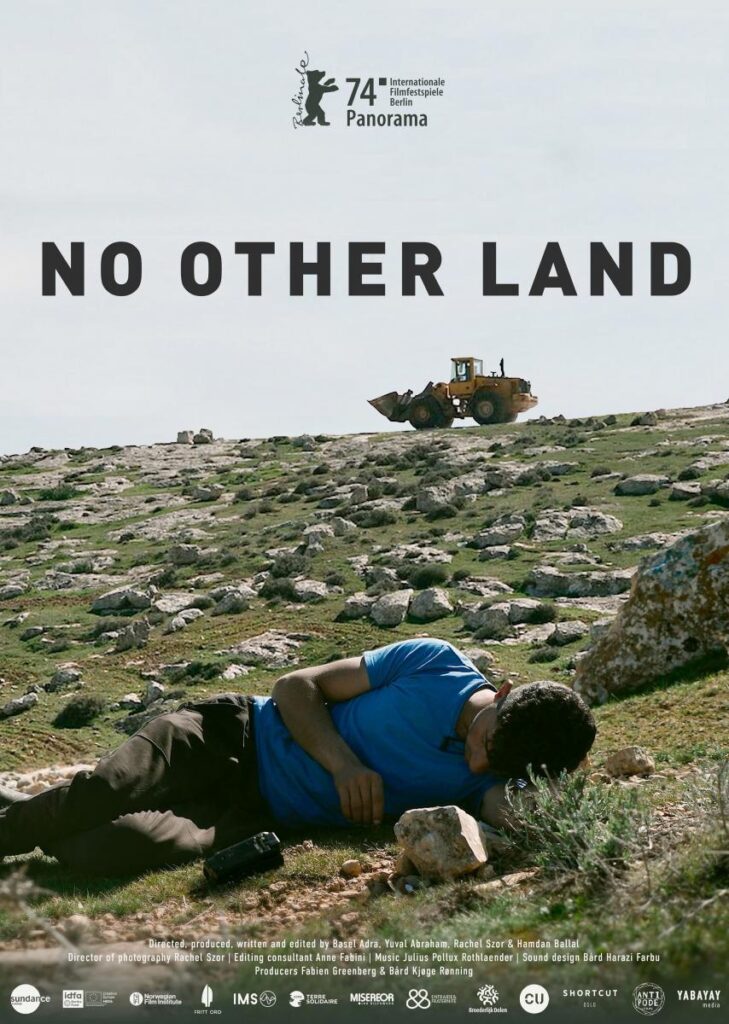
“No Other Land” is the story of contemporary Masafer Yatta, a collection of 19 hamlets and communities in the southern region of Palestine, near Hebron in what is now the West Bank. Recognized as inhabited Palestinian land since at least the late 1800s, the area has been under Israeli occupation since 1967, under particular attack since the 1980s, and an especially contested site over the past decade. The Israeli Defense Forces, or IDF, under the pretext that this land is now a military training area, bulldozes homes, schools and every sign of life. The Palestinian families who have been rooted there for generations argue that there is no other land for them to go to; it is almost impossible to obtain permits to build and live anywhere near their traditional villages. The Palestinians rebuild; the Israeli army re-bulldozes. Such is the cycle of life, and — as the documentary poignantly reveals — of unnecessary and bellicose death.
Some of us remember the settlement area in South Africa’s Western Cape called Crossroads, which is now one of Greater Cape Town’s largest townships. In the 1980s, as the anti-apartheid movement was growing by leaps and bounds, both within South Africa and internationally, Crossroads came to international attention when what was seen as a temporary area was flattened by bulldozer despite outcries from the United Democratic Front and mainstream church and human rights groups. The people of Crossroads rebuilt. The South African Defense Forces re-bulldozed.
The cycle continued in an unmistaken fashion, jarring to anyone involved in those days and viewing this modern film, which is written, directed, and expertly edited by Basel Adra, Hamdan Ballal, Yuval Abraham, and Rachel Szor. Some of us remember Rachel Corrie, a U.S. student activist and Christian. Along with her secular Jewish anti-Zionist Israeli professor, Corrie helped lead an International Solidarity Movement delegation to Israel/Palestine in 2003. She was killed by an Israeli bulldozer that ran her over when she was trying to block their demolition efforts. And now, IDF bulldozers have become a symbol of death in Lebanon and elsewhere.
There are many important differences between the South African situation then and the Palestinian situation today. But there are some striking similarities as well. Simple acts of steadfastness and survival as methods of resistance and mobilization are among the inspiring parallels. But there is another ripple from the past to the future, perhaps most important for an international audience. In the middle of Crossroads was a medical clinic, a living testimony to building healthy, creative alternatives in the midst of racism, settler colonialism and military might. Like the building around it, the clinic was destroyed on several occasions and rebuilt by the community and their supporters. A key component of the Crossroads clinic was its doctor, Ivan Toms. In addition to being a well-respected physician, Toms was also a leader of the End Conscription Campaign — dedicated to support those drafted into South Africa’s military service who refused to join and fight their neighbors. Toms, you see, was white.
In the middle of the sometimes-precarious filming of Palestinian demonstrations, Israeli attacks and late-night rebuilding, Israeli journalist Yuval Abraham enters the scene. By the end of the movie, one has not only been educated through documentary filmmaking but witness to what often feels like a traditional “buddy movie” as Basel Adra and Abraham become like brothers in more ways than one. The work to tell the story of — and to safeguard and empower — the people of Masafer Yatta becomes a joint project. The responsibility, and contradictions, of the privileged Israeli in the middle of a violent, often brutal, imperial occupation are explored with greater sensitivity than many books, articles and other reports of contemporary Palestine display.
Like Ivan Toms in Crossroads, Yuval Abraham is in no way the “hero” or the center of the story. But the potential and powerful dynamic of alliance-building and solidarity are not unimportant side-stories either. In the growing consciousness of Israeli society, like white South Africa before them, there is a window, however small, of strategic hope and possibility.
The most significant hope for Palestine is the continued and diversified resistance of its own people. And, for the international community, solidarity with Palestine has to mean increased support for this resistance — and a hoped-for future that goes beyond the neoliberal transitions that saw the end of political apartheid in South African alongside the strengthening of economic apartheid. A growing number of Jews — Israeli and otherwise — against genocide, occupation and the ever-expanding Zionist project, must be an important element of this resistance. They/we must be in favor of Palestinian human rights, freedom and liberation, under the leadership of the Palestinians, as Yuval is clearly under Basel’s leadership on this land.
Our crossroads today centers around growing that international consciousness and concrete solidarity, so that “never again” genocide becomes more than politicized, one-sided rhetoric.
In an interesting perhaps simple twist of fate, this year’s Oscars has many notable cues and clues. In competition with “No Other Land” is “Soundtrack to a Coup d’Etat,” the extraordinary story of resistance to French colonialism in Africa and support for Patrice Lumumba and the Pan African movements of the 1960s. In the Best Original Screenplay category are two Holocaust-related films, “The Brutalist” and “A Real Pain” — two starkly different films, both centered on Jewish survivors/descendants of Nazi genocide and fascism. The less celebrated and nominated of the two, “A Real Pain,” portrays in beautiful lyricism the legacy role of people of Jewish descent today.
In a world of Christian Peacemaker Teams (recently renamed “Community” Peacemakers), the long-dedicated institution-building of direct, on-the-ground partnership, accompaniment, and solidarity with grassroots Palestinian communities has been vital but small. Perhaps now is a time for greater explicitly Jewish Peacemaker Teams, donning large yellow “Jude” Stars of David, as ACT-UP popularized the Nazi pink triangle as a symbol of LGBT resistance. It is time for global solidarity to be as inclusive, broad, creative, joyful, culturally appropriate and militant as ever. Working under and alongside Palestinian leadership has got to mean careful listening, sensitivity and humility, as Yuval Abraham displays in “No Other Land.”
Our crossroads must not be met with a woe that suggests that all is lost and the fascist elements that sometimes seem to surround us, more resilient than ever, will always have the upper hand. Our crossroads must not be buried under so much rubble and the rage about the rubble, but rise up like so many Palestinians, without hatred but with visions of a peaceful future.
One especially striking part of “No Other Land” is when Adra teases Yuval that he wants and almost expects the occupation to end in 10 days (after his excellent journalistic reports), so he could go home to his “normal” life. This struggle, Adra reminds us, has been going on for decades, and requires both patience and flexible, strategic campaigning to meet both short-term and long-term goals.
The international solidarity movement would do well to take heed of these perspectives, whatever the outcome of the Oscars. We would do best to learn quickly from the many sources of direct information from many organizations and friends in the West Bank, Gaza and in the Palestinian diaspora, filtering out so much U.S.-centric propaganda that does little to reveal the actual needs and viewpoints of those at the center of the struggle. “No Other Land” is one such source, now easy to access. Our crossroads must be met by developing deeper relationships and more direct camaraderie with others.
In competition with “No Other Land” is “Soundtrack to a Coup d’Etat,” the extraordinary story of resistance to BELGIAN colonialism in Africa and support for Patrice Lumumba and the Pan African movements of the 1960s.