In a time before the reality of the pandemic, in May 2019, I was able to travel to Andalusia, the southernmost autonomous region of Spain, situated in the intersections of Europe and Africa, the Atlantic and the Mediterranean bodies of water. Andalusia is formed by a long history of mixing cultural influences, among them nearly 800 years of Arabic-Islamic rule. I traveled to Sevilla, the capital of Andalusia, to conduct a workshop on civil disobedience for climate justice activists, and to link up with resistance communities. Additionally, I gave a talk in another province of Andalusia at the University of Granada, at their Peace and Conflict Studies Institute.
My entry into Andalusia was through an invitation from an old friend from Germany, Andrea(s), who now lives in Sevilla. Andrea(s) is a queer activist, antimilitarist veteran, nonviolent action trainer and online techie who provides services to activist groups through a cooperative. They live in a small activist community in the old town of Sevilla, so it was possible to take walks among old beautiful houses and narrow streets. One day we took an activist-oriented walking tour of the city, checking out places where struggles against the dictatorship of Franco fascists occurred (1939-1975), old squats and activist centers, and the abundance of graffiti and posters in this area of a city formed by a leftist subculture.
During one of the days in Sevilla we joined the global movement of Fridays for Future together with striking school kids. A lot of older people like me joined in to protest the climate crisis and to walk in solidarity with the kids, the leaders of our future. We gathered at a central square. People worked on their individual and creative banners, old friends greeted each other, chatted and smoked. While we waited, hoping more people would join us, we looked with envy to the other side of the street, where a much larger crowd of people were lined up in a queue waiting to get into a TV broadcast music show.
Then we gathered and listened to some short and strong statements while reporters interviewed several activists. Finally we started to walk, shouting slogans through the city center, feeling the power of our committed crowd. We circled around the city center, passed lines of waiting cars held up by the police and after about an hour we ended up in front of the local parliament. There the traditional speeches were delivered, although wisely enough, not too many or too long. Of course, no one from the parliament showed up to meet the protest, so we scattered and went home. All in all a good, typical — and ritualized — protest demonstration.
It is an old form of resistance that was once novel, controversial and powerful when it first appeared in history, some 200 years ago. Today, it seems very doubtful to me that such types of demonstrations are still as important, or if they are at all anymore connected to social transformation, especially when they are so common.
In any case, this does not seem to affect their popularity. Demonstrations happen all over the world, conducted by all types of people, articulating all kinds of demands; with the ritual of marching from point A to point B in major cities, the shouting of slogans, carrying of banners and posters, and the speeches from leaders.
On the other hand, when millions gather all over the world in student strikes and protests against irresponsible government inactions as we face the climate emergency, they might indeed have an impact. Perhaps. At least while we walk together we might feel empowered, have fun and get some healthy exercise.
Rebellious May Day energy
The feeling was a lot different during the creative May 1 demonstration in Sevilla. That was a creative spectacle. Instead of tricking participants to believe that protest marches in a liberal democracy will change anything of importance, this demo was a celebration of community, resistance, solidarity and joy. Despite my slight irritation with the ritual of protest demos, I had a premonition that a May Day demo in anarchist Sevilla would have a more creative energy, and I was right.
You could feel the vitality, commitment and playfulness already when we gathered in a working-class neighborhood. People stood in groups, gathered around their particular left-wing ideological fraction, favorite flags and banners. The mood was optimistic. Some were rehearsing drum beats with their music group. Others stood around, talked and were catching up with friends. Andrea(s) and I went into the store and gathered water and some snacks for a long hot day that awaited us.
After enjoying an energetic samba group, and some chanting rehearsals, I was intrigued by an unusual sculpture on a wooden frame that stood in the middle. Andrea(s) explained to me that it was a creatively decorated vulva and that the first procession in 2014 in Sevilla with a vulva like this one got sued by a group of conservative Catholics. The legal process was seemingly settled in October 2019, but it has been brought back to court. If the case is reopened again the women of the “Brotherhood of the Blessed Rebellious Vagina” are facing the risk of jail time for their procession.

Eventually, the march started, and we joined in with the feminist, queer, anarchist and sex worker section. As we started to walk in rhythm to the drums, chanting the slogans — being enveloped by the rebellious energy of a May Day demonstration in Sevilla — I realized that this once unique, powerful and beautiful feminist display of vaginal power in Catholic Spain has not been repressed. Because of the legal and political repression, it had actually grown into seven vaginas, only in this particular demo in this city Sevilla.
All along, Andrea(s) was kind and honest enough to share their story of successfully being able to register themselves as a gendered “other” in their country of birth: Germany.
“Germany is among the first countries in the world to recognize a third gender in official documents,” they explained, “whereas in India and Pakistan, a third gender has existed culturally for a long time.”
I smiled and said: “Well, that is a real success then, right?” But Andrea(s) just looked frustrated and clarified: “In Spain everyone has to either register as ‘male’ or ‘female.’ So, now I have to fight the same legal process once again.”
As we continued to walk on, and hundreds more joined us, the feeling of rebellion was clear. I am indeed skeptical of protest marches, but this one I loved. The approach was really different. All the celebration makes sense for those who have worked hard for socialism year round since the last May Day demo. Who does not need inspiration and new energy? After walking in the sun for an endless time, shouting and singing, we joined some of the activists at a local bar, drinking cold beer and discussing the feminist politics of vaginas and vulvas.
Keeping the socialist spirit alive
Andrea(s) and I also traveled to Marinaleda, a town of 2,600 inhabitants, and a self-described communist utopia with full employment, communally-owned land, an abolished police force and wage equality. But the town looks like any other we passed along the way. Their few shops look the same as in any other place, the houses and their processing plant are not clearly different in any visible way and there are no banners or paintings or other visible signs of their radical politics.
In the 1970s, people occupied land, blocked roads, occupied airports, went on hunger strikes and fought the rich landowners to eventually gain the rights to their own land. They formed an agricultural cooperative and adopted socialist principles. For example, they created housing for all, including the possibility of putting in work hours in building houses as payment if one did not have the money to get their own apartment or house, and a ban on selling houses for profit.
While the village looks like any other, the values they live by are pretty radical. After decades they are still there and they keep the socialist spirit alive. Their charismatic mayor has, for example, led activists in raiding supermarkets, stealing food in order to give to poor and homeless people.
We met Juan at the main cooperative building on a hill, close to the Street of Utopia. We got a guided tour of their production facility, a food-processing plant. They had machines with the capacity to process the vegetables that they grow themselves (artichokes, olives, beans, etc.), which they sell and distribute all over the country. They also make their own wine. We went to a meeting room to talk, and passed through the workers’ break room. Pepsi vending machines sat alongside their own produce. We were told the story of how they struggled together and how the principles of the village were formed, how they still try to stay in touch with other socialist, peasant and agricultural struggles today and bring international visitors to the village to learn from them.
When we asked about the gender relations in the village we were assured they were “completely equal” and that they had “no problems” with gender injustice. That is hard to believe in a country like Spain that suffers under a strong patriarchy. Unfortunately we did not get any explanation of how they had managed to achieve such a result. Of course we got an official version, as that is what happens if you just drop in and have a chat for an hour without staying around and learning about the everyday life of a place.
In any event, it was clear that they felt proud of what they have achieved, that they still struggle to survive economically and to find ways of connecting to and being relevant in today’s struggles, and that they are preoccupied with maintaining and enjoying their daily socialist life.
While we were both impressed, Andrea(s) and I were also a bit doubtful in what way this was “utopia.” It is clear that Marinaleda belongs not to a traditional but a more radical version of the left. Having turned the workers’ struggle into more than just a matter of improved salaries and working conditions, the workers’ self-governance and daily life is formed by their beliefs. They have succeeded in staying economically resilient over decades, and maintaining their values.
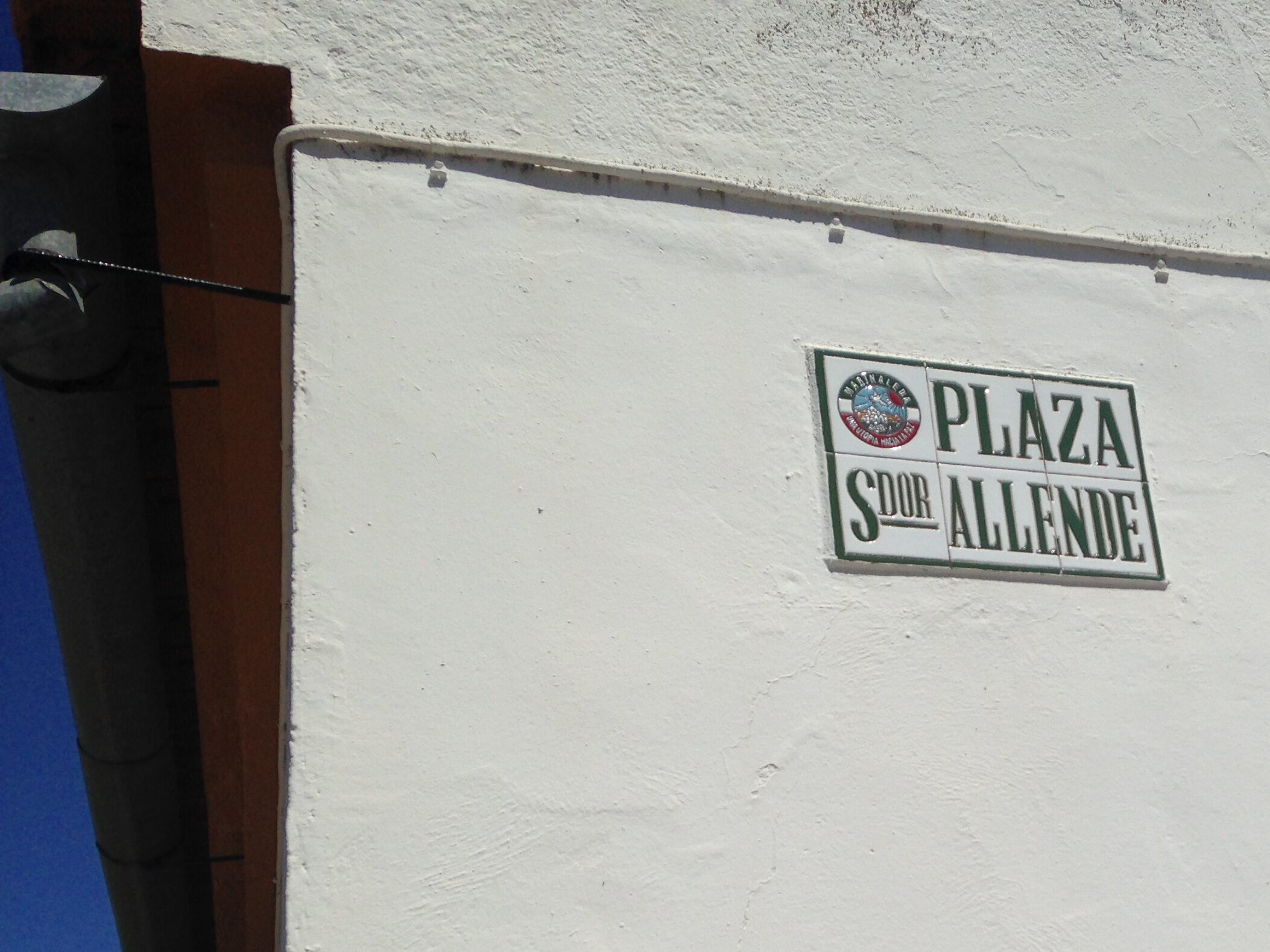
It also seemed like a village that wanted to blend in, despite having counter-cultural values. There are street names in the town displaying an impressive set of socialist revolutionary’s names from all over the world, and a cultural center decorated with a sign about building “utopia.” However, if you did not talk to people you would not understand that you were actually in a socialist village.
A refreshing discussion in Granada
The bus ride towards Granada seemed like an endless landscape of olive tree farms, and then a city surrounded by impressive mountains, whose famous old town is a model of multicultural life with a strong Arab influence (and tourism).
During a panel discussion on antimilitarism at the University of Granada’s Peace Center I tried my best to understand the comments in my poor Spanish. I argued that activists, politicians and academics have tried since the 1960s to get governments and generals to understand the potential of a national defense based on civil resistance and organized nonviolent activism to no avail. Therefore, we should recognize that states will never shift militarism into non-military forms of defense. It can only be done through mass mobilizations of people, by proving the potential of people power, and from that base, creating a civilian-based defense. This position was not easily accepted, and led to a lively discussion on the role of the state and civil society for social change. Some of them argued that some aspiring new states might be more open, like Catalonia.
This was refreshing since peace studies as an academic discipline has evolved from a radical system critique and movement orientation in the 1990s, into a state reform-oriented critique of militarism and war. A return to a focus on peaceful and radical resistance by civil societies is necessary if peace studies is going to be relevant for the creation of peace and justice in the future, as peace studies professor Richard Jackson argues in the first issue of the Journal of Resistance Studies (in 2015, which is Open Access for everyone).
Yet another night we fulfilled a dream of mine: enjoying a live music performance of flamenco in a local bar in the old town of Sevilla, in an intimate space of 40 people. The combination of passion, sadness, aggression, dignity and intensity of flamenco ties in with Andalusia’s history of oppression, migration, slavery and the Roma people.
Andrea(s) and I continued to enjoy our evening routine at their terrace under the night sky, eating cheese, bread, olives and salad, discussing activism, life and politics of the revolution. One night we had a party with their community of friends, singing along with videos of old Spanish hits from female singers, drinking wine and laughing wildly together. I enjoyed taking part in this very human activity: a fundamental way in which activists stay sane, build resilience and community.