How the health care struggle is building a broad anti-Trump resistance
By incorporating different stakeholders using diverse tactics, the health care struggle is showing the way forward for the Trump resistance movement.
Last week’s recess offered little respite to the Republican senators supporting the Better Care Reconciliation Act, or BCRA. After the bill failed to gain enough support for a vote before the recess, opponents of the health care reform legislation — which would entail major cuts to Medicaid and the loss of health coverage for roughly 22 million Americans — used the holiday weekend as an opportunity to express their outrage at town hall meetings and public events. When some Republican legislators refused to attend the meetings, activists staged sit-ins at their offices and sought them out at town parades and picnics. One group even sailed a boat outside Sen. Thom Tillis’ vacation house in North Carolina, flying a banner that read “Sink Trumpcare.”
While Republican Party leadership is still attempting to move the bill forward with possible revisions and a delayed August recess, others within the GOP are less certain. Sens. John McCain and Bill Cassidy both released statements on Sunday calling the bill more-or-less “dead,” signaling a possible triumph for progressive activists led by groups like Indivisible, Our Revolution, and Planned Parenthood, which have mobilized large crowds and grassroots networks to oppose the bill.
Opposition to the BCRA has entailed a widespread, diverse range of actors and tactics, from progressive lobby groups in Washington, D.C. to community groups in small towns across the country. Dramatic dilemma actions have mobilized support and pressured opponents by creating public spectacle through sit-ins and “die-ins.” Other groups have used creative, fun tactics to increase participation and recruit passersby to the cause. Finally, several significant actions have reframed the debate to involve unlikely allies or target moderate opponents, from police officers to sex workers.
These examples show how a variety of tactics, from glitter-strewn dance parties to dramatic public stunts, can prove useful in targeting a range of actors. In order to continue building momentum, however, the movement must continue to draw in new diverse allies, including disenchanted Trump voters who stand to lose their health insurance if the BCRA becomes law. The fight for health care is only one front within the wider resistance, yet it may be the issue around which progressives and conservatives can start finding common ground for a bipartisan movement against policies that adversely affect ordinary people on both sides of the political aisle.
The mobilization for health care can therefore show the way forward for the Trump resistance movement, offering a strong example of how to incorporate different stakeholders using a wide range of tactics. These examples demonstrate the importance of finding common ground with opponents when possible, and the need to develop a common vision for the future that can shift the anti-Trump resistance from simply opposing his agenda toward “proposing” an alternative path forward together.
Drawing in supporters and opponents alike
Numerous actions opposing the health care bill show how public spectacle and dilemma actions can serve as effective tactics to mobilize moderate supporters, or to pressure strong opponents into concession. One group of disability rights advocates on Capitol Hill managed to achieve both aims in a single action when they staged a “die-in” outside Senate Majority Leader Mitch McConnell’s office in the Russell Senate Office Building. Organized by the disability rights group ADAPT, the protest formed in the hallway, as activists climbed out of their wheelchairs and laid on the floor, chanting against the proposed cuts to Medicaid that would prevent them from receiving the care they need to survive. Many were eventually carried out and arrested by the Capitol Police, and photos and videos of protesters screaming and struggling against law enforcement were widely shared on the internet in the following days. Other “die-in” protests have been held by activist groups around the country; participants included pregnant women, medical students, veterans and senior citizens — either taking place in major urban centers like Brooklyn, New Orleans, Chicago and Orlando, or more rural states like New Hampshire, Missouri and Oregon.
The die-in is a clever and strategic tactic for several reasons. First of all, it aimed to mobilize an important group of potential allies — the passive supporters of the cause who simply lacked sufficient motivation to take action. Using a dramatic public spectacle and making sure it was widely covered in the media created the kind of outrage-inducing scenario that would compel supporters to take a stronger stand by calling their senators or staging direct actions in their communities. According to ADAPT member Marilee Adamski-Smith — who was born without arms and legs — the action at Sen. McConnell’s office was a catalyst for more than 30 additional actions. What’s more, she said, their group has since been joined by many others, including a group of Louisiana mothers with children who have a tracheostomy.
Die-ins also embody an important principle of successful direct actions by bringing private concerns into the public eye. Comments like one by Idaho Rep. Raul R. Labrador — who said that “Nobody dies because they don’t have access to health care” — demonstrate how many people, including lawmakers, do not understand the reality of those who rely on government-funded health services to survive. In Adamski-Smith’s case, the proposed cuts to Medicaid would force her into a nursing home, an even costlier option than the Home and Community Based Services she now receives.
Kings Floyd, another participant in the die-in, said the die-in “brought attention to the fact that this bill is imperative to the health and well-being of the disability community.” This isn’t enough, she said, “but is a start to the change we are looking for.” In short: Die-ins make the invisible visible, drawing in stronger supporters and exposing how out of touch lawmakers can be in regards to issues facing ordinary citizens.
Additionally, the dramatic die-in targeted strong opponents by putting Sen. McConnell, his staff and the police in a decision dilemma — a binding situation in which any response to the activists works in their favor. For example, if the police had left the group in the hallway, they would have likely drawn as much attention to their cause as they did by being removed in front of the cameras. Dilemma actions are often even more effective when they are led by vulnerable groups — children, people with disabilities, the elderly — because it sends a more compelling message and creates more sympathy for the campaign. This expert use of the die-in tactic enabled ADAPT to succeed in mobilizing more supporters and backing their opponent into a corner. It also allowed them to hold onto the moral high ground and use the media to their advantage by creating a scenario in which the cruelty of the health care bill was publicly exposed.
Activating the fence-sitters
Protesters have used other tactics in fighting the health care bill that are particularly effective at targeting neutral or passive observers, the people who fall in the middle. They may not consider themselves overtly political, or feel intimidated by taking part in high-risk tactics that could lead to arrest. In this case, actions can use creative, humorous and participatory tactics to expand a movement’s reach and incorporate a variety of actors who want to join in on the fun. These tactics can build unity and solidarity within a campaign, providing activists a much-needed release from the somber mood of a “die-in” or the orderly nature of marching through the streets. These tactics can also draw in people who are on the fence about participating, or who feel discouraged about their ability to affect a situation. Holding no expectation to change the status quo, people may still want to take part in an action because it seems like a fun way to spend the afternoon.
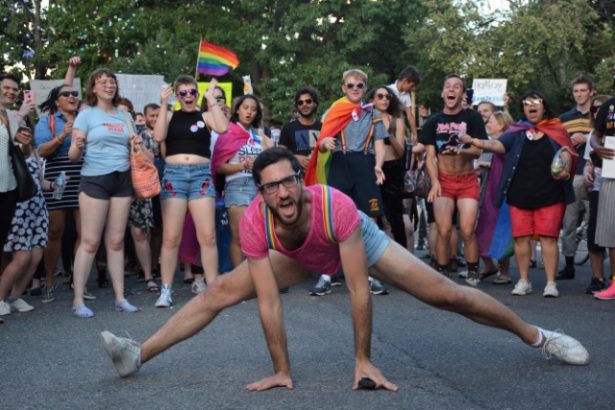
In Washington D.C., the queer activist group WERK For Peace organized a dance party called “WERK for Your Health” outside Sen. McConnell’s house to protest the health care bill. Organizers clad in bright colors and rainbow suspenders chanted “Mitch McConnell come dance” and scattered glitter and confetti in the streets. Firas Nasr, who founded WERK for Peace after the Pulse nightclub shooting in Orlando, said the group’s actions are “as much about expressing opposition as they are about celebrating our bodies, communities and basic human rights.” Nasr also said dance was a particularly important tactic in the fight for health insurance coverage because it is closely connected to peoples’ health and the well being of their bodies. “If Congress isn’t going to work for our health, then we will be out in the streets WERKing for our health,” Nasr added.
Another creative, participatory tactic was used in Raleigh, North Carolina, when activists from the Indivisible group Protecting Progress in Durham created a “Wheel of Misfortune” in front of Sen. Tillis’ office. The wheel featured a colorful selection of pre-existing conditions, accompanied with stories of how the BCRA will harm individuals with these conditions. Activists asked people passing by to spin the wheel and see which condition they got. One video shows the “host” cheerfully calling out, “You got bankruptcy!” Flashy, low-risk tactics like the Wheel of Misfortune draw in participants, from curious people passing on the street to passive people scrolling through social media on their couch.
The power of common ground
Finally, certain actions can be used to target the moderate opponents of a movement by seeking common ground among a wide range of stakeholders. In these cases, it is important to reframe issues using the language or narratives of one’s opponents. This can lead both parties to realize they may have more shared interests and grievances than they realized before. Many actions opposing the health care bill have drawn support from unlikely allies, building the campaign’s legitimacy by showing it is not a partisan issue but something that affects all citizens. Movements are more effective if they are not seen to represent a one-sided echo chamber, but rather to elevate the voices of ordinary people from all walks of life.
Republican legislators in traditionally red states, for example, may not heed protests by liberals in their state who would not vote for them anyway. But they will pay attention when booed and confronted by angry conservative constituents, as happened in town hall meetings in Utah and Tennessee in February 2017. Republican voters shouted down their congressmen over the proposed health care legislation, contributing to pressure that led Republican Speaker of the House Paul Ryan to pull the initial draft of the health care bill from the House floor. Anger and opposition to the bill has continued in conservative states around the country since the House voted to pass a new draft of the health care bill in early May. These instances of conservative opposition to the health care bill present a critical opportunity for progressives to expand the stakeholders in the fight for affordable health insurance.
One group of sit-in protesters in Denver, Colorado demonstrated the importance of reaching out to opponents to seek common ground. The exchange occurred between a group of disability rights activists camping outside Sen. Cory Gardner’s office and the police officers who were called in to remove them. In a conversation captured on video, one police officer can be heard saying to the protesters, “I didn’t know they were going to get rid of Medicaid. I had no idea.” One activist replied by saying, “Yeah, and that affects everybody. It could affect you … God forbid you get shot on the job or something. Would the cops take care of you for the rest of your life? Or would you need Medicaid or something?” The police officer admitted he didn’t know and then asked who would be losing coverage. “Everyone you see here,” the activists replied, gesturing around the room.
By reframing the issue as something that affects everyone, and could potentially affect police officers who get injured on the job, the protesters in Denver targeted a group who initially seemed like opponents, but certainly have the potential to become allies. If they do, that will put them on the same side as the group Hookers for Health Care, which is comprised of over 100 licensed sex workers in Nevada who have pledged to engage in lobbying, protesting and petitioning to oppose the BCRA. Ultimately, a campaign that recruits conservative voters, police officers and sex workers will be more influential than one composed solely of activists and NGO leaders. What’s more, the movement will be more effective in the long run when it incorporates a variety of actors in devising alternative solutions.
Developing a shared vision going forward
In order to truly protect health care coverage for all Americans, activists must remember that opposition can only take a movement so far. Amassing a diverse base of support with a variety of stakeholders and using different tactics to mobilize a range of actors has strengthened the campaign against the BCRA and could contribute to the failure of the bill altogether.
Still, recruiting people to the campaign must be accompanied by a clear vision for the future, rather than solely expressing dissatisfaction with the present. This is exemplified by the notion of the “two hands of nonviolence,” as developed by the late feminist writer Barbara Deming, which states that nonviolent action must comprise efforts to both stop injustice and offer a new path forward. This is also known in Gandhian theory as the difference between constructive and obstructive action.
The bulk of any successful campaign must consist of imagining alternatives and proposing solutions. There are some hopeful signs that this is happening among many Democratic leaders, who have become increasingly supportive of a single-payer health care system due to pressure from liberal constituents. While nonviolent struggle may be sustained in the short-run by fighting against something, it is only by fighting for something that movements are able to affect long-term social change. This is why the struggle against the proposed health care legislation must not stop at opposing the Senate bill. Instead, it needs to use the energy and momentum that has mobilized such a rich spectrum of allies to begin the work of envisioning alternative systems for the future.