When I first heard that Gandhi was viewed as “the enemy” by many Dalits in India (formerly called “untouchables”), I was dumbfounded. How and why could Gandhi be seen as having betrayed the Dalits when he opposed untouchability even in the face of active discomfort on the part of close associates?
Last month, while I was in India teaching Nonviolent Communication to 120 people, including a significant number of Dalits, I had the opportunity to explore this question further. During a session called “Gandhian Principles for Everyday Living,” a topic about which I have written at length, one of the 60 people present expressed anguish, pain and anger towards Gandhi. He was a Buddhist, like many other Dalits who had chosen to follow the Dalit leader Dr. B. R. Ambedkar in leaving behind centuries of mistreatment under Hinduism.
I dedicated much of the two-hour session to hearing and understanding his experience. I learned more about the power of deep empathic reflection than about the issue itself. With the presence and active attention of an entire group, he experienced a profound shift in his perception. In the end he said: “Perhaps it’s personal pain from my childhood and all the experiences I had that I just attached to Gandhi.” He didn’t actually know the details of what Gandhi was held accountable for. Nor did I.
After the training ended, I went on a personal pilgrimage to Gujarat, Gandhi’s home state and the birthplace of the Salt March. I met with the editor of a Gandhian journal in Gujarati, who told me that he believed Dr. Ambedkar saw things more accurately than Gandhi, and that his followers have something to teach the Gandhians. Slowly, the details emerged.

The bitter dispute originated in the 1930s, when Gandhi mounted a “fast-unto-death” in response to a British proposal, based on Ambedkar’s recommendations, to award the “depressed classes” (the Dalits) a separate electorate in the Indian parliament. Frantic negotiations under pressure of saving Gandhi’s life resulted in the Poona Pact which substituted a guaranteed number of seats in the parliament for the separate electorate. Although the pact was signed by Ambedkar, his followers, and many of Gandhi’s followers, the complex provisions elaborated in it appeared to many to deny the Dalits any real access to power.
Despite what Ambedkar said at the time to Gandhi and others, he later said he signed under immense pressure and claimed that Gandhi was actually against equality for the Dalits. Ambedkar suggested in a 1955 interview that Gandhi didn’t truly “deserve” the title of Mahatma (great soul). And yet, a close look at Gandhi’s own words leads me to conclude that his position was based on a deep commitment to fully eradicating untouchability from Hinduism.
I have no difficulty understanding and even sympathizing with Gandhi’s reasoning. Gandhi didn’t see political solutions per se as fundamental and lasting. He sought, instead, moral and spiritual paths. He called on Hindus to atone for and redeem the sin of untouchability. He was concerned that being politically separated from the issue would leave Hindus without the motivation to create the necessary change of heart. He believed that his willingness to die would awaken Hindus to the poison of untouchability. Indeed, following his great fast, scores of communities removed barriers to “untouchables” attending temples and drinking water and eating with others.
Nonetheless, I see Gandhi as having made a serious mistake in pressing the point, and am not surprised that his strong opposition to granting rights to a despised minority has been seen as lack of interest in their equality and empowerment.
Knowing people’s dedication to him, Gandhi used the moral force of his person to call on people to live up to a vision that was not yet possible. In other instances, he accepted purely political and less-than-ideal solutions to work with practical realities. This is what Ambedkar was proposing, and what the Civil Rights movement in the US was able to press for: despite a lack of true change of heart, legal-political solutions can make a tangible difference in the lived experience of disadvantaged groups. The vision of a united Hindu society was so dear to Gandhi that he wasn’t willing to accept a partial solution. This error is one of the reasons why Gandhi ultimately failed. The moral force of a person is not sustainable. The partial gains made at the time of his fast were short lived.
Once Gandhi died, all that remained was what people had internalized and integrated. A true change of heart happened only to a few. The legacy of separation, endemic to most of our human cultures, took hold again, and violence swept the country. Instead of the unity and transformation Gandhi sought, and the empowerment and freedom that Ambedkar stood for, India remains saddled with the weight of untouchability, which is still widely practiced despite being proscribed since 1950, and the Dalit community is splintered into several religions and still separate from the rest of Hindu society. As the Dalit Freedom Network tells us “In 70% of India’s villages…non-Dalits will not eat or drink with Dalits” who also “constitute the largest number of people categorized as victims of human trafficking and human enslavement in any single nation on earth.”
I struggle with similar dilemmas today, albeit with far smaller ramifications. Hardly anything possible in the present would ever align sufficiently with my large vision for me to support it. I nonetheless know that to remain relevant and respected I need to balance vision with practical reality.
No easy answers, ever. Working for a true change of heart may well be an unaffordable luxury when urgent action is required, such as when global planetary resources as well as social, political, and economic institutions are collapsing. And yet, no matter the urgency, if we want to create sustainable long-term change and establish relationships, structures, and systems that serve all life, we need to augment political and structural arrangements with ongoing efforts to transform how we approach social change work. Gandhi’s fundamental lessons still stand. There is no substitute for an inclusive vision and actions based on love.

Hi Miki,
Thank you for this thoughtful reflection. However, I wonder if Gandhi’s opposition to the particular solution of a separate electorate in parliament was not only a preference for moral as opposed to a political solution, but a worry about the pragmatic political effects of that particular political solution.
I haven’t read extensively in the Collected Works on this matter, but given his deep skepticism about certain kinds of democratic mechanisms, my guess would be that Gandhi worried that by creating a separate institution for Dalits it would be exacerbating the already deep divisions by putting different classes in political competition with one another. We should not assume that he was wrong about this. After all, we saw what “separate but equal” style-separation did in the United States — far from resolving the issue it made it much, much worse.
Dear Dustin,
I am so happy to read your comment, both because I am always happy when people engage, and because I am appreciating the thought itself.
I find what you say very compatible with my understanding of Gandhi’s thinking, and entirely complementary to the point I was making. I imagine both were true for him at the time. I can only wish that I had found a way to include this hypothesis in the original piece I wrote.
As to whether or not Gandhi’s view was or wasn’t a contribution, I can only observe that his choice combined with the response of others to it yielded and unhappy state for the Dalits. We of course have no way of knowing what would happened had he conceded to Ambedkar what he wanted.
Thank you again for your thoughts.
Agreed all around Miki. At the very least, by Gandhi’s own standards — and more importantly by the standards of the Dalit community itself — not nearly enough has been done on just about all fronts — political, economic, moral and spiritual.
Hi Dustin
All we are talking about the communal award and pune pact but let me focus all the bloggers to the issue why there was need in India for separate electorates and communal award for any community would it be possible if ambedkar was not born in India Gandhiji would fight for the reformation of untouchables if yes then on moral grounds or social or political if on moral then that would change the 2000 years misery of untouchables the answer is big no because before Gandhi many mahatmas came and gone but none fruitful if on social ground then that would end the misery of untouchables many kings tried but not successful because the king who tried this the the society did not recognise him as a king then what was the solution for the plight of untouchables the answer was political key to give them a chance to rule but Gandhiji refused to give them their liberty key from the tyrannical rule of Hindus Gandhiji feared that Hindu society would divide if it is so then how can only few people belonging to Hindu fold live without respect and dignity ie the untouchable class
For anyone interested in a glimpse of the state of many untouchables in India today, I recommend Joe Sacco’s haunting graphic essay in the current issue of the Virginia Quarterly Review.
It was so encouraging for me to read this today. Your views also represent a struggle that I experience in conversations with others about this topic of rectifying the ideal with acting practically for real results.
How does one hold true to honoring truly ethical action both personally and while taking political action in America’s immensely corrupt system? I am one who believes that the often stated belief that human nature is “evil” is an incredibly entrenched indoctrinated LIE that way too many believe. We have choice. We can choose a different way. We can share with and reach others. We can enliven our visions to create the possibility for World Peace on this planet. Occupy has given so many a restored hope to know that WE ARE the majority. These who dominate are the Minority.
In my mind alone to hold true to the highest values of compassion, love, being world peace, justice, non-violence, etc. it is vital to be uncompromising. In discussions with others I am told to take off my rose colored glasses, accept the realities and vote for “the lessor of two evils” anyway to prevent the far worse from assuming more power. I see very little difference in these forms of spiritual and actual violence being perpetrated by the elites in America/the world. The results appear to be much the same. That Gandhi gave much is what I take in lessons to be cherished.
Thank you for the discussion. I am sharing it as so many continue to try to “be the peace we wish to see in the world” Jane aka Poet
Thank you, poet. I believe that the more of us take the risk of putting forth a view of human beings as willing to collaborate with each other when supported in doing so, the more that view of an “evil” human nature can start being questioned and dislodged.
I have just been reading about the Dalits (untouchables) in volume three of Gene Sharp’s “The Politics of Nonviolent Action”. He uses the example of the 1924-25 Vykom temple road campaign by untouchables against orthodox Brahman Hindus (which resulted in victory for the Dalits) to illustrate how “under certain circumstances conversion (of the opponent) is possible despite extreme social distance.”
This sounds like a story worth publicising.
I think Dustin is on the right track. Gandhi was against further separating Dalits from caste Hindus by creating a separate electorate for them.
Gandhi accepted separate electorates for other minority groups, such as Muslims and Sikhs, but opposed a separate electorate for untouchables lest a separate electorate for them would further divide the Hindu community into two classes. Trying to imagine a separate electorate for African Americans in the U.S. makes it easier to see what Gandhi was opposed to — deeper segregation.
Gandhi said his fast unto death over the proposal was aimed at Hindus:
“If the Hindu mass mind is not yet prepared to banish untouchability root and branch, it must sacrifice me without the slightest hesitation,” he told the press. (Gandhi’s passion: the life and legacy of Mahatma Gandhi (167), Stanley Wolpert)
Fasting to death was a drastic measure, but Gandhi tried to cure Hinduism of untouchability in other ways as well. Early in his career, Gandhi “would attend weddings only when the marriage was within the same caste.” Years later, “he had decided to attend no wedding in which one of the two parties was not a harijan, one of the so-called ‘untouchables.’” (“Growing Up With Gandhi” Narayan Desai)
In retrospect, Gandhi’s attempt to dub untouchables “Harijans” (children of God), may appear condescending. But a man willing to die over equal rights for a minority group must have had a great love for that group in his heart.
Hi Pablo,
Your additional comments highlight the painful irony even more. I share your view that Gandhi fasted because of a profound commitment to equality with the Dalits. And, still, he is being perceived by many as being opposed to their equality.
thank you,
Miki
Mr. Mahatma Gandhi was a staunch supporter of Varna System and Caste System. Both Varna System and Caste System are the enemies of Humanity, Equality, Liberty and Fraternity. Mr. Mahatma Gandhi was a fundamentalist Hindu. Up to his last day he (Mr.Mahatma Gandhi) strongly opposed the Democratic movement of Baba Saheb Dr.Ambedkar. Mr. Mahatma Gandhi tried his best to crush the Human Rights, Fundamental Rights, Social Rights, Economics Rights, Political Rights, Educational Rights and Religious Rights of the Untouchables (Dalits) of India, through “Poona Packet” on Sep.24, 1932. i.e. the Untouchables (Dalits) of India hate him (Mr. Mahatma Gandhi). He (Mr. Mahatma Gandhi) was not only a casteist but also a racists. The whole world knows that Mr. Mahatma Gandhi was the “ENEMY NO-ONE” OF the Untouchables of India. Future, the Untouchables (Dalits) and Human History will not spare him(Mr. Mahatma Gandhi).
yaa its right
very well said…
People of India say that only the ghost of Gandhism exists today.
But Baba Saheb Dr.Ambedkar is still a living symbol because he
(Dr.Ambedkar) is a symbol of the masses.
CONGRATULATIONS & HEARTIEST GREETINGS ON THE BIRTHDAY OF
DR. B.R.AMBEDKAR.
“THE GREAT SON OF THE UNIVERSE WHO WAS NOT ONLY THE FATHER OF
THE INDIAN CONSTITUTION BUT ALSO AN ARCHITECT OF NEW INDIA.”
He was an Economist, a Philosopher, a Thinker, a Socialist, a Secular, a Democrat, an Intellectual, a Scientist, a Parliamentarian, a Statesman, an Editor, a Constitutionalist, an Educationalist, a Social reformer, a Revolutionary, an Apostle of Peace, a Pillar of National Unity, a Sociologist, a Historian, an Orator, a Legal Luminary, a Critic, the Champion of Human Rights, a Strong Supporter of Women’s Rights, Equality and Freedom and the Massiah of Workers, Peasants, Poor and the Untouchables (Dalits) of India.
14th. April, is an International “DALIT CHETNA” (CONSCIOUSNESS) DAY” ON this Revolutionary day, we pledge to fulfill the Mission of BABA SAHEB DR.AMBEDKAR.
{ HARBANS LAL BADHAN }
I am a std.8 student.I have just studied about Dalits in class.the first name who contributed in dalit’s welfare was of GANDHIJI.I can proudly say that I m an INDIAN and GANDHIJI was born in such country and we too belong to this country.Finally I would like to quote-MERA BHARAT MAHAN.JAI HIND.
Thank you for touching this topic Miki, I would like to clarify a few mistakes or overlooked reality in your article.
Yes, it is true that gandhi was the greatest enemy of Sc/Sts, it was said by Dr.Ambedkar and we about the quarter of a Billion dalits believe it is true, he was not only the enemy of just us, all other minorities and to the nation itself.
You see, he is a pacifist, actually a confused and disturbed Pacifist. There was no realistic connection between what he spoke, wrote and said in public to that of what he practiced.
He used this Pacfist identity to con Indians, particularly the dalits of India, he used this fast unto death act, yes, he is a finest actor, he had put up this act to destroy one of the greatest, practical and problem solving method Dr.Ambedkar had suggested, a separate electorate for dalits. He used the non violence acts to get his works done, get his self centered, megalomaniacal beliefs satisfied that means he is more violent than some violent people. The contemplation or the intent to Kill someone is even worst than the killing itself, because that is what propel the act to be accomplished, so a pacifist trying to destroy dalits freedom and liberty, has put up this non violent agitation and got his work done and betrayed both Dr.Ambedkar and his people, the close to 360million dalits of India and other countries.
In a speech in London (rather interview) Dr.Ambedkar said, I never called him Mahatma, I never will, he is not even fit to be regular man, where is the room for Mahatma, well if the hindus and perpetrators of human society wanted to call a man with “Sword in his armpit and sweet talk in his tongue as Mahatma”, then he is one?.
His personal life and activities are even more pathetic and disturbing, in the name of celibacy, he slept for years with teenage girls, will you allow any of your family members young and growing up to sleep with a old man, whole night for days, weeks, months and years, what kind of behavior is this?.
He also wrote, spoke and published materials saying caste system should be preserved and it has scientific meaning, wow………………caste system is one of the Most Pathological social evil that has no treatment or remedy till today even after 3000 years, even in this 21st century. As you have already mentioned, the caste discrimination is rampant throughout India, more people are killed in India by caste abuse than any other deaths in a single measure in India or other countries, and that evil man gandhi said caste system must be preserved, whereas the great Dr.Ambedkar not only said we must annihilate caste system from the face of this earth, he dedicated his whole life to just accomplish it, though he only succeeded marginally, but his life was spent on it.
all the untouchability work of gandhi is a gimmick to keep the dalits within the hindu fold, it is one of the deadliest and clandestine act of any known so called leaders of his world…………..he deserves no mention in the history of human civilization, he and his hindu clowns took India back to jungles right this moment. Go to India and see for yourself..
gandhi is anything but non violence, a pacifist of the worst kind.
nice comment!!
Mahatma Gandhiji was, is and will be a great man. He practiced what he propagated. Dr. Ambedkar was thinking about untouchables only. His solutions for free india was in favour of all the people. He believed in segregation. Gandhiji believed in unification. Gandhiji supported right side of the varnashram dharma. His support was not against harijans. What is greatness if a Dalit leader fights for his rights. seperate electorate would have proved sucidal to the nation. It may give raise more such demands and take the country in to anarchy. Gandhiji gave us everything that we are enjoying now. many dalits still love gandhiji for he represents our freedom. Only neo-buddhists and Ambedkarites hate gandhiji with out reason. May be because Dr. Ambedkar say so. Dr.Ambedkar could not give solutions to many problems that are faced by dalits. These social problems have roots in various social, economic, and political situations. In the democracy people will will take care of many problems. What we need is Investors, Employers who generate employment and people who develop the country economicaslly. after 65 years of independence our country could achieve 3rd position in GDP in the world only after US and China. the rich brahmins became poor, dalits marginally developed, many forward castes became fabulously rich. we all must try to become enterprising people and stop talk hate non-sense for years together
Mahatma Gandhi was a fundamentalist Sanatni Hindu and a staunch supporter of Varna system and Caste system. Hindu Caste system is more dangerous, cruel, barbarous, inhuman and harmful than any other kind of Racial discrimination and slavery system. It is not only a social, educational, economic, political and religious evil but also mental disease and mental sickness. To believe in Caste system is not only a crime against Humanity but also a violation of Human Rights. The Untouchables (Dalits ) of India was/are the victims of Caste system, Varna system and Untouchability. That is why the Untouchables (Dalits) of India bate Mahatma Gandhi.
Mahatma Gandhi was a fundamentalist Sanatni Hindu and a staunch supporter of Varna system and Caste system. Hindu Caste system is more dangerous, cruel, barbarous, inhuman and harmful than any other kind of Racial discrimination and slavery system. It is not only a social, educational, economic, political and religious evil but also a mental disease and mental sickness. To believe in Caste system is not only a crime against Humanity but also a violation of Human Rights. The Untouchables (Dalits ) of India was/are the victims of Caste system, Varna system and Untouchability. That is why the Untouchables (Dalits) of India hate Mahatma Gandhi.
very well said…
This is an important subject but I wish that it had been covered more competently. It is still difficult to understand the nature of the tension between Gandhi and Ambedkar. The author writes: “Although the pact was signed by Ambedkar, his followers, and many of Gandhi’s followers, the complex provisions elaborated in it appeared to many to deny the Dalits any real access to power.” What were the provisions? Did they really deny Dalits “real access to power,” or did they just “appear” to? What is the evidence supporting Ambedkar’s view that Gandhi did not support rights for Dalits? From my reading, Gandhi opposed special quotas for untouchables but that is not the same as denying them rights. All that is evinced is Ambedkar’s opinion. Also it is hard to tell from how this post is written what Gandhi’s supposed “serious error” was. From the comments I see that the dispute hinges on the question of separatism of some kind but this could all be explained much more carefully. But thanks for starting a conversation.
“The Untouchables (Dalits) of India want economic, social, political, religious and educational equality in Society, not in the eyes of God”
(Harbans Lal Badhan)
Firstly, untouchability was not the greatest evil of Indian society.
It was Caste !
Caste system was the fountainhead of untouchability. The system was devised by Brahmins whereby upper castes can be at the top of the social pyramid and the lower castes (shudras and dalits) can be of eternal service to their upper caste masters. This is what Hinduism is. This Hindu caste society was also a rigid system of division of labour by birth. Thus a lower caste or dalit man will always be doing servile works for their upper caste masters.
Now the “non-violent” Gandhi did nothing to stop this evil caste system that plagued India. In fact he vociferously argued for the perpetuating caste. In his own typical saintly writings, he called for upper caste men to do menial jobs reserved for lower castes as a mark of showing the dignity of labour. sigh ! He sure knew that such tokenisms are not going to work.
If he was really against the evil racist strands of Indian society he should have opposed the entire caste system. But he chose to talk only about untouchability as if unctouchability was a separate system and has got nothing to do with caste system. Whereas Ambedkar was the true prophet of a modern and egalitarian India when he called for “total annihilation of caste”.
After all, what Gandhi feared was the exodus of dalits from the oppressive Hindu fold. Gandhi’s venomous hate-speeches against Indian Christians and refusal to acknowledge Medieval India (Islamic rule) speaks about his secular credentials. Gandhi is nothing but a closet-hindu supremacist megalomaniac.
And it is an insult to the struggle of dalits when we hear about the patronizing statements made by people when they say Gandhi fought for “harijans” !
Gandhi’s idea of India was a society that was deeply rooted in caste (varna-as he calls), pervasive regressive hindutva (which he paints as spiritualism), regressive feudalism (modernity is evil !) and absence of individual freedom (his self righteous proclamations on sex, celibacy etc).
I long to see an India that is modern, egalitarian, secular, tolerant, respecting the rights of each and every citizen and having a progressive international outlook rather than deceiving itself by proclaiming on the rooftop about it’s own “moral superiority” (which Gandhi and many Indian “saints” of that time stood for). To realize this dream we have to look up to Ambedkar, Rabindranath Tagore, EVR “Periyar” and other great rational men and not an irrational , self righteous, megalomaniac like Gandhi.
Every one knows that Mahatma Gandhi was a staunch supporter of Varna System and Caste System. Indian Caste system is more violent, hard, dangerous and harmful than chemical weapons. It (Indian Caste system) divides the society and state. Indian Caste system is also a great threat and challenge to world peace and unity. It (Indian Caste system) is also an enemy of human rights and fundamental rights of an individual.
I read your piece with little interest at all as from the beginning till the end, you did not seems to understood the plights of Dalits, their rich and great history, hindu sabotage of dalits and the thousands of years old Oppression, segregation and discrimination.
At your conclusion you said “gandhi’s fundamental lessons still stand. There is no substitute for an inclusive vision and actions based on love”…..this alone indicate that your understanding about Gandhi and his work is utterly flawed and poorly understood.
Like many other gandhi writers, you showed that you are not any exception because of the repeated dissemination of perpetrated information about gandhi, repetitive illusion based praises on him continued ever since he was dead and it is still continuing.
did you ever read gandhi’s own writings and speeches?, his life and myriad of dramatic behaviors in public, none of them suggest remotely he was anything but inclusive, any thing but love and peace.
Let me clarify this, he wrote and spoke as well as practiced caste system, he wrote “we must preserve caste system”?. This is one of the worlds deadliest discrimination, and it is coming right out of gandhi’s most revered hindu religious texts Veda’s, the Rig Veda, one of the Oldest and most respected of hindu religious scripts is the foundation for caste system, its consequences we see today, including the rampant corruption in India, the rampant rape of woman and trafficking. Every bad things that is happening in India is the result of corruption and the foundation for it is laid in the caste system, as when a human treates another human as upper, lower or out caste, that is when the corruption reaches the highest point. And, gandhi revered this system and wrote and spoke we must preserve this caste system.
Secondly, this is not only a religious practice or part of its scriptures, there is so much violence and discrimination going on because of this practice, the end result untouchability..
So, how can a man who want to preserve caste discrimination can be inclusive, how can a man who opposed Dr.B.R.Ambedkar’s proposal for a equality and equal rights for all can be a man for inclusiveness?. How?.
He has not only abused and destroyed the opportunity of Babasaheb Ambedkar to draw attention of the British at the round table conference to declare this freedom to dalits but throughout life gandhi used clandestine means to destroy any opportunity for dalits to liberate themselves from this hindu pathology, his clandestine harijan magazine, he will write in hindi one thing but write the same story in different light in another English periodicals such a deadly bigotry belongs to gandhi….he was never an inclusive personality or individual. If he was for inclusive, why did he let Pakistan go as separate nation, why?.
Thirdly, the so called peace, love and non-violence, gandhi is nothing to do with all these, Peace and non-violence is a gift from Buddha, it was his teaching that gandhi sabotaged and the whole world thought gandhi is a peace lover and freedom preacher and so on, is a mockery of real world Buddha’s contribution of Peace and non violence. He slept with teenage girls in the name of experimenting with truth?, would you send your sister or daughter or someone from your home to gandhi so that he can experiment?, if so, then I believe he is a peacemaker?. And he was a wife abuser, a woman abuser. He abused the quarter billion Indians the dalits betraying them, this is his life time work.
He goes to S.Africa as an immigrant, instead of respecting and living with the natives in their country, he called the S.Africans as Kaffirs?, do you know what this means?. Not only he abused the dalits in India his whole life, but he abused the S.Africans in their own country, and you call him a inclusive and peace loving man, never.
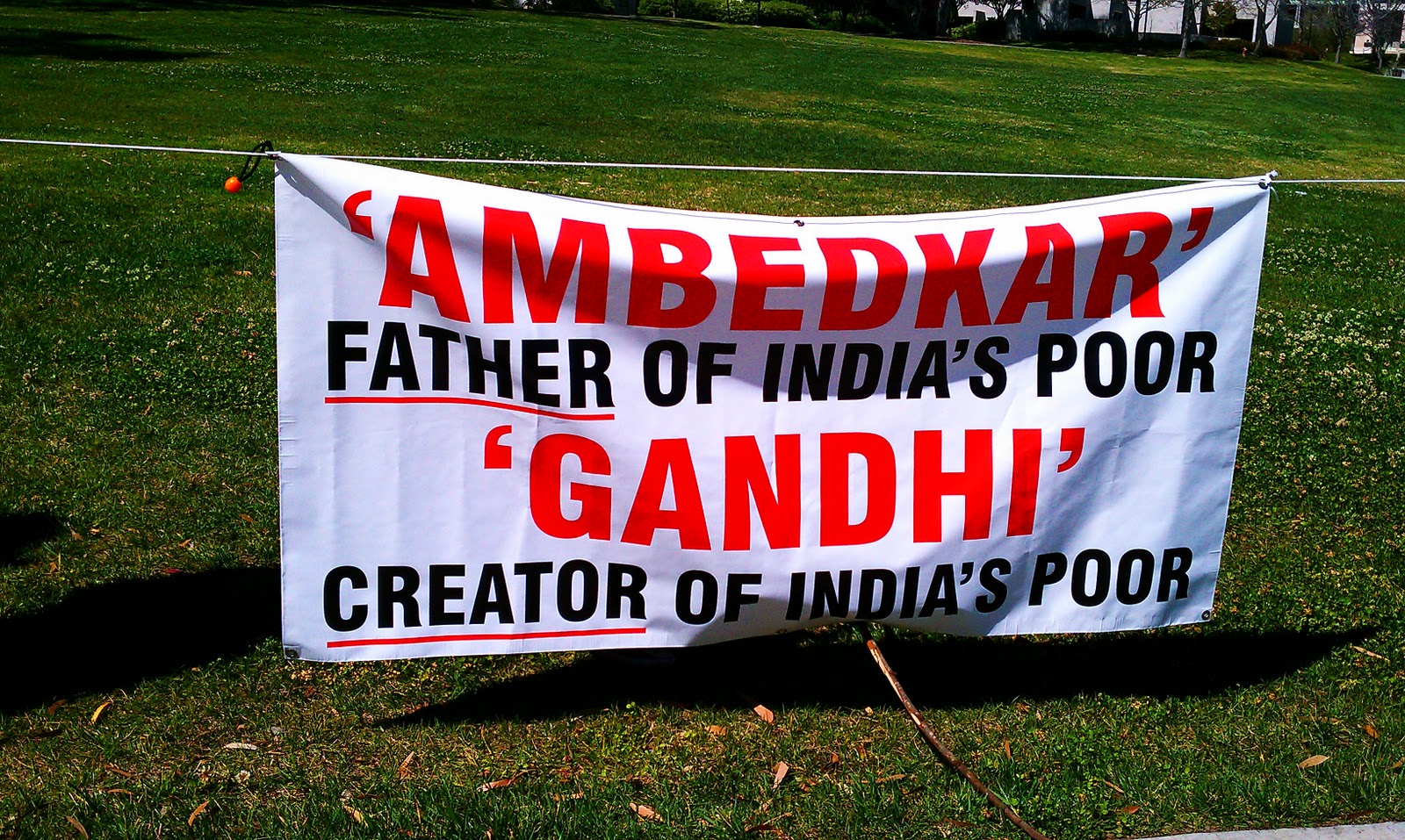
I was one of the leading member on that day in San Diego, protesting against some hindu thugs who came to run a replica of Dandi march, a gandhi rally, instead they ran for cover because they could not answer our questions, they could not justify their march against the anti gandhi rally we put up, because we had the truth on our side……….that poster you used here on this article is one of the many we put up, every single banner or poster was a world of information in itself.
The greatest betrayer of dalits and law maker Dr.Ambedkar was gandhi, and more than 60 years after his death, we are still fighting not only in India, Indian law and Indian pathological hindu system, but we have to fight against the global ignorance on gandhi displayed by people like yourself.
Hope after this you will do your diligence to learn the true background of who was gandhi, if I were you, I would change the organizations name Buddhas Peace foundation or something along the line, because gandhi is anything but peace, non-violence and love, they call him the greatest Pacifist of our times. And, if you do not believe this, go read the letter gandhi wrote to Hitler, a love letter praising Hitler, and also read about how gandhi made the Whites in S.Africa to create a third door in the post office for Indians to enter, because gandhi did not want to enter as black in blacks entry door, as whites had their own door?………………..tell me now, how much you have not known about the truth or real background of gandhi…..will you be honest enough to apologize publicly and write a rejoinder to your original “this current” piece?.
Buddhas Blessings be with you…..
Saint…..
nice comment Saint !
Madam,
After the fast of one mister Mohan Das karamchand Ghandhi alias “Mahatma” gandhi, people did not open temples and Wells to dalits following a “heart change”.they did so only to pacify the dalits who rose like one man under the leadership of bhim Rao Ambedkar.for the first time in the history of India did they recognize dalits as a potent entity in the politics of power.they did not want them to team up with the other powerful minorities namely muslims and sikhs.this was not in the interest of high caste hindus.gandhi was only interested in allowing them entry into temples not at all
Gandhi was not at all interested in emancipation of dalits.someone earlier commented that gandhi opposed Ambedkar because he did not want the hindu community to split, that his agreement to a separate electorate for muslims and sikhs was an indicator of his sensibilities towards minorities!! Haa! Haa! One should take note of the fact that apart from muslims and sikhs and Anglo Indians there were other minorities in India, like dalits and Christians, whose political representation needed protection.why then did the great Mahatma was only not oppressed to the muslims and the sikhs?? Simple! They were the powerful aggressive minorities as opposed to the dalits and Christians who were weak and non violent.so it was easier to suppress the dalit and Christian demand.and that its exactly what hee did!protection
WHAT NON-HARIJAN MEDIA WON’T TELL YOU
Jinnah’s great concern was that a united India would treat its Muslims as second-class citizens, persecuted by the Hindu majority. Sachar committee proved him right. Committee report admitted that 138 million Muslims across India are severely underrepresented in government employment, including Public Sector Units. Ironically, West Bengal, a communist ruled state, reported 0 (zero) percent Muslims in higher positions in its PSU’s! The share of Muslims in government jobs and in the lower judiciary in any state simply does not come anywhere close to their population share.
The only place where Muslims can claim a share in proportion to their population is in prison! Muslim convicts in India are 19.1%, while the number of under trials is 22.5%, which exceed their population ratio. A note sent on January 9 by the army to the Defense Ministry in 2004 said that there were only 29,093 Muslims among a total of 1.1 million military personnel — a ratio of 2.6%, which compares poorly with the Muslims’ 13.8% share in the Indian population.
As per a survey on Media, The share of upper caste Hindus or `dwijas’ in the upper echelons of the media is 85 per cent. These castes account for 16 per cent of the national population.
Brahmins alone, the survey found, hold 49 per cent of the top jobs in national journalism. If non-`dwija’ forward castes like Marathas, Patels, Jats and Reddys are added, the total forward caste share stands at 88 per cent.
In contrast, OBCs, who are estimated to constitute around 40 per cent of the population, account for an “abysmally low” four per cent of top media jobs. In the English print media, OBCs account for just one per cent of top jobs and in the Hindi print media eight per cent. Muslims too, the survey noted, are “severely under-represented in the national media”: they account for only three per cent among the key decision makers in the national media, compared with 13.4 per cent in the country’s population.
Not only the Muslims even SC/ST/OBC are living as second class citizens in India, The cumulative percentage of SC/ST/OBC employees in Central government services continues to be below their percentage in the general population. :
Depts/Bodies Class I Class II Classes III & IV All Classes
SC/ST OBC SC/ST OBC SC/ST OBC SC/ST OBC
Ministries / Departments 7.18 2.59 13.66 3.98 30.95 8.41 16.83 4.83
Autonomous Bodies 6.64 5.09 18.16 11.74 20.78 20.98 18.06 14.43
Public Sector Undertakings 4.51 4.59 18.74 9.91 31.72 15.77 19.95 10.61
Total 5.68 4.69 18.18 10.63 24.40 18.98 18.72 12.55
[OBCs are considered to be 52% of TOTAL POPULATION]
BASED ON THESE FACTS, ONE CAN SIMPLY ASSUME THAT 16% OF UPPER CASTE HINDUS ARE RULING INDIA. THEY ARE NOT READY TO GIVE EVEN 50% RESERVATION TO REST OF 84% POPULATION. THEY ARE LIKE SOME NAZI RACE THAT HAS GOT ALL THE TALENT.
SO AS JINNAH SAID, ONE CAN CONTINUE TO LIVE LIKE SECOND-CLASS CITIZEN, OR DEMAND RESERVATION AS PER THEIR POPULATION OR FINALLY DEMAND A SEPARATE NATION.