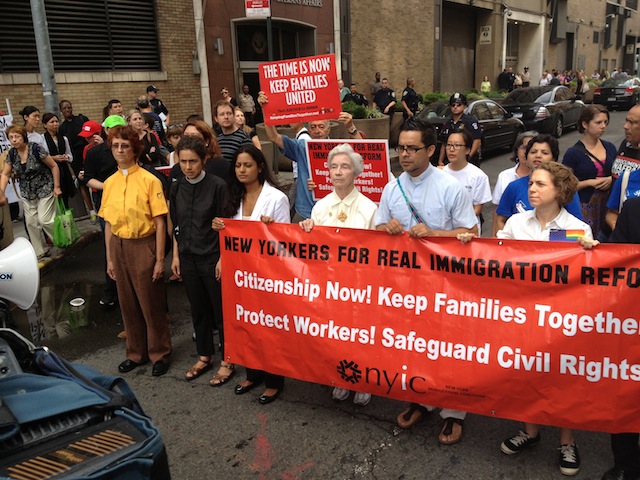
Faith leaders in New York City protest outside a Lower Manhattan detention center. (WNV/New York Immigration Coalition)
Ten immigrant justice activists, including one elderly nun, were arrested in New York City on Thursday in protest of the unprecedented detentions and deportations under the Obama administration. They also condemned the U.S. House of Representatives for its lack of action in passing a comprehensive immigration reform bill that would include a clear path to citizenship for the 11 million people living in the United States without U.S. residency papers.
Several faith leaders led a “Jericho walk” to the Varick Street Detention Center in Lower Manhattan, where people being detained are held for processing before they are transferred. The marchers arrived cloaked in white and singing freedom hymns. Others who were unable to risk arrest because of their immigration status amassed along the sidewalk, carrying signs, chanting and singing. The 10 activists spoke out against detentions, as well as the particular challenges for LGBT detainees, before the crowd coalesced in the street, effectively blocking the entrance to the detention center. Police gave warnings before the protesters, who included faith leaders and an academic, were handcuffed and taken away in a police vehicle.
Detention centers across the country are increasingly being targeted for actions that highlight the struggle of immigrant families separated by deportations. Earlier this week, four activists were arrested in Phoenix, Ariz., after chaining themselves to a fence outside the city’s Immigration and Customs Enforcement headquarters. These protests are part of 40 days of nationally coordinated civil disobedience and other actions to protest the House’s stalled immigration reform negotiations, which will not be debated until after Congress’ five-week August recess. Under the bill passed by a bipartisan Senate vote in June, undocumented immigrants will be required to come forward about their status, pay back taxes, learn English and wait an estimated 10 to 13 years to become a citizen.
The 40-day campaign began on August 1, when more than 40 civil rights, labor, religious and immigrant leaders and Dreamers — undocumented youth organizing for the passage of the Dream Act, which would provide a path to legal status — were arrested in Washington, D.C., outside the Capitol building. Protests continued in the districts of House Republicans who have not pledged support for a path to citizenship. Last week, more than 1,000 immigrant rights activists descended upon Bakersfield, Calif., at the district office of Rep. Kevin McCarthy. Several House Republicans have publicly backed a pathway to citizenship in the last few weeks, although McCarthy has not yet reversed his position.
The coordinated civil disobedience in New York City on Thursday signals that advocates — which include a broad network of workers, faith leaders, families, business owners and students — have intensified their efforts and reaffirmed demands on Congress. As Manuel Castro, campaign organizer for the New York Immigration Coalition, said, “Across the country and here in New York, we are escalating pressure and demanding a vote on citizenship for all 11 million people living in the U.S. without residency papers. This week we protested in front of the Varick Street Detention Center to highlight the fact that every day the House of Representatives fails to act, another 1,100 people will be deported, separating families and leaving children without parents.”
Tens of thousands of people are detained inside the United States’ immigrant detention system every day for unauthorized entry, reentry or residency in the country, and many are later deported. These detentions are one of the nation’s most rapidly growing segments of the federal prison system. As outlined in a new report by the National Immigration Forum, the country’s immigrant detention system costs taxpayers a whopping $5 million every day, much of which ultimately profits private prison corporations that have been contracted by the government. Under current immigration laws, judges often have little power to halt mandatory deportations of people, even those with extremely minor or outdated charges.
One of the people arrested at Varick Street protest was Juan Carlos Ruiz. He came with his family to the United States from Mexico without authorization when he was 17. Ruiz, who is now a citizen, is an ordained minister and the co-founder of the national New Sanctuary Movement. He and other leaders of New York City’s New Sanctuary Coalition staged the protest because they felt Dreamers should not be the only ones escalating action. “We believe that clergy, prominent and concerned citizens, and people of consciousness need to step up,” he said.
Ruiz expressed concerned over the immigration reform bill as it currently stands, stating that at least at least 2 million immigrants would not be eligible for legalization due to minor criminal history. “Once you are labeled as a criminal, you don’t have any rights — you are not treated as a human being.” This bill, he explained, “is going to drive people deeper into the shadows.” Ruiz also cited frustration over plans to expand the country’s detention system as well as to build additional fencing along the U.S.-Mexico border.
The issue of augmented border security has proved divisive for immigrant rights. One option they face is to accept a Senate bill that would drastically increase military presence at the border and government spending funneled to private security contractors — despite record low levels of unauthorized crossings. Otherwise, they could reject the bill despite heavy negotiations and compromise from lawmakers on both sides of the aisle. Dreamers and advocates in border communities have been particularly outspoken against border provisions in the Senate bill.
As attention is drawn to greater militarization of the border as well as the costs, scope and impact of the country’s detention and deportation policies, and as pressure for reform is amplified, faith leaders like Ruiz have increasingly joined the struggle. Catholic bishops and priests from major dioceses throughout the country have declared they will preach a coordinated message in support of reform with a path to citizenship. Evoking biblical teachings and the fact that many Latino immigrants are Catholic, their efforts will include special masses on September 8, prayer marches and phone calls targeting 60 Catholic Republican lawmakers. Even big business interests are wading into the debate, with Facebook founder Mark Zuckerberg and other tech industry entrepreneurs leading a pro-reform organization called FWD.us.
Dreamers continue to orchestrate the most radical grassroots actions to highlight the immorality of the current system. Last month, nine Dreamers who had been brought to the United States as children staged a rare protest along the U.S.-Mexico border in order to highlight record deportations under the Obama administration. When they attempted to reenter the United States, they were arrested, detained and later freed from custody after supporters nationwide demanded their release.
There are still three weeks left in the 40 days of escalating actions, which straddle the 50th anniversary of Martin Luther King, Jr.’s “I Have a Dream” speech at the 1963 March on Washington. As the anniversary was commemorated by a march in the capital on Saturday, the coordinated surge of civil disobedience highlights the persistent injustices and inequality embedded in the nation’s immigration policy.
Organizers say that after the 40-day push, massive mobilizations will occur nationwide on October 5.
Thank you for your interest in republishing this story. You are free to republish it as long as you follow these four requirements:
Credit Waging Nonviolence and link to the original. We prefer with a note at the top of the article. For example: This article was originally published on Waging Nonviolence.
Don’t sell our material or edit it, unless editing to reflect relative changes in time, location and editorial style.
Use photos or images only if you are certain they are in the creative commons or have received permission from us. To do so, email: contact@wagingnonviolence.org.
Include our Matomo tracking pixel by copy-and-pasting this HTML code into the article:
Copy and paste the following into your page to republish:
From police killings to genocide in Gaza, collective grieving practices have built lasting movement infrastructure and helped overcome alienation and burnout.
Peace and justice organizations, as well as universities, publish their own independent content on Waging Nonviolence. This Community section offers just a sample of their latest stories. Visit their individual pages to see more.
Get Waging Nonviolence delivered to your inbox
Sign up for our weekly newsletter to get the latest in people-powered news and analysis.
Donate
Waging Nonviolence is a nonprofit organization and all donations are tax deductible.
To donate by check, cryptocurrency or other method, see our Ways to Give page.
Laughable article created by a detached ivory tower liberal. It’s hard to tell after taking a look at the author’s LinkedIn profile whether this is just another day at the office for the author, or if she truly cares about struggling humans.
Charity begins at home. The author doesn’t stand on the side of the people. She stands on the side of big business, corrupt politicians, lawbreakers, and the sclerotic left wing intelligentsia.
Go ahead and call me a nativist scumbag who sits around all day complaining about “muh jerbs,” but illegal immigrants take jobs, drive down wages, commit numerous frauds (example: Jose Antonio Vargas), and contribute to the Balkanization of America. These aren’t immigrants with rights. These are lawbreakers who deserve armed escort back home.