In this issue of Fellowship we examine some of the spiritual illnesses underlying our current political dilemmas, as well as a few ways to start resolving them. But first, a moment of celebration is in order. As we go to press, it appears that a wholesale subversion of U.S. democracy has been, for the moment, prevented. We should take the time to give thanks for that, before we go back to work. Ingratitude is at the root of so many sorrows!
But gratitude to what, or (let’s be very daring) to whom? Just because not everybody in the world makes use of it, progressives need not be frightened of the name of God. I would even argue that we will never carry the day without it. The name of God moves people.
Reactionary politicians are very aware of this. That’s why Trump was preached as “God’s man” from a hundred heretical pulpits; and as soon as he seemed to be faltering, Ron DeSantis laid claim to the very same title. It’s why Mike Pence’s new book is called “So Help Me God,” and why even poor Herschel Walker was instructed to call himself a warrior for God.
It seems that the folks who are strong on the Second Amendment tend to be weak on the Third Commandment: “Thou shalt not take the name of thy Lord in vain.”
Not taking something in vain doesn’t mean not taking it at all. Perhaps it means trembling a little when you take it. There is a whole movement in evangelical Christianity (as subtly and sympathetically set out in anthropologist T.M. Luhrmann’s book “How God Becomes Real”) to turn God into the believer’s personal best friend. But this trend leaves something essential out of religious practice: humility. There can be no self-examination when there is no awe. Our integrity as people of faith depends on recognizing that God is bigger than we are, bigger than our private interests or even our private convictions. As Rabbi Abraham Joshua Heschel thundered half a century ago, “God is not an uncle. God is an earthquake!”
The whole genius of the Abrahamic religions lies in two foundational revelations. First, that what is worth worshiping is never the private deity of some tribe or another, but only the creator and sustainer of everyone. And second, that human hearts and lives are significant. We will be held responsible for how we treat them — and possessing them, for how we treat each other, and the world.
To call something God that is not this God is to turn monotheism into idolatry. The God of our scriptures is likely to take a dim view of that.
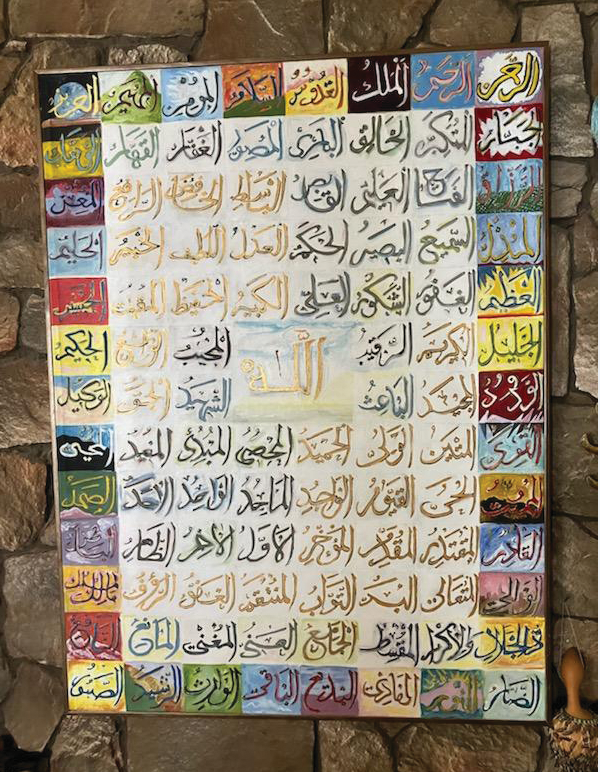
Now it is perfectly possible to serve the G-d (as our author Muhammad Hatim phrases it in his article) without naming God as such, if one’s heart is not attracted to the personalization of the divine. Accepting this possibility may be theologically easier for Muslims, who are explicitly taught that there are multiple accesses to the G-d through multiple divine names. The Qur’an says, “Call upon God, or call upon the All-Merciful: however you call upon That, to That belong the most beautiful names.” (17:110) (I am avoiding customary “Him” here in my translation; gendered languages are not necessarily making gendered identity statements!)
It is well-known that Muslim devotions include the recitation of a list of 99 divine names. It is less well-known that while there are several largely overlapping versions of this list, they all contain divine names that are impersonal as well as divine names that are personal. So if the name “God” and all the apparatus that surrounds it gives you the willies, but in your heart of hearts you love Peace, or Justice, or Truth, or Light above every lesser thing — and you put that love into practice — then there is no reason I should not joyfully embrace you as my fellow aspirer to the great community of servants. And I hope that you will similarly embrace me.
Progressives, whether or not they call upon the name of God, are united in their esteem for a conception of universal human rights. Human rights are founded on a baseline intuition of human dignity. But on what is our intuition of human dignity itself founded? On what can it rely? Given the immensity of the cosmos, why should any person matter?
It is here that the utility of theism actually begins. And progressives cannot afford to cede this territory to those who would assign that universal dignity to only a few.