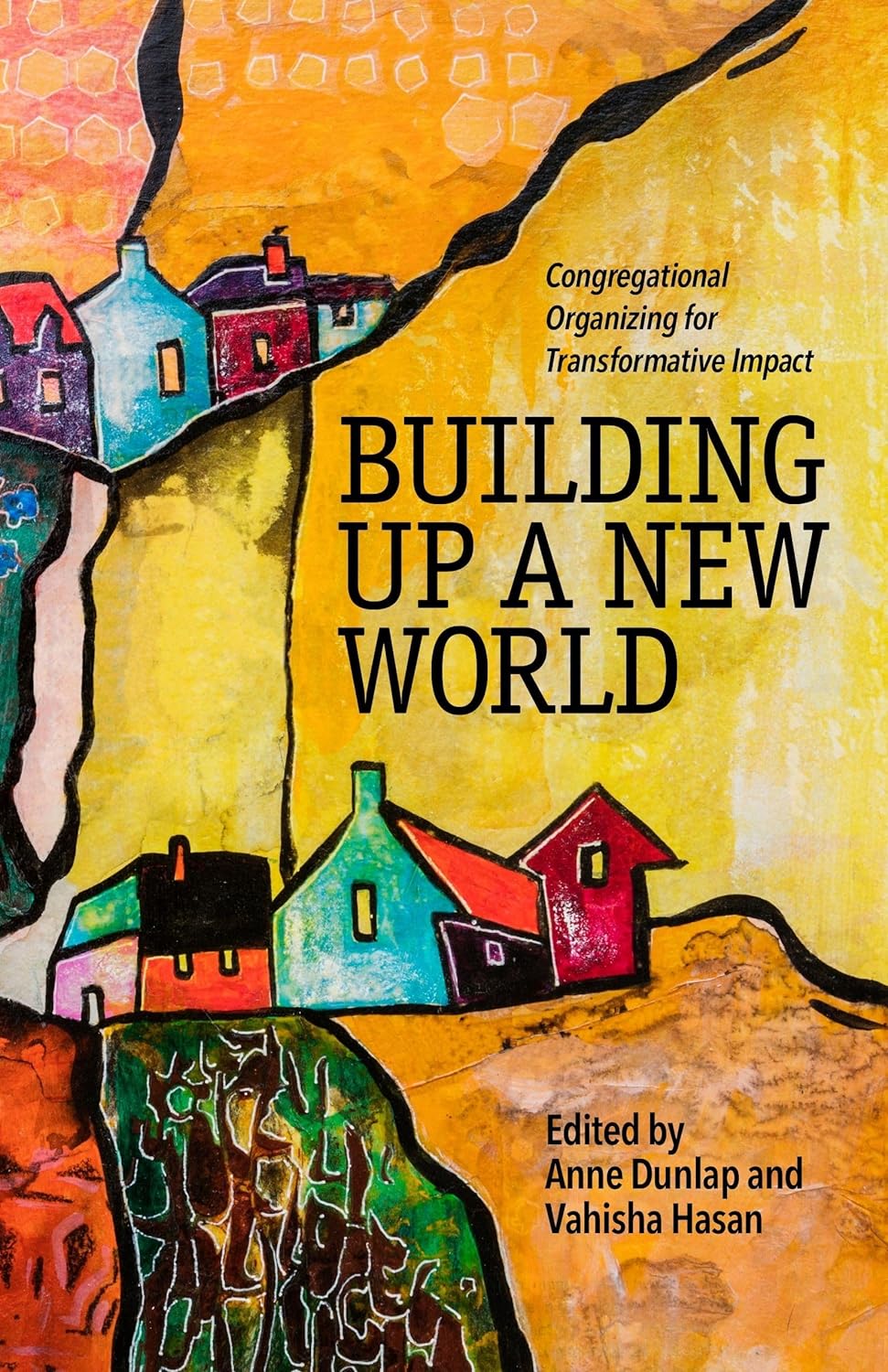
In “Building Up a New World,” editors Anne Dunlap and Vahisha Hasan have created a roadmap for congregations seeking to disrupt white supremacy on the journey toward justice.
As a minister serving a congregation in the heart of our nation’s capital, I was eager to distill the book’s wisdom even as I wondered if the language of community organizing would translate to the people in the pews. By now, my copy of the book has a creased spine, its pages stained with coffee and wrinkled by rain, since I pored over its chapters during breakfast and carted it to my child’s soccer practices. It is a book that travels — from urban streets flush with protesters to rural grocery aisles; from the isolation of COVID to the common loaf received around God’s table.
The book opens with a power analysis, not for the faint of heart, which roots systemic oppression in theological malpractice. It suggests that if toxic theology got us into this situation, then a praxis that listens to “the least of these” is our road out. In the words of Marilyn Pagan-Banks, “community organizing demands proximity.” The church, if it is not too busy attempting to save its own skin, is a natural location to gather people of every identity in transformational relationships to build collective power to incarnate a new world.
From direct action to community healing, advocacy to mutual aid, potlucks to policy reform, Building Up a New World takes seriously the setting of the local church as a site of liberation and transformation. The book includes “Breath Flow” practices, emancipatory psalms, and reflection questions. Each chapter ends with scripture, and the book concludes with a list of justice- seeking organizations.

While its critique of the church can be biting, with the inclusion of voices that organize primarily outside of the congregational setting, the book insists that the church is ultimately an organizing body. Vignettes of the Black Church providing physical assistance to disabled elders and churches sharing communion bread across the border wall into Mexico paint a picture of not simply what the church can be, but who we already are when we embody the community organizing of Jesus of Nazareth.
What issues matter in your local setting? Whether your congregation wants to reduce its reliance on policing, or to house migrants in the sanctuary, or to embody the principles of disability justice, Building Up a New World includes areas for growth and a roadmap to get there through capacity building and organizing. In fact, it might just lead to the transformation of your justice ministries, mindful that the pursuit of justice is profoundly relational.
Though some of the chapters cut to the bone with piercing language and disquieting truths about the church, grace appears in these chapters too. In the words of Chris Davies, “Church is one of those places where transformation is possible, and yet it is a slow and grace-filled process. One does not grow into oneself overnight — it’s a loving journey.”
It is also an inter-generational one. Indeed, the book’s title is taken from lyrics by Black Christian mystic Vincent Harding, a mentor to one of the editors. These words begin the book but might also serve as its benediction:
We are building up a new world, Builders must be strong.
Courage people, don’t get weary, Though the way be long.
Rise, shine, give God glory Children of the light.