Syrian independent media offers bold challenge to extremism
In Syria, the Union of Revolutionary Bureaus is empowering women and children to uphold their rights and freedom through education, job training and art.
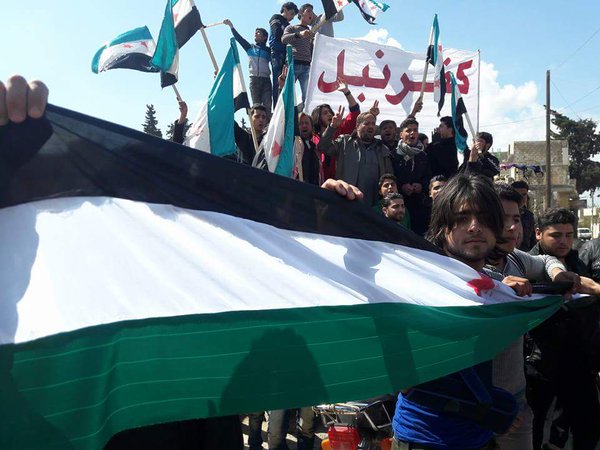
On January 10, the Nusra Front, an al-Qaeda-affiliated terrorist group in Syria, stormed the headquarters of Radio Fresh in Kafranbel and arrested its director Raed al-Fares and journalist Hadi Abdullah. The flag of the Syrian revolution was thrown on the floor and al-Nusra members stepped on it and forced the station’s members to do the same. They destroyed and confiscated equipment and books, burned the flag and — according to Ghalia al-Rahal, director of Mazaia, a women’s center in Kafranbel — shouted, “We do not want any media in Kafranbel.” They closed the station and placed a sign at the main door saying, “Confiscated by Jabhat al-Nusra, do not approach.”
This raid came in response to a post on al-Fares’ Facebook page, in which he said, “If our main concern is what’s between a man’s lips [cigarettes] and women’s legs, and as long as we are herding people to prayers and flooding our schools with Sharia books, we will have a thousand years of death to come in Syria.” Al-Nusra also claimed that songs broadcasted on the station were against the Islamic ruling of Sharia.
Members of the radio station were held inside the office for almost two hours while al-Fares was taken by al-Nusra. After hours of negotiations with al-Nusra’s leaders and Sharia judges, Abdullah provided guarantees that al-Fares would not post messages critical of Sharia on Facebook again, and he was released. Al-Nusra had to also admit that raiding the station was a mistake and promised to return all their equipment.
“As we were waiting for the negotiation, we were organizing for a massive protest that was planned to take off the next morning,” al-Rahal said. “Al-Nusra knew that we would have not kept silent.”

Al-Nusra’s attack on the station generated a strong reaction on social media where al-Fares’ story was closely followed and solidarity posts were proliferating on activists’ pages. Kafranbel’s Facebook page, which tracks local demonstrations and news, posted pictures of men and women holding signs that repeated two phrases: “Freedom for Radio Fresh,” and “No Media Oppression.”
Radio Fresh is one of the many activities of the Union of Revolutionary Bureaus, or URB, a grassroots organization that tries to empower community members to uphold their rights and freedom in Idlib province. Established in Kafranbel in 2012 by al-Fares and a young activist named Khaled al-Issa, the URB currently has 475 employees with various offices that focus on enhancing education and empowering women and children. They provide training in sewing, hairdressing, nursing, and other skills that enable women to work. Similarly, URB established centers for children where they are encouraged to express themselves through painting and art. “The bureau activities came as a natural result of the needs on the ground,” said al-Rahal, whose center is part of the URB.
This was not the first time al-Nusra has attacked the station. On January 17, 2015, al-Nusra raided a number of URB’s offices, including the headquarters of Radio Fresh and Mazaia. In response to this incident and continuous harassment and interference in civilian affairs, people took to the streets calling for freedom. They forced al-Nusra to keep the station and the women’s center running.
Al-Nusra is emerging as a powerful force to rival the Islamic State in Syria and has seized several strategic towns in Idlib and Hama provinces. Al-Nusra’s goals are to overthrow the current Syrian government and create an Islamic Emirate under Sharia law. Al-Nusra uses Islam and Quranic texts to oppress people and impose strict social values, including limiting women’s movement and dress code.
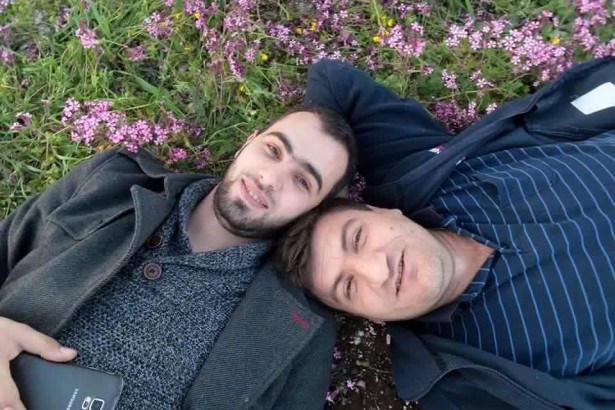
Activists, who are also Muslims, have been using Islamic values to push back. The radio station dedicates the first two hours of the day to broadcast Quranic texts, transmits prayers five times a day, and airs four religious programs a day. “While religious extremists call for death and blood, we call for mercy, respect and forgiveness — all core values in Islam,” al-Fares said. “We need to use the same tool and that which is understood by the general public.”
According to al-Fares, the true reason for his latest arrest was a campaign that he launched on the radio to raise awareness of basic human rights and against religious extremists’ practices. Using female voices, nine messages were repeated between programs and songs that challenged not only extremists, but the whole culture. These messages defend women’s basic rights and ask men to take some responsibility and support them in obtaining these rights. They are also a direct response to armed and extremist factions’ strict rules on women’s dress code and education.
In some places, al-Nusra has been busy fighting and has not had the time to interfere in civilians’ affairs. However, this may change once the fighting halts. “It is important that people increase their civil activities now as this would make it harder for al-Nusra to take control in the future,” al-Rahal said. “Al-Nusra’s members respond to people because they know that without people, nothing has value — not arms, Emirs or rulers.”
People who took to the streets in early 2011 against Assad’s oppressive regime have recently been demonstrating against all oppression. “We protest against the regime, extremists, the Russians, NATO and starvation in besieged Madaya,” al-Rahal said. Madaya is one of 19 Syrian towns under siege, where cases of death due to starvation have been reported. While Madaya is besieged by pro-Syrian government forces, other places like Foua and Kefraya are besieged by armed opposition groups. According to U.N. estimates about 500,000 people are currently living under siege.
There have been protests against al-Nusra’s aggression and strict rules all across Idlib. On January 15, people in Maraat al-Numan in Idlib demonstrated against al-Nusra and called for its departure. “Maraat is free free, al-Nusra is out out,” they chanted. A new wave of protests has coincided with the ceasefire, which went into effect on Feb. 27. On March 14, hundreds took to the streets against al-Nusra’s aggression against civilians and moderate factions. In places like Khan Shaykhoun and Salqueen, people have protested against al-Nusra’s attempt to impose Sharia clothes, or niqab, on women. In other parts of Syria, like Raqqa, where the Islamic State is in full control and brutal against civil organizations, residents are resisting by not swearing allegiance to the group. Those who do not swear allegiance have to pay for social services, which IS provides for free, and additional taxes.
Five years into the revolution, people have deeper knowledge of themselves and the concepts of citizenship, the state and human dignity, al-Fares explained. Now they are demonstrating against any regressive thoughts or oppression. “Al-Nusra and the Islamic State have arrested me and tried to kill me many times,” al-Fares said, “but this is irrelevant because what I have established in the community and with URB’s activities will always live. People believe in our values and cause, and that is why we live.”
Interesting story, which I may reprint on my website (with credit and link back, of course). But I am curious what NATO has to do with anything. NATO has not intervened in Syria.
Hello, it is very tragic what is happening in Syria. I have been speaking out for Syria since it all began, but I was shocked at the lack of compassion in the majority of people in America. So I wrote this song for the people of Syria, to bring awareness, to bring hope. Please take a moment and listen: https://www.youtube.com/watch?v=KGZDFW5kc7
Posted to my website. Thank you. http://ww4report.com/node/14799