Canada’s climate movement welcomed a new PM and a new era of organizing
Over four days of action earlier this month, activists changed the conversation on climate change in Canada, and learned some important lessons for the next four years.
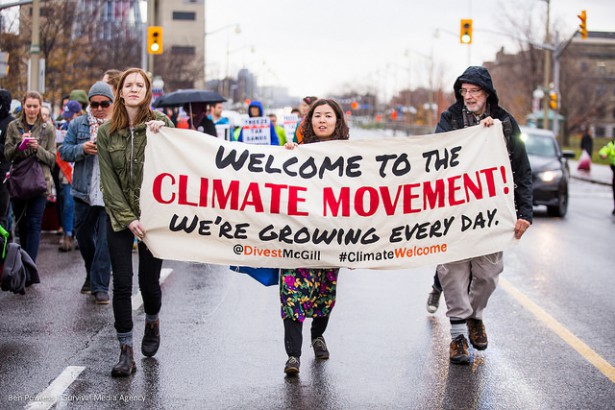
Three people march in the streets as part of an 80 person action to give the new Prime Minister, Justin Trudeau, a Climate Welcome. (Survival Media Agency/Ben Powless)
It was going to be “shrill,” “tone deaf” and “too soon” — or at least that’s what my email inbox was saying the week before kicking off four days of sit-ins called Climate Welcome at the residence of Canada’s new prime minister. The plan for the sit-ins, which I helped organize, had been hatched over 11 weeks earlier, days before Canada’s most recent election campaign had started. The goal was pretty simple: Change the conversation on climate change in Canada. We knew that no major political party in the country had a plan that lined up with the science of climate change, which requires that the majority of Canada’s fossil fuel reserves, starting with the tar sands, be left in the ground.
The welcome we had planned started months before we even announced the November action, when we launched an audacious plan to confront the leaders of every major political party on their climate plans during the election campaign. All across Canada, we worked with grassroots groups, students and community organizers to put pressure on Canada’s party leaders. The point was two-fold. First, to make it impossible for climate to be ignored on the campaign trail, and second to soften ground within the climate movement for an inevitable post-election escalation.
Two weeks before the election, we launched Climate Welcome — a pledge to show up, no matter who was elected, and risk arrest to call for bold climate action, specifically, a freeze on tar sands expansion. It was a pretty big gamble, one of the biggest I’ve ever taken in my organizing life, to call for an action without knowing who your target would be. We gamed out every possible electoral scenario and planned as extensively as we could, with strategies to handle everything from a return of a Harper majority to a hung parliament with a dangling question of who would form government. The one common denominator, and the key piece we bet our success on, was that the election, happening 42 days before this month’s Paris climate talks, would create a political pressure cooker — one that we could take advantage of to make the case for civil disobedience, no matter who won the election.
On October 19, we finally had our answer and a slew of new challenges. On the one hand, we had a clear case for our action. Justin Trudeau had been pretty weak on climate change in the election. He had a TransCanada contractor helping run his campaign and had been a supporter of the continent’s most infamous pipeline, the Keystone XL. On the other hand, he had been elected with unprecedented, and unexpected, levels of support. What was more, it seemed like progressives across Canada were so relieved with the ousting of Stephen Harper that the prevailing wisdom was to give the new prime minister a grace period. The idea of civil disobedience out of the gate had gone from raising eyebrows to genuinely raising ire. It didn’t help when the prime minister decided to forgo moving into his traditional residence, the chosen physical target of our sit-in.
As this was happening, people — who just days before the election had unequivocally supported our action — started to question the logic of our plan. While it presented a new hurdle, it also reinforced the necessity of an action like Climate Welcome. We knew that after nearly a decade of Harper in power, a lot of progressives and people in Canada’s climate movement were tired of the Sisyphean task of fighting for any climate action. The truth was, and remains, that Justin Trudeau is miles ahead of Stephen Harper when it comes to a lot of issues, climate change included, and for many that would be enough. The challenge was, and remains, that Trudeau being better doesn’t reset the damage done by a decade of Stephen Harper in power. Nor does being better on climate inoculate him from the influence of big oil, a lesson the climate movement in the United States learned the hard way in President Barack Obama’s first term.
Nevertheless, the Climate Welcome sit-ins came under a lot of scrutiny. Our team spent hours replying to messages, writing blogs and talking on the phone, going over our plans in excruciating detail to adapt to changing situations. It felt like we spent more time defending our plans than actually executing them, and I personally had started to seriously question what we had gotten ourselves into.
The Trudeau honeymoon was in full swing, and one night, while obsessing over how to respond to the latest email questioning our plans, I took to searching for someone else’s words to make the case for our plans. I was confident in them, and believed the basic underlying premise of our action was true. We knew that most politicians remembered as progressive by history were only so because people-powered movements forced them to be. The examples were many but it was the case of John F. Kennedy and civil rights that brought it home.
Specifically, it was Kennedy referencing how Martin Luther King’s “Letter from Birmingham Jail” had impacted his view of the civil rights movement, and how it had convinced him of the case of civil disobedience, in general. I had read the letter before, but this time I got stuck on one paragraph that explained the decision by King and the Souther Christian Leadership Conference to engage in civil disobedience so quickly after the election of a new mayor, Albert Boutwell, in Birmingham. King responded to critics questioning the timing of their acts by arguing “that the new Birmingham administration must be prodded about as much as the outgoing one, before it will act … While Mr. Boutwell is a much more gentle person than [the previous mayor] Mr. Connor, they are both segregationists, dedicated to maintenance of the status quo.”
Change the names and the issue, and the scenario was close to our own. Similar too was our argument for the need for action to King’s own, that “we have not made a single gain in civil rights without determined legal and nonviolent pressure.” King’s argument was so perfect that we eventually used a whole section of it (which you can read in full here) as the definition for nonviolent civil disobedience during our nightly action trainings.
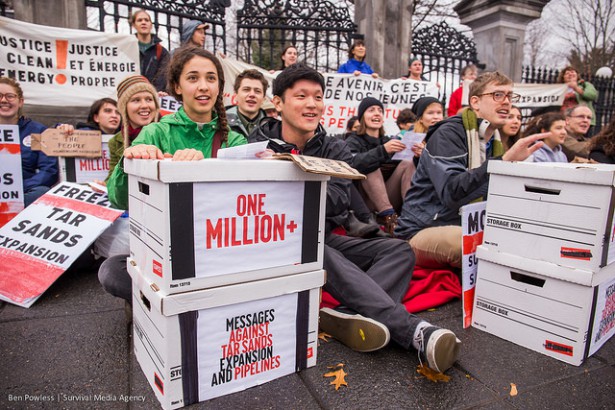
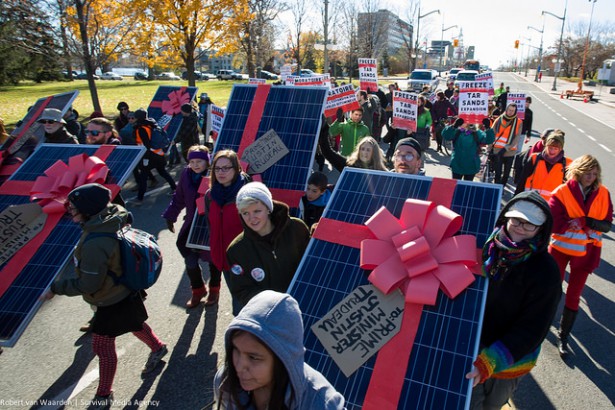
We genuinely had no idea what was going to happen on the first day of our actions. We hoped that we had made the case for Climate Welcome well enough that people would show up and risk arrest, and in the end they did. Over the course of four days, more than 200 people from all across Canada risked arrest, and many more showed up in support. We delivered reports making the case for freezing tar sands expansion, a million messages gathered over nearly a decade of tar sands resistance from around the globe and over 50 samples of water from rivers, lakes and streams threatened by pipelines and tar sands development across Canada that people brought or sent via mail to Ottawa. On the last day, we brought a final gift of solar panels for the new prime minister with a request that he install them on his residence as a symbolic commitment to real climate action. He declined to accept most of our gifts, and refused to give a clear answer to our demands, but over four days of action, we changed the conversation on climate change in Canada, and we learned a lot of important lessons for the next four years.
Young people chant and sing songs during a sit-in at Prime Minister Trudeau’s house to urge him to to freeze tar sands expansion. (Survival Media Agency/Ben Powless)
Lesson 1: Justin Trudeau is not Stephen Harper
To a lot of people on the left, Justin Trudeau is little more than Stephen Harper with a better coat of paint — a gloved hand instead of an iron fist. Whether they’re right or not doesn’t really matter because if the climate movement, and people fighting for justice as a whole in Canada, treat Trudeau like Harper, we’re probably going to lose.
Many within the climate movement, myself included, have spent their entire organizing lives dealing with a Harper government. In some ways, this has made our lives pretty easy. When you have an intractable target on your issue, the moral high ground is easy to maintain. With a prime minister who was one step shy of an outright climate denier, we didn’t really have to worry about how we were perceived. With Prime Minister Trudeau, that era is over.
Whether it’s legitimate or not — and that remains to be seen — Trudeau has cultivated an image that he is a different kind of politician. He is young, he listens to people and he has a very talented public relations team backing him up.
Case in point: During the lead up to Climate Welcome I was floored by how quickly Trudeau, who only two years ago was the subject of great derision by the climate movement for his positions on tar sands, won people over. He did it without taking any action, but simply by showing up as the polar opposite to Harper and appealing to a sense of Canadian identity that, whether a true reflection of our character or not, resonates with a lot of people.
Lesson 2: It’s not about what we say, it’s about what they hear
The work of the climate movement going forward will be a tightrope walk between co-optation and dismissal. We will need to be ambitious enough, and grounded enough in a vision of real, transformative change to resist the gravitational pull of co-optation. This is especially true in the climate movement, where for many in the mainstream, Trudeau’s election has signaled a return to a bygone golden era of access to government, appointments to committees and ambitious promises. It’s no secret that the environmental movement has often valued access over influence, and so we will need to continually remind ourselves that solving the climate crisis will require a transformative shift, the kind that can only be achieved by a mass movement pushing government outside of its comfort zone.
At the same time, we will also need to be disciplined enough to not give our targets or opponents just cause to ignore or delegitimize us. The public perception and media honeymoon for Trudeau is real, and ignoring that would be courting disaster. Tactics that may have worked with Harper in power may need to be re-thought, or at least presented in new ways, with a new tone. That’s why we showed up for Climate Welcome with the Prime Minister’s own quotes, dressed formally and with gifts. On paper it was civil disobedience, but in the streets it was a welcoming committee. It’s also why the action was designed to bring new people on board with a tactic many had never considered. We half-joked that this was the “politest act of civil disobedience in history.” By taking that tact, engaged people who likely never would have considered risking arrest — let alone on day one of a new government’s mandate — felt empowered to do so.
There’s an old saying that when you treat every problem like a nail, the best tool is always a hammer. With Harper, we were always dealing with a nail. Now we’re not — and that means we need new tools. In less metaphorical terms, it means that the climate movement needs to re-examine not only our relationship to the government, but the public’s perception of that relationship. We can’t be the apologists for this new government, nor can we be it’s harshest critics. Instead, we need to force the government to pick a side between people and polluters, and for that to work we need to be the side of the people.
A group of citizens walks down Sussex Drive in Ottowa to delivery solar panels to Justin Trudeau’s home during the fourth day of the Climate Welcome. (Survival Media Agency/Robert van Waarden)
Lesson 3: Make them pick a side
We know that a choice between real climate action and the fossil fuel industry is one that Prime Minister Trudeau doesn’t want to make. Trudeau’s administration wants big oil to hear their talking points on building the economy and protecting the planet and hear that business as usual will continue. At the same time, they want us to hear that line and infer a commitment to real action. We know that when it comes to climate change, and especially fossil fuel reserves like the tar sands, the math just doesn’t add up. We also know that the fossil fuel industry already has an inside track to this government, and that we can’t afford to underestimate the power that big oil has, even over the most well-intentioned government.
We need to force the prime minister, over and over again, to pick a side. It needs to be people or polluters, real climate action or big oil. With Harper, we knew which side he was on, but now we have the potential to start a tug of war, with Trudeau in the middle.
This will take as many sticks as it will carrots. We need to be ready to congratulate the prime minister if he does the right thing, but be no less ready to hold him accountable when he steps out of line. Remember too that baby steps won’t be enough to change Canada’s course on climate — we need bold action, and we can’t be afraid to demand it. That means that small, symbolic acts are good, but we need to consistently articulate the size of the gap between where the government is and where they need to be.
Lesson 4: We can’t forget who is leading this fight
If it were not for indigenous resistance — on the land, on the street and in the courts — there wouldn’t be a climate movement to write about, and it’s imperative that we remember that. This government has come to power with big promises on reconciliation and respecting a nation-to-nation relationship with indigenous peoples. Simply put, if the climate movement has any hope, we can’t let the government do better at working with indigenous peoples than this movement.
The work of decolonization and supporting indigenous and frontline community-led organizing is more important than ever, especially when it comes to talking about the emerging clean energy economy. Now is the perfect moment to define what a justice-based transition really looks like, and that it starts with communities on the front-lines of extraction being the first to make the transition to 100 percent clean energy. We need to make sure that while we’re driving forwards with the work of keeping fossil fuels in the ground, we’re remembering that doing so is part of a broader fight for a more just Canada and world.
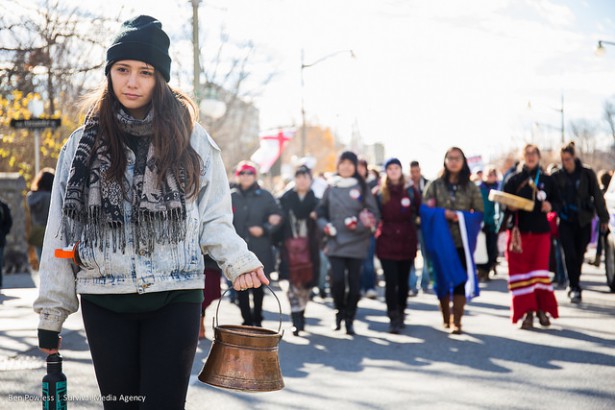
Indigenous women leaders from different parts of Canada came together to help carry the sacred water to Prime Minister Trudeau’s house on November 7. (Survival Media Agency/Ben Powless)
Lesson 5: It’s time to be relentless
There are a lot of lessons from the Keystone XL campaign that can be applied to our work in Canada, but perhaps the most important right now is to be relentless. Keystone XL activists dogged President Obama at every chance they got, calling on him to pick a side to secure his climate legacy, and now it’s our turn. This is not the moment to wait and see, but rather for what Naomi Klein has called “relentless pressure from below.”
In “Letter from Birmingham Jail,” King explains that their plan was to “create a situation so crisis packed that it will inevitably open the door to negotiation,” and that too should be our goal. If this government does not follow through on its proposed overhaul of the National Energy Board review, we should be prepared to shut it down with joy and resolve. If they do announce a new environmental assessment plan, we need to be ready to ensure that that plan is accountable to people and not polluters. We have to hold Prime Minister Trudeau to his oft-repeated line that while “governments grant permits, people grant permission.”
Part of being relentless is also about pushing our movements to be bold and creative with their tactics and targets. That is exactly what Climate Welcome aspired to be. Risking arrest during a positively-framed mass action targeted at the prime minister’s house represents a departure from the run of the mill marches to Parliament Hill and created new experiences, as well as a new level of commitment, for many activists in the climate movement.
Perhaps most of all, we have to believe in the new prime minister’s own words that “a better Canada is always possible.” We have to believe in those words so much that we refuse to let this new prime minister fail them, whatever that takes.
Thank you for your interest in republishing this story. You are free to republish it as long as you follow these four requirements:
Credit Waging Nonviolence and link to the original. We prefer with a note at the top of the article. For example: This article was originally published on Waging Nonviolence.
Don’t sell our material or edit it, unless editing to reflect relative changes in time, location and editorial style.
Use photos or images only if you are certain they are in the creative commons or have received permission from us. To do so, email: contact@wagingnonviolence.org.
Include our Matomo tracking pixel by copy-and-pasting this HTML code into the article:
Copy and paste the following into your page to republish:
From police killings to genocide in Gaza, collective grieving practices have built lasting movement infrastructure and helped overcome alienation and burnout.
Peace and justice organizations, as well as universities, publish their own independent content on Waging Nonviolence. This Community section offers just a sample of their latest stories. Visit their individual pages to see more.
Get Waging Nonviolence delivered to your inbox
Sign up for our weekly newsletter to get the latest in people-powered news and analysis.
Donate
Waging Nonviolence is a nonprofit organization and all donations are tax deductible.
To donate by check, cryptocurrency or other method, see our Ways to Give page.
Keep working on it, a great job. After all, our chidren and grandchildren will inherit this world.
Shin