Protesters call for investments in green jobs and clean energy outside the Treasury in London on October 9, 2024. (Vuk Valcic/SOPA Images/LightRocket via Getty Images)
Analysis
What the climate movement can learn from organized labor
The climate movement needs the kind of leverage that comes from shutting down the economy — and it can only get there through deep organizing with workers.
Protesters call for investments in green jobs and clean energy outside the Treasury in London on October 9, 2024. (Vuk Valcic/SOPA Images/LightRocket via Getty Images)
Climate activists engaged in nonviolent direct action are used to the rinse and repeat of arrest: handcuffs, short trip to jail, a misdemeanor charge and then release to friends for a post-action pizza dinner. Show up at court a few weeks later for a brief arraignment and wait for the case to be dismissed. Low drama.
Simultaneously, with the gutting of the Inflation Reduction Act and its attendant tax credits for clean energy investment, the federal path to climate action is blocked. And local wins, while important, cannot surmount the incredible rollbacks happening at the federal level, as Sunrise Movement Executive Director Aru Shiney-Ajay recently pointed out.
Indeed, the U.S. climate movement is in deep trouble. If all that weren’t enough, the climate crisis is no longer top of mind for many on the left, especially with the rising authoritarian threat and the focus on affordability. With civil disobedience demanding greater risk, traditional policy advocacy for climate action at the federal level closed off and public attention turned elsewhere, what tactics do we in the climate movement have left?
What’s left is deep engagement with the labor movement — its members and its tactics.
Sign Up for our Newsletter
We’ll send you a weekly email with the latest articles.
Organized labor has a broad base, a track record of major wins and the power to shut down the economy. And make no mistake: Economic leverage is a necessary ingredient in the struggle to bring down companies as profitable as those in the fossil fuel industry.
Climate activists have relied heavily on tactics of protest and persuasion (see Gene Sharp’s categories), underinvesting in tactics of economic noncooperation. While the environmental movement has a history of consumer boycotts, there have been fewer instances of work stoppages or rent strikes. The climate groups that do engage in symbolic work and school stoppages (most famously, Fridays for the Future), have mostly been confined to students and are largely to make a political statement rather than a strategic attempt to gain concrete concessions from a specific target.
Strategically aligning workers with a rapid energy transition not only broadens the coalition needed to win durable policy victories, but builds power with a movement versed in strikes, walkouts, slowdowns and other forms of economic disruption. (Not to mention a bevy of tools like community benefit agreements and co-enforcement to promote follow-through on corporate environmental promises.)
Labor-climate alliances go back decades (see Blue Green Alliance, Climate Jobs National Resource Center and Labor Network for Sustainability), and unions have long advocated for a just transition that supports workers employed in polluting industries. But in the current political environment, we need these relationships to be stronger than ever.
One major opportunity for the climate movement is the May Day Strong coalition, which brings labor and community groups together to organize mass strikes and make big demands for systemic change. The coalition’s demands don’t yet include climate, but the climate movement can still organize with them to learn nonparticipation tactics and build solidarity toward a broad base that sees climate, anti-authoritarianism and affordability as one united fight.
Lessons from labor
Think about the situation at your job. Workplaces are pretty authoritarian: the leader doesn’t care much for the input of the people on the shop floor, and what the leader says goes. If someone gets hurt, let the government step in to help them. As unions teach us, for a group of workers to extract real concessions from a profit-maximizing boss requires building enough power among workers to shut the workplace down (or at least threaten to do so).
The same dynamic is true of the fossil fuel regime and the general public. The fact is that fossil fuel companies operate with little accountability to the public they endanger through their greed, harming the many for the enrichment of the few. By thinking of them as essentially authoritarian, we can focus on how to weaken their pillars of support so as to bring about their collapse (per Gene Sharp). In the face of fossil fuel oligarchs who operate without checks and balances, a worker-inclusive climate movement capable of strategic noncooperation offers the most viable path to transformative change in the current political landscape.
Pillars to target might include shareholders, frontline workers, the regulatory landscape, physical infrastructure and institutional investors. Some of this can be done in direct partnership with unions and workers (which I’ll explore more in another piece). Concentrating on a specific choke point like port logistics or oil refining can paralyze supply chains, amplifying our impact. Sectoral strikes within these industries are also powerful, making building common cause with their workers paramount. Strikes by public-sector workers like teachers also carry a heavy punch (though they are only legal in about a dozen states and typically only when a contract has expired).
Identifying the demand, as well as the target, is key to such acts of noncooperation. Strikes targeting companies can include demands for corporate investment in public infrastructure, on-the-job retraining, environmental audits or electrification of the supply chain. Strikes by municipal workers can include demands to divest pensions from fossil fuel companies, electrify public transit, retrofit publicly owned properties, pass heat safety mandates or clarify protocols for workers responding to climate disasters. Some of this is already happening through existing climate-labor alliances. Winning more campaigns like these would weaken the fossil fuel regime’s pillars of support by targeting the physical infrastructure, financial systems and legal regulations that enable it to continue wrecking the planet.
In addition to weakening the pillars of support, other indicators of a campaign’s success include increasing popular engagement and enhancing the capacity of the movement to escalate further (by bringing in more organizers, developing replicable tactics, etc.). The tactic of economic noncooperation can deliver all three.
But if we are serious about making a real dent in emissions, we need to target the federal government. The fossil fuel industry is so profitable and so powerful that it will likely require a major policy intervention to curb its rapacious behavior. The Inflation Reduction Act was a step in the right direction, but our movement was unprepared to exert the leverage needed to protect it from an unfriendly administration. That kind of leverage comes from bringing the economy to a standstill.
Almost all of us are workers (and customers, renters, borrowers, etc.), and all of us rely on a functioning planet to live. So what would happen if we simultaneously stopped? Didn’t show up at work for a few days, and didn’t buy anything? This would take massive preparation and coordination of course, but the impact would grind the economy to a halt. No bus drivers, no teachers, no bank tellers, nothing being built or sold. This is what is known as a social strike –— a mass action by an entire population.
Carbon emissions might briefly drop, but the impact of a strike reaches beyond a single day. The United Auto Workers’ use of the “rolling strike” to win big concessions from the nation’s three largest automakers shows the power a movement wields when it can credibly threaten to strike anywhere, at any time, in enormous numbers. Just as runaway capitalism caused the climate crisis, it has also constructed an economy that would be hobbled by mass work stoppages and consumer boycotts.
This is a tall order, to be sure. Even the labor movement’s use of work stoppages has declined over the past 40 to 50 years due to national policy change, employer opposition campaigns, the collapse of union membership and deindustrialization. But recent years have seen an upsurge of interest in unions, increased organizing and heightened class consciousness — suggesting a renewed opening for organizing workers and showcasing their power.
And the climate movement has turned out en masse in the past; by some estimates, the 2014 People’s Climate March turned out 400,000 people. Imagine the number that will turn out after a historic El Niño cycle and four years of federal incompetence. Now imagine if that number of people — rather than flying to New York City and marching — all stayed home for a week. No shopping, no selling, no driving, no working.
Social strikes are rare and tough to pull off, but we saw a stirring example of their power in Minnesota this year. Roughly 25 percent of voters in the state either participated in the day-long strike or had a loved one who did.
For community members and workers across industries to participate in a nationwide social strike would take years of organizing. That’s why we need to start planning now.
The power of relationships
To engage broader swaths of the population, we need to build a bigger tent. Here the labor movement provides valuable wisdom. A helpful distinction that organizers often make is between our base and our allies. Our base shares our values but not necessarily every demand, while our allies share a specific demand but not necessarily all our values.
The climate movement’s base is made up of environmental activists, while our allies come from a wide variety of backgrounds including faith communities, student groups, human rights activists, lawyers, Indigenous groups, politicians, scientists, renewable energy companies and more. Anyone may have kids in public schools that are struggling with rising utility costs; they may rent an apartment in a complex with crumbling infrastructure; they may be part of a religious community that emphasizes responsibility for creation; they may be active with a political party that values outdoor recreation and fiscal responsibility.
These identities and memberships are valuable when we recognize that we do not need to agree on every issue in order to share some common self-interest and cooperate on a specific campaign. What enables us to continue to take coordinated action with our allies is a commitment to continued relationship building rather than shutting each other down for divergencies in viewpoints. Here climate can take a page from Saul Alinsky, who advocated for sidestepping ideological landmines and focusing on concrete issues that make a difference to real peoples’ lives.
In the current political climate, organizing based on shared self-interest is the only way forward. Families are struggling to pay the bills, and calls to deprioritize climate messaging in favor of an affordability frame are mounting. (Even Democrats are engaged in “climate hushing.”) We need a coalition broad enough to fight for both a living wage and a livable planet. Relational organizing based in self-interest is the way to build that. In his book “People, Power, Change: Organizing for Democratic Renewal,” Marshall Ganz explains that “relationships grow out of the realization of mutual benefit, the creation of shared value, and the commitment to a shared future.” Organizing to save our planet checks all three boxes.
In a labor campaign, relational organizing relies on the identification of organic leaders, training the leaders to recruit other workers, the workers agreeing on issues and then engaging in increasingly challenging structure tests — smaller actions that build organization and faith in each other. The bonds built between the workers through these tests are the basis for future organizing. In her book “No Shortcuts: Organizing for Power in the New Gilded Age,” Jane McAlevey spoke to the interaction between risky actions and building strong relationships. “[F]or workers to win substantial gains, the strike weapon is essential. … Transformational experiences come through high-risk collective action,” she wrote. Those transformational experiences tighten the bonds holding the group together and facilitate political education.
Relationship building is also important for climate groups. Organizations like the Sunrise Movement or Fridays for the Future rely heavily on peer-to-peer organizing and one-on-one conversations. Incoming activists are given real responsibilities and opportunities to guide campaigns. And campaigns against specific pipelines or other pieces of fossil fuel infrastructure tap into preexisting community networks (like neighborhood groups, Indigenous communities and faith congregations), growing stronger by building alignment around a common demand.
What the climate movement needs now is to expand those networks to include communities that we may not see as natural partners. These diverse coalitions are prominent in local struggles against data centers that engage disparate groups such as farmers, parents, IT professionals, local businesses, sports clubs and more. We need to make sure they include workers across sectors, too.
The fulcrum
The ramp-up to May Day 2028 offers a prime opportunity for the climate movement to build powerful relationships with labor groups, while at the same time engaging in structure tests toward a social strike making climate demands upon the federal government.
After the United Auto Workers, or UAW, won their successful September 2023 sit-down strike (winning wage increases, job security and the inclusion of electric vehicle plants into existing contracts), they began building for more. The union called for locals across different sectors and unions to strategically align their contracts to expire on April 30, 2028, so workers can strike on May Day, the international worker’s day (rather than run the risk of an unauthorized “wildcat” strike). When different unions align their contracts in this way, they have more leverage than if one union acted alone. The May Day 2028 demands are not yet set, and the UAW’s goal is broad: “to create a crisis for the billionaire class to win more for all of us.”
Given low union density, even 2028 contract alignments by the UAW (and possibly the American Federation of Teachers and other unions) would have limited impact without community support. Even if some workers couldn’t walk off the job in a general strike (such as those covered by a current contract, precariously employed or unable to afford taking time off), they could still participate by not buying anything, calling in sick, engaging in a slowdown, working to rule, showing up to picket lines or rallies while off work, supporting striking workers with donations or sharing strike demands on social media.
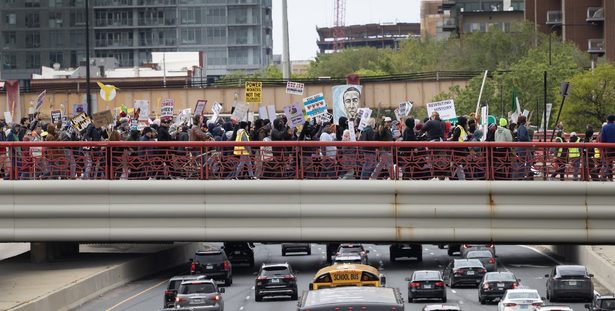
That’s the idea behind May Day Strong — a labor-community coalition that deploys economic noncooperation to demand taxing the rich, protecting the vote, reining in ICE and expanding democracy. May Day Strong explicitly organizes community members who do not belong to unions, thereby building a broader community-labor coalition. On May Day 2026, they coordinated one of the most widespread May 1 actions in U.S. history. Right now, they’re focused on solidarity schools and local actions, like support for an Indiana community that lost power during a series of storms due to the local utility company’s alleged malfeasance. Ultimately, they are ramping up to a nationwide action on May Day 2028.
Demonstrators with May Day Strong march into downtown Chicago under the banner “Workers Over Billionaires” on May 1, 2026. (Photo by Scott Olson/Getty Images)
The coalition includes many climate groups, like Climate Defenders, Extinction Rebellion, the Climate Museum, the Sunrise Movement, and more. But the coalition’s affordability agenda contains not a single mention of climate change. Given the presence of climate organizations in the coalition, that could change, depending on the power that climate-focused coalition members bring to the table.
Regardless, May Day Strong represents an opportunity for the climate movement to engage in deep relationship building, both with union and nonunion workers, and to build strike-ready capacity. It offers a chance for the climate movement to stand in solidarity with unions and with working people, in a show of good faith. If the climate movement shows up for organized labor in 2028 — and the year and a half of organizing that precedes it — strong relationships will be built.
That means participating in structure tests so the strike muscle is strong and practiced when the time comes to use it. Climate activists should commit to deeper engagement with May Day Strong, attending trainings, turning out for May Day and Labor Day actions and advocating for the inclusion of climate demands in the platform. Climate activists should also show up for workers anywhere they are on the picket line, finding common cause against the billionaire elite who threaten us all.
None of this is to suggest that the climate movement should stop organizing for local climate policies. Local decarbonization and climate resiliency remain key battlegrounds. But in the face of overt hostility to national climate policies that encourage job growth while protecting our planet, we must also expand our tactics.
Noncooperation has been underleveraged in the climate movement, and we now have a chance to learn the tactic from organized labor while expanding our base. The time is ripe for these efforts. Broad coalitions are being built to oppose the authoritarian takeover, but the climate movement has found itself on the periphery. Despite the urgency of threats to our democracy, we cannot overlook the escalating threat to our planet. Engaging more deeply with May Day Strong allows the climate movement to drive home how the pillaging of our planet goes hand in hand with efforts to squash dissent and dismantle democracy. The climate movement cannot afford to wait until other threats are resolved. When the next “natural” disaster inevitably comes, the climate movement needs to be strike ready.
Where we go from here
By using May Day 2028 as a structure test, the climate movement can build capacity for a later date of climate noncooperation. Possible demands might include asking the president to declare a climate emergency or pass an executive order reinstating certain Inflation Reduction Act provisions. The important thing is to make a clear demand that can feasibly be granted by the specific target; in Minnesota, it was simple: “ICE out.”
Significantly, this tactic could be effective regardless of the party in power. The concepts of the pillars of support and Erica Chenoweth’s rule of 3.5 percent (the principle that movements have historically succeeded when they engage 3.5 percent of the population in sustained nonviolent action), both come from the literature on civil resistance to authoritarianism, so they do not depend on a functioning democracy. Furthermore, both parties rely on the economy functioning normally and would face significant public pressure if essential workers like teachers and janitors stayed home. Economic noncooperation — including, but not limited to strikes — has the benefit of being legal (for workers not covered by a contract with a no-strike clause). And if the climate movement keeps showing up for our allies in labor, we signal to all presidential candidates in 2028 that we will not be hushed.
Support Us
Waging Nonviolence depends on reader support. Make a donation today!
With the upsurge of interest in unions, increased organizing, the narrative focus on affordability, historic polarization and heightened class consciousness, the public is ready to be organized as never before. By organizing workers across sectors and engaging in economic noncooperation, we weaken the political and financial pillars of support for the fossil fuel regime, thereby hastening its eventual collapse. That moment can’t come soon enough.
Thank you for your interest in republishing this story. You are free to republish it as long as you follow these four requirements:
Credit Waging Nonviolence and link to the original. We prefer with a note at the top of the article. For example: This article was originally published on Waging Nonviolence.
Don’t sell our material or edit it, unless editing to reflect relative changes in time, location and editorial style.
Use photos or images only if you are certain they are in the creative commons or have received permission from us. To do so, email: contact@wagingnonviolence.org.
Include our Matomo tracking pixel by copy-and-pasting this HTML code into the article:
Copy and paste the following into your page to republish:
Peace and justice organizations, as well as universities, publish their own independent content on Waging Nonviolence. This Community section offers just a sample of their latest stories. Visit their individual pages to see more.
Get Waging Nonviolence delivered to your inbox
Sign up for our weekly newsletter to get the latest in people-powered news and analysis.
Donate
Waging Nonviolence is a nonprofit organization and all donations are tax deductible.
To donate by check, cryptocurrency or other method, see our Ways to Give page.


Speaking sense. Too much of climate activism has been limited by purity, perfection, and ideological tests. Once, I was an Alinsky-style organizer. Following her advice would improve effectiveness AND solidarity.
Well done Emma! I’m going to share this!
Thank you for these excellent suggestions, Emma, from a long-time union member and ecology activist. I hope you won’t mind if I shamelessly plug my website, https://greenunionism.org where I have shared my writings on the subject (based on relevant organizing experiences) as well as some historical background and various case studies on the subject.
There are numerous examples of unions and/or workers partnering with environmentalists which are worthy of further study, particularly the Australian Builders & Laborers Federation’s “Green Bans” campaign in the early 1970s; the UK Lucas Aerospace Shop Steward’s Combine in the early-mid 1970s; and Judi Bari’s excellent work forging alliances between timber workers and Earth First!ers in northwestern California in the late 1980s-1990s (I was somewhat involved in the last example).
That is a wonderful article, very well written and extremely informative.
Emma, this analysis is compelling, and I’m a long time student of the Union movement. The challenge we find as local organizers in the climate and pro democracy movements is that most of our local, regional, and state unions and their labor councils are pretty much moribund.
Aside from UFCW and SEIU which do effectively focus on actually moving their members to political action, the building trades and manufacturing unions in the west seem to have lost their organizing chops. We would dearly love to engage with them, but so far we can’t break through their own tightly wound bureaucracy.
We’re very interested in the May Day Strong movement, and would love to know: Do they actually have union participation? If so, that could be huge.
Hi there to all, for the reason that I am genuinely keen of reading this website’s post to be updated on a regular basis. It carries pleasant stuff.