Discussion of demonstrations at the 2024 Democratic Party Convention in Chicago is being shaped by perceptions of what happened outside the 1968 Democratic Party Convention in Chicago and the trial of the Chicago 8 (popularly but wrongly known as the Chicago 7) that followed. But that history involves a larger cast of characters than has been depicted in Hollywood versions of the story.
One piece of this missing history with potential lessons for activists is the role of Eric Weinberger, who was one of those considered for indictment as organizers of the convention demonstrations.
Who was Eric Weinberger? Why might the government have considered including him along with the Chicago 8? How do I know about his close call with indictment in the Chicago conspiracy case? And why does this matter (or does it matter at all)?
Who was Eric Weinberger?
Eric Weinberger (1932-2006) was one of those activists (many of them women) whose contributions to movements against racism, war, and injustice have been largely overlooked by history and mass culture because of their modesty, low self-esteem, and role behind the scenes and out of the spotlight as organizers and facilitators rather than spokespeople or media figures.
Eric shows up in many histories of the antiwar and civil rights movements of his time, but often only in passing or in ancillary roles. Eric appears in some photos of the demonstrations outside the Democratic Party Convention in Chicago in 1968, for example, as the person holding the microphone rather than as one of those speaking into that microphone.
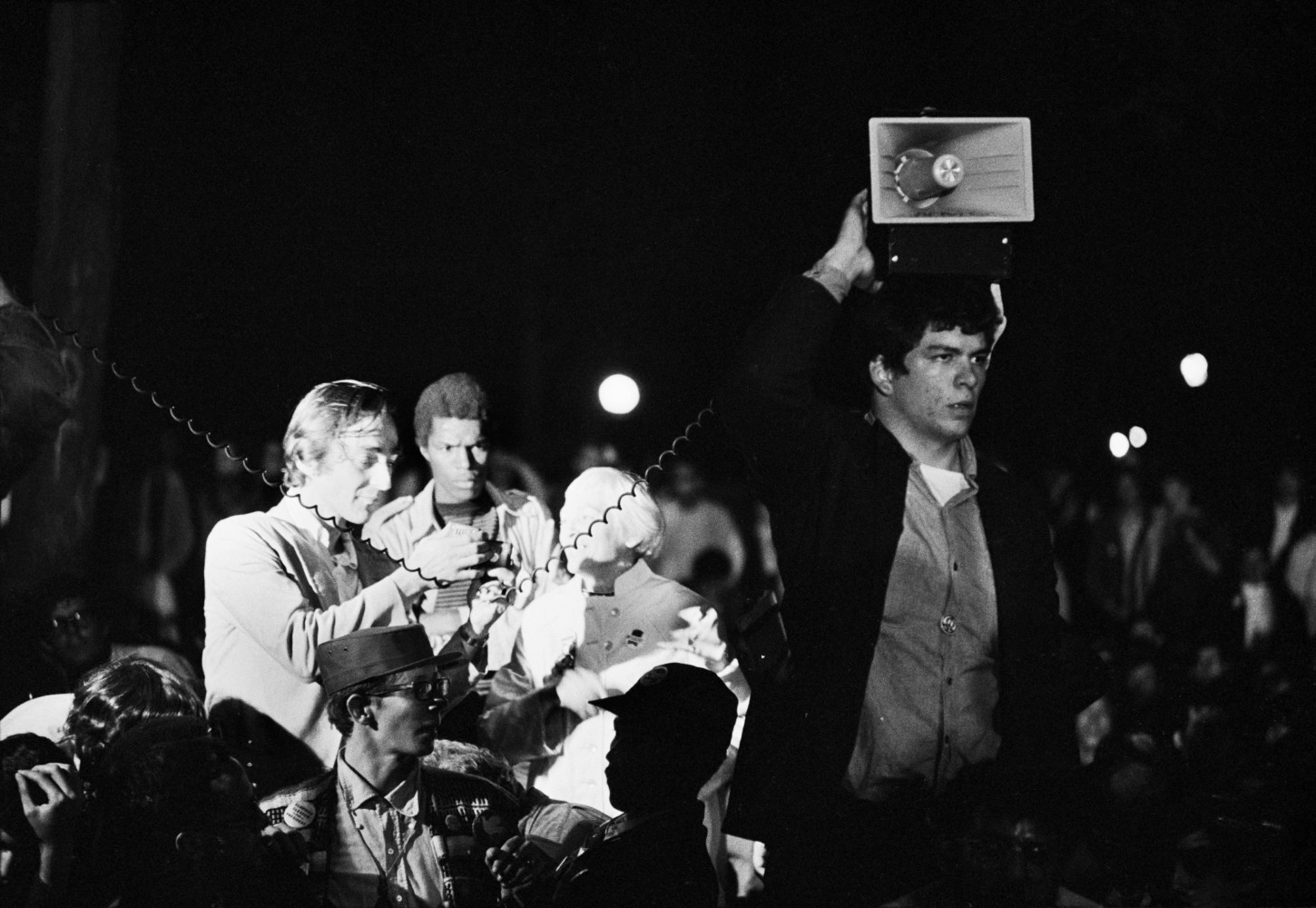
Eric saw racism and war as part of the same pattern of oppression. Already active in campaigns against nuclear weapons, he was one of the first northern white folks to go to the Deep South in the early 1960s to support Black struggles. He set up a handicrafts cooperative to help Black sharecroppers replace some of the income they lost when they were kicked off their farms for trying to register to vote. He was repeatedly targeted for police and vigilante beatings, some nearly fatal.
Eric was one of the trainers for Freedom Summer volunteers in 1964, and staffed the community center in Meridian, Mississippi, after Black Meridian activist James Chaney and northern white Summer volunteers Mickey Schwerner and Andy Goodman were murdered.
Eric played a key role in connecting anti-racist and antiwar activists and movements. One of the campaigns of which he was most proud was the Assembly of Unrepresented People, a tent city in Washington, DC, in 1965 that marked one of the most explicit convergences of the civil rights and antiwar movements. In his autobiography, “From Yale to Jail,” Dave Dellinger notes that, “The Assembly had grown out of a meeting of Black SNCC activists with Staughton Lynd, Eric Weinberger and myself.” It was Eric who followed though on coordinating many of the logistics.
Eric was part of a delegation of U.S. antiwar activists invited through later Chicago 8 defendants Dave Dellinger and Tom Hayden to a meeting with Vietnamese diplomats in Bratislava, Czechoslovakia, in 1967. Eric’s impression was that the meeting was intended by the Vietnamese as rehearsal for the upcoming Paris peace talks, with the U.S. activists as stand-ins for U.S. government representatives. Eric, a talented character actor, put his best efforts into realistic role-playing to help the Vietnamese prepare to negotiate with their U.S. government enemies.
Why did the government consider including Eric Weinberger with the Chicago 8?
With typical modesty, Eric disclaimed being the sole originator of the idea for a mass mobilization outside the Democratic Party Convention in Chicago in 1968. According to David Farber’s Chicago ‘68, “Eric Weinberger, the treasurer of the National Mobilization, or Mobe, and administrator of the Fifth Avenue Peace Parade Committee, said later that the answer ‘occurred to millions of people simultaneously.’”
The idea may have occurred to many, but Eric was among those who did the most to make it happen. Farber describes part of Eric’s role in evangelizing for the Chicago demonstrations as follows:
“Eric Weinberger tried to light a fire under the national Mobe staff. He wanted them to print up and distribute the call to Chicago. But the Mobe staff… did nothing. Finally, in exasperation, Weinberger produced the flyers himself, but he succeeded in getting out only fifty thousand.”
While movement media figures were barnstorming the country giving speeches recruiting for the demonstrations, and then flew to Chicago, Eric was holding down the office in New York and then drove to Chicago — doing his best not to attract the notice of the FBI or local police who would have loved a chance to sabotage the encampment and demonstrations — with a truckload of equipment and supplies.
Eric was part of efforts that continued until the last minute to obtain permits from the City of Chicago. Farber says that as of the day of the Mobe’s first planned march in Chicago, “David Dellinger was, that morning, still hoping he could finesse the permit snafu. He and Eric Weinberger thought that they had managed to set up a breakfast meeting with Deputy Mayor Stahl to discuss the problem. But Stahl simply didn’t show up.”
During most of the convention week, Eric was either in the streets or running the open mike in Grant Park. Eric drove back to New York after the convention, and wasn’t at the Chicago trial. It wasn’t until the 1980s, when I was studying Eric’s FBI file with him, that he realized how close he had come to being included in the conspiracy indictment.
My interest in the Chicago conspiracy trial
When I arrived at the University of Chicago in 1977 as a college student and activist for youth liberation, the unresolved traumas of the 1968 convention demonstrations, the police riot, the conspiracy trial, and the related emergence of the Weather Underground out of the SDS national office in Chicago continued to haunt all attempts at progressive organizing in Chicago, on or off campus.
Since these events were still too recent to be considered “history”, I started with primary sources. Much has been written since, but the volume of trial transcripts edited by Judy Clavir and John Spitzer, “The Conspiracy Trial,” provides a better introduction to the case than any of the secondary sources.
From the defendants’ points of view, Tom Hayden’s “Trial,” his testimony about the events in Chicago to the House Un-American Affairs Committee in “Rebellion and Repression,” and Dave Dellinger’s commentary on the trial in “Revolutionary Nonviolence” and “More Power Than We Know” may be most helpful to activists looking for case studies and analysis.
During my second year in college, Dave Dellinger came to the U. of Chicago to speak at a teach-in about the war crimes of Robert McNamara, who was being awarded a prize by the university for his “outstanding contributions to international understanding.” That night, I was arrested for the first time in the street outside the hall where McNamara was being fêted. Among those arrested with me was C. Clark Kissinger, a U. of C. alumnus and former SDS president who had been an alibi witness for Tom Hayden during the Chicago conspiracy trial.
In 1982, Dave Dellinger came to my trial for refusing to register with the Selective Service System for a possible military draft. Eric Weinberger was one of three people arrested for chaining themselves in front of the courthouse doors that morning in a symbolic attempt to block the trial from proceeding.

While it was staged by the government as a show trial, as the trial of the Chicago 8 had been, my trial had little of the drama of the Chicago conspiracy trial. But I consider it a success in having spread the message that there was both safety in silence and safety in numbers for most nonregistrants for the draft.
Dave was especially sympathetic because, like me a generation or two later, he had chosen to refuse to register for the draft despite pressure from peace movement elders who thought that draft resistance was the wrong tactic and that he should register and apply for classification as a conscientious objector.
At a teach-in the night before my trial, Dave criticized those anti-draft “leaders” and lawyers who were trying to talk me and other indicted nonregistrants into registering or making technical legal defenses. He endorsed nonregistration and noncooperation with the courts not as “protest” but as an exercise of the revolutionary power of nonviolent direct action.
In 1987, at a college student organizing conference where Abbie Hoffman and I both spoke, Abbie sought me out for advice for his son america, who was turning 18 and facing the decision of whether to register with the Selective Service System. Later in the 1980s and 1990s, I worked on defense committees for political trials in which the legal teams were led, in different cases, by Leonard Weinglass and Bill Kunstler, who had been the lead trial lawyers for seven of the Chicago 8.

What I learned about Eric Weinberger and the Chicago conspiracy indictments
I met Eric Weinberger in the early 1980s, and lived with him and his son Jeffrey before and after my time in prison for draft resistance in 1983-1984. Eric was an eloquent although reluctant raconteur as well as a perceptive observer. Like his lifelong friend Dave Dellinger, Eric listened to and sought to learn from younger activists, sharing his stories as teachable moments rather than sermons.
At some point, after the enactment of the Freedom Of Information Act and the exposure of COINTELPRO by the “Citizens Commission to Investigate the FBI”, Eric had gotten a copy of the file the FBI had kept on him. It made for fascinating reading. In Eric’s case as in that of many other activists, it was the FBI that kept the most detailed records of movement activities.
The FBI’s file about Eric included a series of urgent telexes from FBI headquarters shortly before the indictments of the Chicago 8, directing FBI field offices to forward any evidence they could obtain as to how Eric traveled from to Chicago to take part in the demonstrations.
Why would the FBI have wanted to know the details of Eric’s travel to Chicago unless the government wanted to include him in the group to be indicted?
“Conspiring to cross state lines with intent to incite” is, if I’m counting correctly, four steps removed from actually rioting, which was one of the reasons the charges were considered so outrageous at the time. Not so today. Conspiracy charges have become the norm in the war on drugs, the war on terror, and many other federal prosecutions. But while it wasn’t necessary for a conspiracy conviction to show that any of the defendants, or anyone else, actually crossed state lines, crossing state lines was an element of the underlying offense and of the “overt acts” in furtherance of the alleged conspiracy.
None of the field offices consulted by FBI headquarters responded with any leads on Eric’s itinerary. Unlike the eight defendants who were indicted, Eric didn’t fly to Chicago. He drove, doing his best to avoid police notice.
Many activists do things that could get us locked up for years. If we aren’t prosecuted, we may never know how narrowly we escaped.
Eric’s son Jeffrey was arrested for the first time during the demonstrations outside the Democratic Party Convention in San Francisco in 1984, where debate continued – as it does today — as to whether it makes more sense to protest the Republican convention, the Democratic convention, neither, or both.
Why does any of this matter?
Would it have made any difference if Eric Weinberger had been indicted as an additional Chicago conspiracy defendant?
The Chicago conspiracy trial was the most significant U.S. political trial of my lifetime. As political theater, it transformed the concept of what a political trial could be, to such a degree that some of the most novel tactics of the Chicago 8 defendants, their lawyers, and the larger conspiracy of their supporters have come to be expected as the norm for political defendants, lawyers and defense committees. On the government’s side of the aisle, the then-unusual and highly controversial charge of “conspiracy” has become the norm for federal prosecutions of both political and “common” criminals.
The government selected the defendants as symbols of a movement, and it sought to put their identities on trial. Both the demonstrators in the streets of Chicago and the defendants in the Chicago conspiracy trial succeeded, in ways that weren’t fully apparent at the time, in turning the tables and putting the system — politicians, police, courts, racism, war and the oppression of youth — on trial in the court of public opinion. If we want to replicate that success today, we should look beyond the media memes to the details of who did what in Chicago, what worked, what didn’t and why.
One of the ongoing themes in analysis of the Chicago conspiracy trial has been how the defendants were selected by the government. Knowing that there was at least one other person who the prosecutors wanted to indict, Eric Weinberger, obviously raises the question of how many others there may have been, who they were, and what omitted segments of the movement they would have represented.
The most obvious omission was, of course, that of antiwar women, including antiwar feminists. But Eric’s omission is a reminder that there were whole generations of men as well as women who were omitted from the picture of the antiwar movement painted by sketch artists drawing the people at the defense table in the federal courtroom in Chicago.
Among the Chicago 8, there was a 20-year gap in ages between World War II draft resister Dave Dellinger and the other defendants. Eric Weinberger is part of the “Silent Generation” in between, who came of draft age during the Korean War. The role of the Beat Generation with which Eric identified in antiwar activism, while significant, has been largely overlooked.
Perhaps I’m particularly sensitive to the elision of Eric’s generation from antiwar history because of the similar elision of my own age cohort, Generation Jones — those who came of draft age during the late 1970s and 1980s — from antiwar history, despite the unprecedented popular anti-war mobilization during the Reagan era. The lesson in this is that there are always counter-currents, counter-cultures, and communities of resistance, even in times of superficial hegemony.
It’s also worth speculating how Eric’s inclusion might have affected the dynamics of the trial. Eric had experience as an actor and extemporaneous performer. He sometimes worked for “liberal” organizations but had radical personal values. Eric wasn’t immune to fear, but he was capable of thinking on his feet and speaking truth to power — whether a gun-wielding KKK nightrider or a gavel-wielding judge — despite that fear. He was older than the Yippies, but respected their skill as countercultural performance artists. He was a coalition-builder who could talk to anyone, friend or foe, of any race or class. Eric seems like exactly the sort of person a movement would most want as part of a group of “representative” defendants in a political pageant / trial / media circus.
A lesson in the extent to which history has relegated Eric and others to its footnotes (in a way that would have been unlikely if they had been among those put on trial), is that behind every “leader” or media figure in a mass movement there are other people whose contributions are at least equally significant but unheralded. It’s a typical failing of Hollywood, historians, and too often of activists ourselves, to see grassroots, participatory, and anarchist movements through the lens of a “Great Man” theory of history and leadership. That can lead us to underestimate “backstage” activist work.
In 1968 as in 2024, with the Democratic incumbent U.S. president having withdrawn his candidacy for another term, the Chicago convention nominated the incumbent vice president as its presidential candidate — a candidate endorsed by the party establishment and drawn from its less progressive faction — and adopted a platform that disregarded the antiwar elements of the party. The convention demonstrations “failed” to produce an antiwar or progressive presidential nomination or platform.
But movements can have long-term impacts even when they fail to influence current events. The demonstrators in Chicago in 1968, including Eric, made history and reshaped their future — our present — and popular thinking, in ways that weren’t readily apparent in the immediate aftermath. They discredited the smoke-filled back rooms of the convention as decision-making venues, which led to changes to partially democratize the nominating process by giving more weight to the primaries. They made a major contribution to exposing the systematically repressive politics of the police, even in a northern Democratic-controlled city and even when faced with mostly-white protesters. And they embarrassed and discredited the claims of the courts (especially federal courts) to be above politics.
The Chicago conspiracy trial has been featured in at least four stage and/or cinematic adaptations, most recently in 2020. If you want history rather than Hollywood, I recommend the 1987 made-for-HBO movie, now available for streaming on Amazon, which features a script based closely on the trial transcript as well as cutaways to interviews and commentary by the real-life defendants and attorneys.
Whichever version of what happened in Chicago in 1968 you read or watch, keep in mind that the stories foregrounded in historical memory are only a small and incomplete sample of the scale and scope of activism and organizing for peace and freedom, then or now.