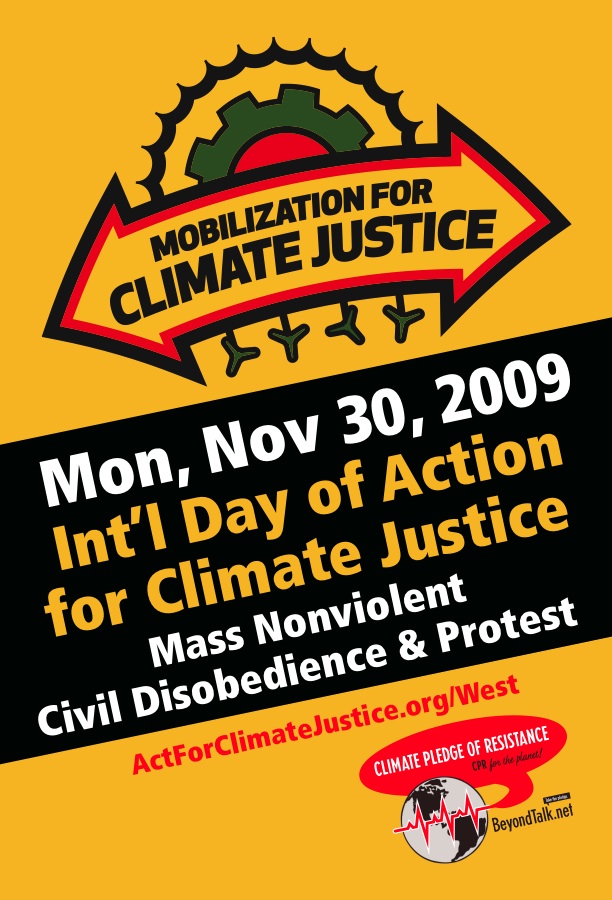
 I was immediately excited about the idea of nonviolence for sustainability when I first heard about the November 30th “Day of Action”. I have come to believe that environmental sustainability will be the issue of justice that defines our generation. Nonviolence offers a path by which to dramatize the issue, and to demand major rapid changes in mainstream systems.
From the Beyond Talk website, I found my local New York City event for November 30. There will be a rally at the Bank of America followed by a march to the offices of the National Resources Defense Council.
And so I am faced with a decision: shall I risk arrest for this particular action of civil disobedience? It’s one day before the event, and my heart’s not in it.
Am I choosing a romantic relationship over a better world? My girlfriend and I are planning to move into a new apartment on Monday: if I risk arrest, we may not be able to continue living together. And I risk losing the closeness that supports my work, and the person who will support me now and in future actions. “You should go to the rally, and join if you are moved to join,” she tells me.
Am I choosing myself over a better world? I have never risked arrest before. Nonviolence sounds smart, feels right, but when it comes to an actual opportunity that risks arrest, am I too afraid? I have no doubt that I can overcome that fear.
Or do I hesitate now because of particular details of this particular upcoming action? The event’s website declares: “Join us in a carnival procession as we chase politicians, corporate environmentalists, and grim reapers, down Fifth Avenue and expose their true alliances!”
This event does not feel like I will be protesting the darkness within myself–my own self-doubt, inactions, ambivalence, inconsistencies, fears, and selfishness.
It is a protest against the corporation, and against the corporation-friendly charity, and not a protest against the damage I do myself as a user of fossil fuels. It is a protest against them, the corporate people–someone else–and not a protest against us, all the people–ourselves. I have tried before to change them, and have not gotten far, now I feel strongly that it is time to change us.
I seek the protest against unjust practices in everyday lives. Block my roads, my bridges, my gas stations, my ATMs, my shopping malls, my produce markets. Make me ask myself whether these institutions are just. When truth stares me in the eye, my own darkness exposed, shared, support offered to defeat it, I will join you.
As for this particular rally, I will watch, and if I am moved, I will join.
As a student of Gandhi, I laud the use of nonviolent civil disobedience and protest. But Gandhi taught never to protest just for the sake of protest. The actions he authorized were always carefully selected by him and coordinated by his ultimate vision to get the British to leave India. Protest for protest sake may feel good, but may be a fairly nonproductive use of time unless the protests are planned and aimed. So I would suggest you refresh your ideas about how “actions” should work, and check out who are the leaders of any given action and what do they intend the action to accomplish. If they seem to have a clear goal and be moving toward it, I’d say give them your time. If not, if it is just protest directed into the dark, well….how you spend your time is your choice.
On a rainy afternoon in New York, I walked the streets near the planned protest, but could find none. Police officers stood idly by the lobby of the NRDC, chatting and sending text messages. Perhaps the rally was abbreviated due to rain, and I missed it.
I look forward to hearing about more nonviolent work for a healthy earth.
November 30th action “reportbacks” are listed on the front page here –
http://www.actforclimatejustice.org/
(I think those listings are easier to navigate — relative to the beyondtalk.net site.)
So far there isn’t a summary of anything that happened in New York.
Looks like the NYC rally went ahead after all: http://tiny.cc/boanrdc.
Here’s a blog entry by a participant: http://wolfenotes.com/2009/11/jim-hansen-takes-on-nrdc-and-bank-of-america/
More reports on November 30 events in other cities are at the link in the comment above. It seems most of these events protested corporate influence in climate policy. I’m excited to see strong actions for climate justice. Still, corporations and governments are the expressions of people, and I look forward to the campaign that targets hearts and minds by addressing our own everyday lives.
Indeed, it is important to follow Gandhi’s example in choosing protests carefully, and to remain focused on the particular intention of the action.