 At a time when, in the United States, majority opinions—like the need for tax increases, military-spending cuts, clean energy, and campaign finance reform—don’t seem to even be on the table in Washington, when whole neighborhoods and cities seem to have fallen off the political map, one might find oneself wondering: Where did our democracy go?
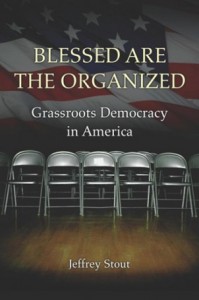
Today at Religion Dispatches, I interview Princeton philosopher of religion Jeffrey Stout. (This is a guy to look out for. His 2007 talk on “The Folly of Secularism” is probably the only academic lecture that has brought tears to my eyes.) We talked about about his latest book, Blessed Are the Organized, which came out last year—though it has been never been so relevant as now. Blessed Are the Organized is an unusual kind of book in academic philosophy; Stout dwells in stories more than theories, recounting his travels among people doing local grassroots organizing in cities around the United States.
Here’s how the interview got started:
Why are the organized “Blessed”?
Well, one definition of “blessed” is fortunate. In a shallow sense, the new elites are as fortunate as anyone has ever been. They practically monopolize society’s blessings. If we ask where the “happiness” of the 400 wealthiest Americans comes from, the answer has a lot to do with power, which is rooted in organizational structures. The CEOs of the mega-corporations acquired their power through some combination of luck and organizational skill. The elites are organized, and politicians are responsive to the organized. The richest among us are calling the tune while the politicians dance. Deregulation, the Bush tax cuts, and Citizens United v. the Federal Elections Commission all make sense when viewed in this context. The transfer of wealth from the poor and the middle class to the rich in recent decades is so enormous as to be hard to fathom. But that transfer—like the wealth itself—is a product of organizational activity.
Unhappy are those who are scattered and isolated. Unhappy are those who are weakly linked. Democratic power is an organizational, relational affair. If there is any hope of creating a balance of power in our society, one that can hold elites accountable to the rest of us, it will have to come from grassroots organizing.
Read the rest at Religion Dispatches.
good post.
Just a point, though: isn’t there majority support for non-military spending cuts as well? Also, perhaps I’ve missed the poll you’re thinking of (that the majority of Americans support alternative energy), but I was under the impression that the majority of Americans supported cheaper energy—whether or not it comes from oil or gas—as opposed to alternative energy. You seem to have conveniently left out these “conservative” preferences, which, in my opinion, made the whole post read like one that says “let’s get ‘liberal’ preferences reflected by Washington” instead of “let’s get majority preferences reflected by Washington.”
Then again, perhaps that’s what you meant, and used “majority” as a concept that would give your position legitimacy?
I don’t think environmental demands are really “liberal” or “conservative”—after all, some of the great leaders of the conservationist movement have been conservatives. In the post I link to an article that cites a great deal of polls to support the fact that these are all majority opinions. Here are a few relevant snippets: