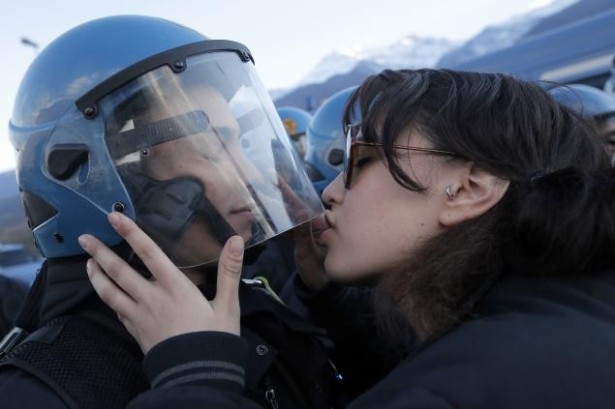
When the photograph of 20-year-old Nina De Chiffre kissing the visor of a police officer at a protest against the construction of a high speed rail line in Italy last month was published, it not surprisingly went viral. Some of the most powerful images of protest — like another iconic kiss at the height of the 2011 uprising in Egypt — are those of displays of affection between opposing sides in the heat of a conflict.
Unlike Egypt, however, where there were no known negative repercussions for the anonymous protester’s kiss, a union representing Italian police officers has announced that it wants De Chiffre to be prosecuted for “sexual violence and insulting a public official.”
While the accusation of sexual assault is a stretch, and would in most cases backfire against the police, that opportunity — and the power of her kiss — is being squandered by De Chiffre as more is learned about her action.
By offering flowers or food to security forces — or hugging or kissing them — demonstrators grab attention by behaving in ways that challenge traditional stereotypes about activism and what is thought possible during such tense confrontations. They can reveal a stark contrast between the violence of the state and a bold love that acknowledges our common humanity. At the same time, such gestures can also serve a strategic purpose by helping to win over an opponent — weakening a key pillar of support to any regime.
Despite appearing at first to be an act in keeping with this tradition, there was apparently more than meets the eye to De Chiffre’s kiss. According to the Huffington Post, she also “licked her fingers and tried to press them to the officer’s mouth before she was pushed away.” As Max Rivlin-Nadler responded on Gawker: “Sounds a little bit less tender than it did before.”
And De Chiffre hasn’t done herself any favors to make the case that she acted out of compassion. She told La Repubblica that she felt “pity and disgust” for the officer and wrote in response to the photo on her Facebook page: “No peace message. I would hang all these disgusting pigs upside down.”
She sounds confused. With love, likely she’d achieve more clarity.
Wouldn’t we all!
Likely
Biblically, on the part of Judas Iscariot, a kiss could mean a betrayal. But, since kissing is a strong tradition in Italy & a way of showing affection, which can also be likened biblically to the issue of the Prodigal son and his father, I would suggest rather than making-troubles all in the name of fighting for justice, the lady involved, should be amicably invited by relevant agency, to inquire from her, her motive or intention for her action.
administration antel.com.uy QUE PERSONNE NE MUEVAAA
Ou est explosé TODOOO 08001111 08001199 74125229171 maire Eric Garcetti
200 N. Spring St.
Los Angeles, CA 90012
(213) 978-0600
mayor.garcetti @ lacity.org
caroline coudre martin.com.uy.