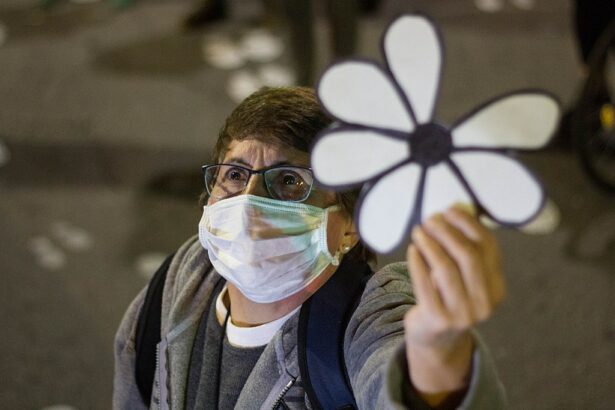
Thousands carry images of the disappeared in the March of Silence in Montevideo on May 20, 2023. (Twitter/MediaRed)
Excavations by forensic anthropologists at a notorious military base in Toledo,Uruguay have unearthed human remains. It is likely that the remains are those of one the many victims of the campaign of forced disappearance carried out by the state during the military dictatorship that began five decades ago.
The remains are the first to be discovered in over a decade, and a painful reminder of the lengths the military went to permanently disappear dissidents and leftists in a campaign that lasted 12 years. For families of the missing, the news has brought a mix of emotions. This is only the seventh person recovered of the 204 victims who were forcibly disappeared from that brutal period during the Cold War.
“For us, every time there is a discovery, there is a lot of confusion, but [there is also] joy because we can rescue a relative of ours,” said Graciela Montes De Oca, an activist with the Uruguayan organization Mothers and Relatives of Disappeared and Detained Uruguayans, whose father Otermín Montes De Oca Domenech was disappeared in December 1975. We also feel “a lot of uncertainty, nervousness, anxiety because the process of identifying that body that they found takes approximately 30 days.”
Montes De Oca was only 11-years-old when she lost her father.
Sign Up for our Newsletter
We’ll send you a weekly email with the latest articles.
According to reports, the remains were found near two other men’s bodies — Julio Castro and Ricardo Blanco, who were forcibly disappeared by the military regime in 1975. Their remains were uncovered just over a decade ago, in 2011 and 2012, respectively.
The news comes just weeks ahead of the 50th anniversary of the coup d’etat on June 27 that ushered in over a decade of military rule. In the years since the return of democracy in 1985, family members and activists have sought to find their loved ones who were forcibly disappeared by the regime. There has been a growing clamor for justice in the South American country for decades.
Since 1996, families and loved ones of the disappeared in Uruguay have marched every year, demanding justice in what has become known as the “March of Silence.” Thousands gather in a silent march with photos of the missing on May 20, seeking to break the silence of military officials from the dictatorship.
The date of the march is important, as it commemorates the assassinations on May 20, 1976 of four notable Uruguayan dissidents: politicians Zelmar Michelini and Héctor Gutiérrez Ruiz; as well as militants Rosario Barredo and William Whitelaw. They were all killed while living in exile in Buenos Aires, Argentina.
“A call to pay homage to them and all the others was made in 1996,” Montes De Oca said, who explained that the march began small. “But we started to do it every year, demanding the truth [about what happened] and justice, and saying never again — state terrorism never again.”
The number of people turning out each year has grown significantly, and has begun to permeate all aspects of society.
A woman holds an poster of a white daisy missing a petal at the March of Silence in Uruguay in 2020. (Wikimedia/MediaRed)
The campaign of disappearances has left a hole in the hearts of many families and society, and the legacy of the brutal campaign still hangs over the region nearly 50 years later. This loss is represented by the depiction of a white daisy missing a petal, which has become an important symbol of their movement, appearing regularly in marches.
The shadow of the Cold War
The Uruguayans are sadly not alone in their effort to find their missing loved ones. Others across South America are also seeking justice for victims of the transnational Operation Condor, the brutal coordinated crackdown on leftists, dissidents and activists by the region’s military dictatorships. By the time Operation Condor ended in the 1980s, between 50,000 and 60,000 people had been killed across the region, 30,000 people were forcibly disappeared, and over 400,000 people were imprisoned and tortured.
The operation was launched in 1975, when Uruguay, Chile, Argentina, Bolivia and Paraguay came together to coordinate a transborder campaign of terror to stifle dissent. Three other countries, Brazil, Peru, and Ecuador would join these operations in 1976 and 1978.
“Countries were already repressing political opposition at home for a number of years” following the coups, said Francesca Lessa, a professor of Latin American studies at Oxford University and author of the book “The Condor Trials: Transnational Repression and Human Rights in South America.” “But because many exiles and dissidents had left their countries and moved especially to Argentina, where they continued to be politically active and denounce what was happening in their countries of origin, these regimes had the same sort of shared need of silencing dissidents.”
The lengths the regimes went to disappear their opponents was extensive. They even threw dissidents into the ocean, or in the case of Guatemala, allegedly threw them into volcanoes.
The brutality of the campaign is best captured in the book “Days and Nights of Love and War” by the late Uruguayan author Eduardo Galeano. In the book, Galeano details his own lived experience as a young journalist, being forced into exile in Argentina, and hearing the rumors of the loss of colleagues and friends.
The war against leftists and dissidents occurred as the United States and Russia were engaged in the Cold War. The brutality across the Americas was part of the proxy war between these world powers. The coordinated operation by the military dictatorships saw their actions as part of the international fight against communism, and found support from the United States, which provided training to the militaries of the region.
“The United States gave support in Uruguay, and in both Argentina and in Chile,” Montes De Oca said. It was “very involved in what the military governments did here. The armies went to study at the School of the Americas to learn how to torture and how to apply repression in our countries.”
These brutal tactics, which left their shadow over generations, were unleashed across Latin America. Forced disappearances were among the favorite tactics of military dictatorships during the dirty wars across the hemisphere.
An estimated 70,000 people were forcibly disappeared during the four decade-long civil war in Colombia.
Central American regimes also regularly used the tactic during the region’s internal armed conflicts and dictatorships, including in Guatemala and neighboring El Salvador, where an estimated 45,000 people and an estimated 9,000 people were disappeared, respectively.
In the case of Guatemala, the tactic was regularly utilized against dissidents following a visit from John Longan, the chief public safety adviser in Venezuela, in 1965. His visit laid out the basis for the campaign of forced disappearances. By the following year, in 1966, the Central Intelligence Agency was acknowledging the disappearances and extrajudicial execution of communists and other dissidents. In the late 1970s and early 1980s, Indigenous rights activists would be targeted as well.
Today, families in the region continue the search for their loved ones. Images of the missing are plastered around Guatemala City, and plaques mark the place where people were abducted and disappeared or killed by government-backed death squads.
“Operation Condor and the machinery of terror deployed by the Latin American dictatorships obviously had their impact on many generations,” said Martín Fernández, a lawyer with the Instituto de Estudios Legales y Sociales del Uruguay, which has represented victims of the dictatorship.
And as Fernández suggests, the impacts of these crimes against humanity have been exacerbated by a “pact of silence” in Uruguay and across the hemisphere. Those who committed the crimes have refused to say where their victims are. Breaking this silence is the greatest challenge in the effort to find those who were forcibly disappeared.
Seeking justice and breaking the silence
The yearly March of Silence in Uruguay is just one of many manifestations in the region of those impacted by the dirty war demanding justice for those who were falsely jailed, tortured and forcibly disappeared. And pressure from civil society is increasing across Latin America, especially from the families who have lost loved ones. They are calling for the prosecution of war criminals, which has led to many high ranking military officials and soldiers facing justice for their war crimes.
In Guatemala, former military and police are facing criminal charges for their part in the campaign of forced disappearances known as the military dossier, which tracked the systematic torture and execution of 195 alleged dissidents and guerrillas in the mid-1980s. Other military leaders are facing criminal charges for their part in the disappearance of over 500 people in Military Zone 21, in Coban in Northern Guatemala, though the case is currently at a standstill.
The efforts to prosecute war criminals for human rights violations during the internal armed conflict are the result of years of struggle by the families for justice. Since 2011, several high profile military officials and paramilitary groups have been convicted of their crimes, including the 2022 verdict that sent five former paramilitary members to prison for sexual violence against Indigenous women in the town of Rabinal in the 1980s.
Organizations such as the Guatemalan Forensic Anthropology Foundation continue to seek to identify the remains of victims in order to provide closure and peace for their loved ones. Similar efforts by other groups have occurred in Uruguay, Argentina, Mexico and Colombia.
Double Your Donation!
We simply can’t create stories like this without your support. Donate today to our summer fundraising drive, and the first $4,000 will be matched!
In Panama, the families and the state have agreed to a settlement for the crimes committed by the dictatorship. The creation of bodies to oversee transitional justice in Colombia, including the formation of the Special Jurisdiction for Peace, have opened the door to begin the search for those who were forcibly disappeared, but it still remains an issue.
Efforts to prosecute war criminals for the atrocities carried out as part of Operation Condor have advanced in countries such as Argentina and Chile. But for Uruguay, justice seems to be just out of reach, in spite of attempts to hold the military accountable.
Organizations took their quest for justice to the Inter-American Human Rights court to seek justice for the disappearance of a young woman in 1975. The case resulted in the Uruguayan supreme court lifting the blanket amnesty for military officials. In the years since, a handful of cases have been prosecuted, resulting in sentencing.
But among the major challenges families across the southern region of South America face in seeking justice for the missing is the continued personal and institutional silence of the militaries.
“Why can’t they know where [their loved ones are]?” Fernández said. “What did they do with their relatives? Why don’t they tell them? Why don’t they give them the right to bury [them] and have a place to go see them?”
Amidst the silence of those who were in power during the dictatorship, organizations such as Mothers and Relatives of Disappeared and Detained Uruguayans have continued to keep the memory of the missing alive in Uruguay. The increased participation of people in the March of Silence is among the examples of the success of their movement. Each year more and more people from across society speak out demanding justice.Through their efforts over the last decades, the month of May has become recognized as the month of memory of what occurred during the dirty war in Uruguay.
Beyond just the March of Silence, they have organized to promote the teaching of the missing in education, guaranteeing that this history will not be repeated. They have worked and pressured the government to include the information in education. Their efforts have found success within the previous administrations of Tabaré Vázquez and José “Pepe” Mujica. But Montes De Oca says they have seen setbacks during the current administration of Luis Lacalle Pou, who she says wants to “misrepresent what occurred.”
“All these events that occurred in the dictatorship need to be taught in schools,” she said. “The only thing that can help us is for people to be aware of all the terror and horror and the non-human acts that the military regime practiced. If the new generations know, it is the only thing that could assure that this will not happen again.”
Thank you for your interest in republishing this story. You are free to republish it as long as you follow these four requirements:
Credit Waging Nonviolence and link to the original. We prefer with a note at the top of the article. For example: This article was originally published on Waging Nonviolence.
Don’t sell our material or edit it, unless editing to reflect relative changes in time, location and editorial style.
Use photos or images only if you are certain they are in the creative commons or have received permission from us. To do so, email: contact@wagingnonviolence.org.
Include our Matomo tracking pixel by copy-and-pasting this HTML code into the article:
Copy and paste the following into your page to republish:
From police killings to genocide in Gaza, collective grieving practices have built lasting movement infrastructure and helped overcome alienation and burnout.
Peace and justice organizations, as well as universities, publish their own independent content on Waging Nonviolence. This Community section offers just a sample of their latest stories. Visit their individual pages to see more.
Get Waging Nonviolence delivered to your inbox
Sign up for our weekly newsletter to get the latest in people-powered news and analysis.
Donate
Waging Nonviolence is a nonprofit organization and all donations are tax deductible.
To donate by check, cryptocurrency or other method, see our Ways to Give page.