A gorgeous bike ride along the Hudson River this Memorial Day took me past West Point. At the front gate, I happened to notice this sign:
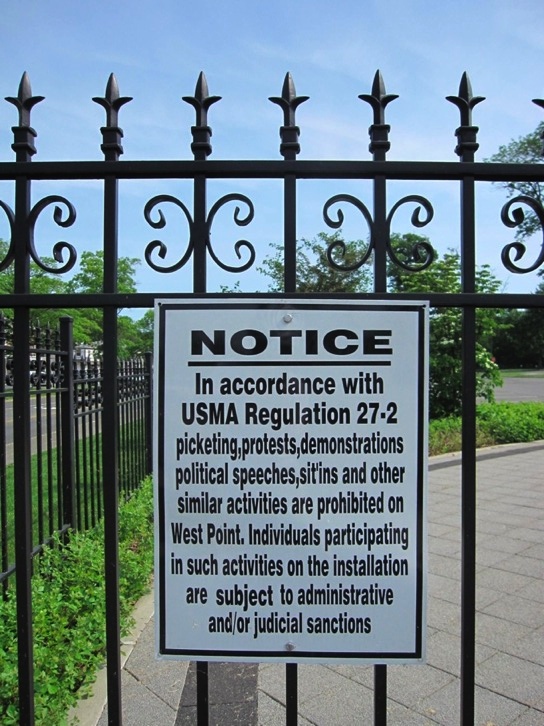
No, we wouldn’t want cadets to know that a great many of those they’re training to protect would prefer not to have the kind of protection they’ve been in the habit of providing.
That said, on the train back this evening, I talked the whole time with two women who just finished their first year at West Point. Both were friendly and eager people—one even has the highest GPA in her class—though it wasn’t clear that they had thought through the decision to attend as much as one would hope. Then again, how could a 17-year-old, or anyone, take possession of a decision like that?
Like many military people I meet, they were quite open-minded. We discussed torture, armed drones, “black sites,” the Iraq War, and just-war theory. They thought it a shame that the humanities—which might make more reflective, empathetic cadets—are so poorly represented at their school.
I wish I had asked them: What does it feel like to pass this sign at the gate when you come to and go from the place you’ve entrusted to teach you about the world?

Correcting your initial supposition: We would want cadets to know that a great many MORE of those they’re training to protect WOULD prefer to have the kind of protection they provide.
The cadets would have probably answered your question something like this: “The sign does not bother me. I came to West Point to serve my country and be a better leader. Political demonstrations have no place on military posts. Individual soldiers may have opinions, but the Army as an institution is apolitical. Go protest Congress or the White House.”
Here’s a court case concerning the sign:
http://openjurist.org/488/f3d/136/sussman-v-a-crawford-07-2171
Cheers
Now it’s clear after reading the biographies of the people involved with this blog. They tout their education and accolades but have nothing worthwhile relating to real world experience. In other words, a bunch of self-styled intelligencia spouting off on subjects they know little or nothing about. It must be nice to sit comfortably here and wax poetic about your non-violent ways. Unfortunately that’s not reality. Until you have done something more than learn in a classroom and sit at your sidewalk cafes with your ignorant friends, you’d probably be better served by saving yourself some embarassment and sticking to subjects you know.
To add to the irony, that sign is on the fenceline of the visitors center, which is not even part of the main post where the cadets are housed.
With respect to the study of humanities at the Academy, you (and they) are incorrect. Humanities and liberal arts studies now represent over 75% of cadets’ majors, to include international relations, political science, leadership, organizational behavior, English, history, and foreign language and cultural studies. Engineering and technical majors are now the minority.
And while the cadets with whom you conversed may not have been able to describe why they came in words, they will figure it out. Many times, entering as teenagers, the reasons that brought them there are not the reasons they stay. A four-year scholarship to the nation’s #1 public university is a great reason to start down the path, but it does not keep you there for four years of hard work and regimented discipline. Not when there are so many other options out there. As they grow up in gray uniforms, they must DECIDE to stay and to serve, that there are more important things than paychecks, fancy cars, big houses, and the latest iPhones. They realize that service to others, even those that don’t realize and appreciate the magnitude of the sacrifice, is a greater reward than any material thing. God bless them and I wish we had more of them.
jop
USMA 96
…and never mind the fact that they signed up during a known time of war. Knowing full well that, upon graduation, they will very likely be going someplace where a lot of people will be very hostile towards them (and no, I’m not talking about NYC, SanFran or the White House).
Along with the other three respondents to this post, I signed away *a decade* of my life at age 18 (four at West Point and six active duty). Did I really *know* what I was getting into at that time? Probably not. Did I have a good idea? Absolutely. Would I change anything? Yes, I would have studied much harder. I would have exploited the educational and leadership opportunities provided me to a much greater degree. But life itself is a learning experience – when *lived* that is (not blogged).
Lastly, if you or some imaginary “great many” would not prefer the protection provided – not only by USMA grads, but American servicemen and women everywhere – there are certainly a *great many* places you can go and be unencumbered by such people. I have always been curious to see what a “nation” or “state” full of non-violent, communal, collectivism types would look like or how long it would survive. It’d be quite comical actually. Someone should call Hollywood – this could be the next great reality show. It may only last four or five episodes or so, but it’d be fun to watch.
All jabs aside, this weekend – above all others – go grab a double skinny, caramel fluff-atte with a couple extra shots (on me) and ponder these two salient quotes. I guess I don’t really expect you to get them, but try:
“The soldier, above all other people, prays for peace, for he must suffer and bear the deepest wounds and scars of war.”
-Douglas MacArthur
“Greater love hath no man than this, that a man lay down his life for his friends.”
-King James Bible
kjw USMA ’96 – For Freedom We Risk
Thanks for all your comments—particularly your answers to my (somewhat) rhetorical question, which are quite insightful. D. Killion, I think you’re right that protests about military policy would be better aimed at Congress and the White House, but I hate to think of young people being trained to protect free speech without being allowed to see or use it.
Vinny C, consider it a mercy that we don’t bother to list every aspect of our life experience on our little bios. We all do what we can with what we have.
Jeff, thanks for your information about the cadets’ majors. Can I ask for the source of your data? My limited anecdotal experience doesn’t support that, so I’d be interested to see better information.
Together with Kyle’s point, I can’t agree with you more that young people should learn to value better things than cars and iPhones. And that we should all honor and aspire to self-sacrifice in the service of a cause greater than ourselves. I hope you realize that’s the kind of nonviolence that we here argue for; not a vapid pacifism that expects the world to suddenly turn harmonious and perfect, but an ethic of resistance against injustice that fears death less than compromising one’s best ideals. Kyle’s two quotations very much speak to our own beliefs, except that I might replace “victim” with “soldier”—and suggest, in keeping with my original remarks, that perhaps the latter is at times among the former.
The pair of jabs against us about coffee is pretty interesting; not that it matters, but none of WNV’s editors happen to be habitual coffee drinkers (though I am admittedly beginning to cave).