In Southern France, from Pamiers to Toulouse, the massive water table fed by runoff from the Pyrenees mountains is under threat. The culprit: gravel quarries.
Gravel pits built above the water table create large, uncovered reservoirs, leaving it exposed to evaporation that clearly lowers the water level. The holes are then filled in with toxic waste from construction sites, either from private construction companies or public demolition works. The gravel quarries are paid to dispose of the waste.
Construction waste does not have the same porosity as gravel — normally the sand and gravel act as a natural purification system for the groundwater. In contrast, the construction site waste destroys this filtering capacity, blocking the natural function of the water table and resulting in polluted water. The gravel quarries’ activities also exacerbate drought, drying up local streams, rivers and soil — as the water table is low, it sucks water back up from streams, leaving them dry.
There have been claims that the construction waste is not toxic, but in contact with water this isn’t the case. Local environmental associations have done tests on the area that demonstrated toxic levels of aluminum — a component of concrete — from the construction waste that is dumped in the water table.
This water table is essential to the city of Toulouse’s water, and according to local environmental groups, 2,500 acres of land are already being exploited, are authorized for exploitation, or are under threat.
Last summer, much of France suffered a drought that ran through autumn and winter. Although it rained in spring, it wasn’t enough to fill up the water tables. With the unpredictable and perturbed weather patterns we face due to climate change, conserving and protecting water is a fundamental issue.
Gravel from the quarries may be used for projects like the proposed A69 motorway extension from Toulouse to Castres, or the harbor extension at Port La Nouvelle — both highly contested by local environmental groups. Campaigns, supported by Greenpeace, Extinction Rebellion (XR), and others, are underway to bring attention to the ecological tragedy of these schemes.
Both the gravel pits and the proposed A69 extension involve land-grabbing and the ensuing degradation of fertile land. The harbor extension at Port La Nouvelle has been of great concern to local environmental groups due to the detrimental effect it could have on the biodiversity of the Mediterranean marine ecosystem, notably the lagoons behind the harbor.
At this time of worldwide ecological breakdown, the need to protect and restore biodiversity is urgent and essential. In December 2022, the U.N. Convention on Biodiversity was held at COP15 in Montréal, Canada, during which the majority of the world’s countries agreed to take action to protect and restore biodiversity planet-wide. Yet the gravel industry continues its destructive activities that harm aquatic and terrestrial ecosystems, destroying biodiversity.
Once ecocide becomes international law, which is expected by 2030, environmentally harmful activities like the production of gravel pits will be open to legal scrutiny. Although Macron has encouraged ecocide becoming international law, it has not yet been adopted in France. So it has been up to a pioneering group of concerned citizens to rise to the challenge of doing something to protect this water table.
Coinciding with Extinction Rebellion France’s 2023 theme of water, water protectors from XR Foix organized an event that took place over the first weekend in July to raise awareness about this hazardous industry. They were supported by local Earth-defending organizations that were at the origin of this fight to protect the water table and have continued for 14 years.
XR Foix pointed out the timely need to review how these gravel quarries function, and the utility and integrity of the projects they are used for. In this current era, which calls for us to restore Earth and reduce global energy use, ecocidal projects aimed at increasing consumption are questionable.
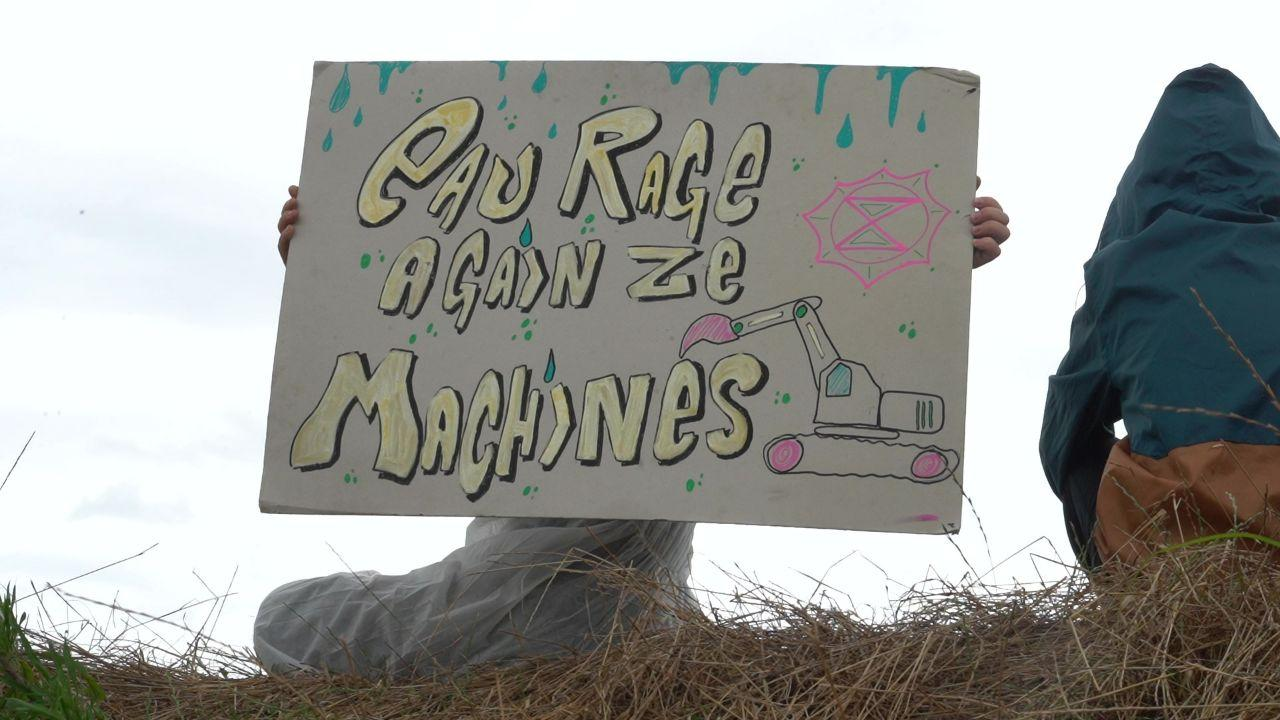
XR Foix’s three-day event was held on private land and included a round table conference, music and food, as well as childcare, in an atmosphere of solidarity. It was well organized with information areas on eco-anxiety, judicial rights during nonviolent civil disobedience and first aid.
On Saturday a nonviolent action took place, with a cortege walking to the site of the gravel pits and putting banners in place. Thankfully, there was no trouble with the police. The organizers had assured the local authorities that there would be no structural damage to equipment in exchange for a peaceful demonstration.
Over the last six months in France, there have been many incidents of police violence against citizens, including against demonstrators opposed to the lowering of the pension age, protests following the death of 17-year-old Nahel, who was shot by police, as well as environmental activists. In France, there is a tendency not to trust the police, perhaps left over from World War II, where they were known to aid the Gestapo. Police violence is a major issue and when demonstrators also resort to violent retaliation, public support can stagnate.
In the spring, a major event was held at Saint-Soline against massive water reservoirs that deplete the environment and negatively affect local farmers, profiting large agricultural corporations. France has a great history of agriculture and of resistance, with farmers highly present in social movements. Even though the large majority of activists present were nonviolent, the scene resembled a war zone as the police used grenades, known as blast balls, to rain down tear gas on activists. Unfortunately, there was a small percentage of demonstrators who counterattacked the police. Around 200 civilians were injured as a result, as well as about 40 police. Violence begets violence.
Since then, the French government has used this event as justification to criticize environmental defense associations in general. The French Interior Minister Gérald Darmanin went so far as to call environmental activists “ecoterrorists,” and they even banned Les Soulevements de la Terre, or Earth Uprising. Consequently, awareness and membership of this organization rose in response to the government putting what is seen by many as undemocratic, authoritarian controls on the public’s freedom of speech and demonstration.
This raises questions as to how international law should respond when citizens are taking nonviolent action with the intention and conviction of protecting and defending the Earth.
The speed at which the XR movement has grown in France, alongside numerous other international and national Earth-defending organizations, is testimony to a growing understanding of the urgent need to protect Earth, and to do so with nonviolence — a principle of XR worldwide.
More and more people around the world are realizing the importance of protecting our sacred Earth, and when a critical mass defends life in a nonviolent fashion, it becomes unstoppable.