- Analysis
Why the climate movement is actually close to winning
Despite widespread discouragement among climate activists, a tested blueprint for successful movements shows immense progress being made.
In January, U.S. climate activists prepared for one of the largest direct action protests against fossil fuels in years. The plan was for people to descend on the Department of Energy headquarters for three days of sit-ins protesting a series of massive liquefied natural gas, or LNG, terminals up for approval on the Gulf Coast. If built, the projects would dramatically increase the amount of fossil natural gas being burned around the world. Hundreds of activists readied themselves to risk arrest.
The sit-in never happened, but not because activists lost their nerve. Rather, just a couple weeks before it was to begin, the Biden administration announced it would delay its review of the LNG projects to look at their climate impacts. The eventual fate of the terminals remains uncertain, in light of court challenges and Biden’s shaky re-election prospects. However, the fact that activists moved the administration without one actual arrest represents a remarkable win.
 How older climate activists helped win the fight over LNG exports
Successful social movements — especially big, complex ones like the climate movement — are messy affairs. Victories are hard-won, and sometimes the end goal seems unreachable. However, there are patterns movements follow as they expand from the political fringes to start shaping national decisions. One framework for identifying these is the eight-stage “Movement Action Plan,” or MAP, articulated by activist and scholar Bill Moyer in 1987.
Trying to fit the whole climate movement, with its many sub-movements, projects and campaigns, neatly into the MAP isn’t simple. After all, it is arguably really a composite of movements for fossil fuel divestment, community-centered clean energy, and just solutions, as well as against coal, oil and gas development.
Still, preventing the worst effects of climate change is a definable goal, requiring a set of policy wins that no single one of the smaller movements above can accomplish fully on its own. For this reason, there’s value in taking a big-picture look at the larger climate movement through the lens of the MAP. Doing so helps show how we got to a point where activists dealt a major blow to one of the biggest fossil fuel build-outs in history with relatively little effort. It also suggests possible paths forward for the movement.
Today, many climate activists seem discouraged, unable to appreciate how successful their own efforts have been. Putting their work in the context of the MAP’s eight stages suggests there is more reason for hope than some realize.
According to Moyer, during Stage One of the MAP unjust conditions “are maintained by the policies of public and private powerholders, and a majority of public opinion.” This applies to the state of affairs for climate issues in the U.S. through the early 2000s, before there was a national, grassroots climate movement. Frontline communities resisted the fossil fuel industry and some explicitly connected their struggles to climate, but without the support of a national uprising. Large environmental organizations supported curbing carbon emissions, but the issue had yet to become a top priority even for them.
The science of climate change has been well established since the 1970s, but its implications were largely ignored by policymakers, the media and the public. Occasionally, events like Dr. James Hansen’s 1988 testimony to Congress elevated the issue in the news, but without much lasting impact. Public confusion about climate science was partly by design, as fossil fuel companies deliberately sowed misinformation.
Stage One is a demoralizing time for movements, when success may seem unimaginable. During this period for the climate movement the scattering of frontline communities, scientists and a few writers seeking to call attention to the crisis seemed to be shouting into a void.
During the MAP’s Stage One, the status quo is reinforced by the public’s misconception that if something were seriously amiss, officially sanctioned forms of advocacy like lobbying should be sufficient to rectify the problem. Stage Two is about shattering this illusion.
Traditional advocacy organizations, which Moyer called “professional opposition organizations,” or POOs, play a key role during this stage. By trying to fix a major societal problem through official channels, POOs end up demonstrating the inefficacy of this approach. Thus, in the ‘90s and 2000s, environmental nonprofits with paid staff and substantial — but largely passive — memberships lobbied, petitioned and pleaded with policymakers to act against climate change. These efforts were not entirely without results; for example, investments in clean energy were included in the Obama administration’s 2009 economic stimulus. Yet, there were limits to what they could achieve.
In late 2009, activists hoped the world would adopt a legally binding climate treaty at U.N. talks in Copenhagen. Instead, the talks collapsed, with the Obama administration expending minimal capital to change the outcome. Efforts to pass domestic climate legislation unraveled around the same time. By mid-2010, it was clear lobbying and petitioning would not, on their own, turn the tide on climate.
Becoming disillusioned with institutions is painful, and during this stage activists may lash out not just at government decision makers, but POOs whose efforts failed to achieve the needed change. This anger is useful when it motivates people to try new approaches to activism. However, POOs serve a necessary function during Stage Two by demonstrating the limitations of official advocacy channels. And, to the extent that they achieve some partial wins, their work may lay a foundation for broader change.
The next stage of the MAP involves conditions aligning to create a political environment where the birth of a broad-based movement becomes possible. This may involve national or global events over which activists have little control. For the climate movement, these included:
 There’s no predicting when movements will erupt, but this classic activist resource maps their path to success
According to Moyer, in response to external events during Stage Three, “growing numbers of discontented local people across the country quietly start new autonomous local groups, which as a whole form a ‘new wave’ of grassroots opposition [to status quo policies], which is independent from the established POOs.” This takes thousands of volunteers pitching in to hold meetings, build supporter lists, and train others in organizing.
In the 2000s and 2010s, a diversity of decentralized, mostly volunteer-run climate organizations took root in the U.S. These included climate justice groups tied to specific communities, such as the Black Mesa Water Coalition in the Navajo Nation, and national projects like 350.org, Rising Tide, Zero Hour and Sunrise Movement. Some eventually developed large paid staffs and now straddle the line between POO and outside agitator group. Others have remained volunteer-run.
All successful movements experience a moment when they enter the public consciousness and become a potent political force, usually after a trigger event that grabs people’s attention. History is full of such moments, from the 1955 Montgomery bus boycott to mass protests against the 1999 World Trade Organization in Seattle. Large movements may involve multiple trigger events that reinforce one message. For example, the civil rights movement was propelled into the spotlight by not just the Montgomery bus boycott, but the 1960 Greensboro sit-in and 1961 Freedom Rides.
Identifying a take-off for the climate movement is complicated because many of its branches can be said to have had their own take-off moments. For instance, the campaign against Keystone XL exploded during a series of mobilizations that began in 2011 and included mass direct action at the White House. Still, it’s possible to point to a period from late 2018 through early 2020 when the broader climate crisis became a national political issue in a way it never had before.
 How young activists turned the old idea of a Green New Deal into a powerful movement
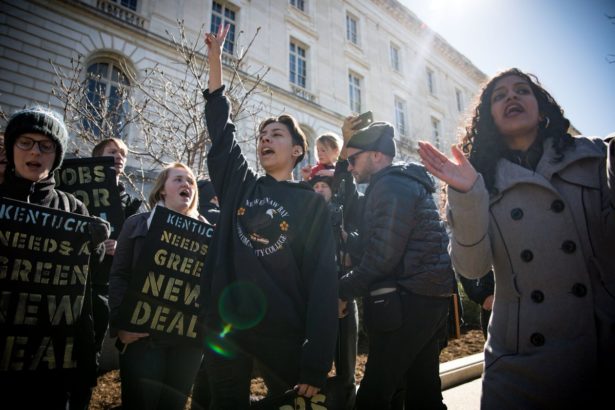
In late 2018, young activists from Sunrise Movement called for a Green New Deal during sit-ins at the offices of Congressional Democrats, who had just won a House majority. Images of young people being led out in handcuffs spread across the internet, forcing Democratic leaders to respond to the activists’ demands. The following year, Sunrise joined forces with the climate school strike movement that spread from Europe, generating an unprecedented display of public support for climate action. That September, over seven million people around the world joined climate protests.
In Stage Four, mass media begin paying serious attention to activists, and casual observers may get the impression this is when the movement began. However, it’s important to understand that while movements seem to spring from nowhere at this stage, this happens thanks to years of work creating conditions where such a take-off became possible.
The MAP’s greatest paradox is that the moment a movement achieves unprecedented recognition, it is followed by discouragement and even despair for activists, who come to believe over a period of months or years that their best efforts are failing. Yet, according to Moyer, the problem “is not that the movement has failed to achieve its goals, but that expectations that its goal could possibly be achieved in such a short time were unrealistic.”
School strike leader Greta Thunberg captured this sense of powerlessness at COP25 in 2019, claiming her movement had “achieved nothing.” Months earlier, climate activists had brought millions of people into the streets. U.S. presidential candidates were signaling support for a Green New Deal and polls showed a clear uptick in public concern about the crisis. Yet, leaders like Thunberg seemed to feel their work had been for naught.
It is understandable that activists want to see immediate results from their efforts. However, there is a lag time between when a movement begins shifting public consciousness, and the translation of public concern into policy. Success may depend on a movement’s ability to prevent activists from becoming burnt out and overly discouraged during this period, so they can carry momentum into the final stages of the MAP.
This stage occurs concurrently with Stage Five, as public opinion shifts to align more closely with that of the movement. Public support for climate action in the U.S. has long hovered somewhere over 50 percent, but the years following the school strikes and Sunrise Movement’s sit-ins saw the issue become a larger priority for more people.
Polling from Yale last December showed 72 percent of respondents believe climate change is happening, while 55 percent think it should be a high priority for political leaders. An AP-NORC Center for Public Affairs Research poll released in April showed 45 percent of respondents becoming more worried about climate change over the past year. The shift in public opinion is reflected in political rhetoric. While Republicans plan to roll back many Biden administration climate policies if they win the presidency and Congress this November, obstructing progress has not become a conservative rallying cry to the degree it did after climate legislation failed in 2010.
In Stage Six, activists’ efforts to elevate an issue lead to a durable shift in public opinion. This can translate into policy wins — if the movement presses its advantage.
In Stage Seven, movements see at least some major goals translated into government policy. This may be achieved through a dramatic showdown, where activists proactively force powerholders to make concessions; a quiet showdown, in which new political realities cause policymakers to reverse previously held positions; or attrition, where victory results from small wins accumulated over years.
 Why climate activists need to celebrate — even if we’re not feeling like it
Current trends suggest the climate movement is now in Stage Seven, even if many activists don’t yet realize it. Climate provisions in the 2022 Inflation Reduction Act helped tip the balance decisively toward renewable energy in the U.S., while similar transitions are underway in other countries. In the U.S., final victory will likely come through either a dramatic showdown or attrition — however, the unique nature of the climate crisis means these two pathways will produce very different results. This makes for unusually high stakes in the final stages of the movement’s fight.
The latest International Energy Agency World Energy Outlook report states current government policies will result in an unstoppable shift toward renewables, amounting to a victory through attrition for climate activists. The risk of backsliding exists, but the energy transition is too far underway to be easily derailed. Even the election of Donald Trump to another term as president would slow, but not stop the shift away from fossil fuels. However, when it comes to climate change, victory by attrition will come too slowly to prevent enormous damage.
The International Energy Agency predicts current government policies will limit global temperature increases to 2.4 degrees Celsius by the end of this century — much higher than the 1.5 degrees beyond which many catastrophic, irreversible impacts become likely. Substantially speeding up the clean energy transition will likely require a series of dramatic showdowns between activists and governments. Fortunately, there are signs this could happen under the right conditions.
A dramatic showdown “resembles the take-off stage” in that activists use trigger events to force policymakers to the table. However, now political leaders respond to activists’ demands much more quickly than after the initial trigger event. Meanwhile, POOs push for change through traditional channels with more success than during Stage Two. The Biden administration’s decision to put LNG projects on hold in response to the mere threat of mass protests — when the campaign against Keystone XL, for example, took years to achieve similar results — gives us a hint of what a dramatic showdown for the climate movement in the U.S. could look like.
For the broader movement, such a showdown could take the form of widespread direct action protests against fossil fuel infrastructure, at the offices of elected leaders and following extreme weather disasters. The goal would be to spur Congress and the federal executive branch to take additional action that builds on the climate provisions of the IRA and significantly hastens the phasing out of fossil fuels.

The work of fighting for a more just, sustainable world is never over. If and when major economies fully move off fossil fuels, activists will need to ensure the transition is permanent while also pushing for government policies that remove carbon from the atmosphere by allowing ecosystems to regenerate. How much planetary “repair work” remains to be done at this stage — and how much of the damage becomes irreversible — depends largely on whether the energy transition happens through a slow process of attrition, or a faster victory through dramatic showdowns.
An unstable political situation in the U.S. and other countries means activists must prepare for multiple future scenarios. Should President Biden win another term, it will be incumbent on climate groups to organize dramatic protests that force the administration into taking additional action — as happened successfully in the case of the Gulf LNG projects. If Donald Trump wins in November, a different path forward will be necessary.
In the event of a second Trump presidency, climate activists should still organize dramatic protests, but with the goal of isolating the administration and creating a political environment where other policymakers — including future presidential candidates — feel an urgent need to act. Based on Trump’s first term, we can be confident of the administration responding to protests in ways that may ultimately tarnish the president’s image; recall members of the National Guard tear gassing peaceful Black Lives Matter protesters in Lafayette Park for a Trump photo op. Protests should seek to make the administration draw attention to its own incompetence and lack of concern about the climate crisis.
Of course, during a Trump presidency, climate groups can also pressure other policymakers who might be more responsive, as they did with Congressional Democrats in 2018. Precious time to avoid the worst effects of the climate crisis will be lost while the administration roles back pollution regulations, fast-tracks approval of the Gulf Coast LNG terminals and similar projects, and attempts to repeal or stymie climate provisions in the Inflation Reduction Act. However, a clear path forward exists for the climate movement.
The MAP helps us understand how social movements successfully capitalize on the political and social influences of their time to achieve a more just world. That said, using the MAP to examine the climate movement is far from a merely academic exercise. Realizing this movement has already progressed through most stages of the MAP can provide activists with a sense of clarity about what work has already been done. It also shows how to increase the likelihood that final victory comes not through slow attrition, but a series of dramatic showdowns that force action fast enough to prevent the worst irreversible impacts of the climate crisis.
Part of what is needed besides a massive social movement ready to act to take advantage of a stepping off point from a severe weather event or a deregulation or Supreme Court Decision like the Chevron and removal of any Administrative Judges or Federal Agencies control of enforcing any environmental and health and safety laws or regulations, is a vision of a renewable energy economy. That is what https://thesolutionsproject.org/ and the https://rmi.org/ have a vision of plans for a renewable energy economy in all 50 states of the US and 146 countries all over the world. We have the technology and the natural resources to meet our energy without fossil fuel or nuclear power. What we lack is the political will to do so. Because the dying profit addicted fossil fuel, private, for profit electric utility & nuclear power industries have bought the votes of our elected leaders from both parties in our government on all levels. If Trump wins the election the Renewable Energy and Infrastructure Acts will be destroyed and any possible “revolutionary reform,” from those bills will be lost as will our democracy. Any levers we may have developed or have found will much harder to move to change the society and the government.
Three cheers for Nick Engelfried’s clear description of how the climate movement’s trajectory is illuminated by Bill Moyer’s stages in his MAP. Big praise and appreciation to the many, many organizers and activists who have moved us laboriously through the previous stages and landed us where we are today. I also agree with Paul Roden’s point if he’s saying that this is no time to imagine that we can relax because “the stages have developed the momentum (and victories along the way) to carry us through.”
In some ways we’re now in the hardest part. Yes, the movement is much more massive and determined, but the the corporations and banks whose “goodies” need to be taken away are closely linked to the politicians who defend them, and politicians will try to use government to fight fiercely to keep the profits coming.
Bill Moyer was my good friend and we used to fight about whether his 8 stages implied a merely reformist program. Does it imagine — CAN it imagine — revolutionary change?
I hoped it could. Still, I went ahead and published a strategy for nonviolent REVOLUTION on the chance that the 8 stages fit too snugly a reformist agenda that limits the sheer amount of change that climate justice in fact would require. (Paul is right to ask, for example: what’s the vision?)
My five-stage revolutionary framework is described in “Toward a Living Revolution,” published by Peace News Press in Britain and Wipf & Stock Publishers in the U.S. WNV articles I’ve published that describe briefly the five stages are: “Occupy the long view” (Feb 18, 2012) and “A revolution comes in stages” (Oct 8, 2013). — George