Treasure Thoreson, labor leader and co-defendant, speaks to a crowd rallying to drop the charges against the Minneapolis 15. (Workers’ Solidarity Circle)
Feature
The movement to defend the Minneapolis 15
In a case with sweeping implications for the freedom to protest, supporters are fighting hard on behalf of the Minneapolis organizers singled out for resisting ICE.
Treasure Thoreson, labor leader and co-defendant, speaks to a crowd rallying to drop the charges against the Minneapolis 15. (Workers’ Solidarity Circle)
When Minneapolis organizer Alec Stewart pulled out of his parking spot on June 16 and headed to work, it seemed like an ordinary day. That is, until Homeland Security Investigations, a detective-like sub-agency of Immigration and Customs Enforcement, rolled up with multiple squad cars and dragged him out of his vehicle.
“I was never told I was arrested,” said Stewart, who goes by Mac. “I was not told what for. I was not shown any warrants. I had no idea [I was going to be arrested] until I was in cuffs.”
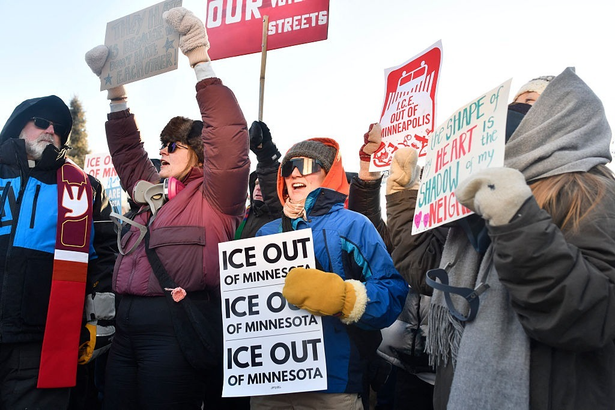
Mac was among the thousands of Minnesotans who rallied to defend their neighbors this January when Trump inundated Minneapolis-St. Paul with federal immigration agents who outnumbered regular police 3 to 1. Residents responded with one of the most sweeping, complex and powerful movements of the decade, mobilizing a multitude of existing relationships and organizations to craft a shield capable of fighting off Trump’s domestic militia. Using the encrypted app Signal, they built networks to track officers and warn potential arrestees. They launched mutual aid networks to support those who were in hiding to avoid becoming targets of Immigrations and Customs Enforcement, or ICE. They blockaded roads, tailed ICE vehicles and went out on a one-day general strike.
The charges faced by Mac and his 14 co-defendants, all of whom were arrested on the same day, carry multi-year sentences. The government claims all 15 people indicted “did knowingly conspire … to prevent by force, intimidation and threats, officers and employees of the United States Department of Homeland Security … from discharging the duties of their officers,” while individual defendants have been charged with additional crimes like assault on a federal officer. The alleged “conspiracy” involved everything from conversations in Signal chats about plans to blockade an ICE processing center, to assigning working groups for the Jan. 23 General Strike, to possessing homemade defensive shields or just following federal officers — as tens of thousands around the country have done.
What’s particularly alarming to the defendants and their allies is that the charges don’t cite any specific officers who were assaulted, and the government’s evidence includes mundane activist chatter: discussing protests and ICE locations, posting an article from the anarchist website CrimethInc. Anything provably tied to organizing, or just radical ideas, became proof of conspiracy: renting a U-Haul, purchasing a trailer from Facebook Marketplace, calling on Facebook for the public to “become ungovernable” — all were alleged evidence of malicious intent.
Sign Up for our Newsletter
We’ll send you a weekly email with the latest articles.
What’s also alarming is how that information was gathered. Recently, the defense filed a motion that revealed the existence of Operation Puppet Master, a program to surveil and investigate Twin Cities labor unions, churches and community groups in advance of the filing of criminal charges. Unions in which defendants were member leaders had their finances quietly inspected, including their national unions’ political donations. Undercover officers attended protest planning meetings and covertly recorded unsuspecting citizens. The level of surveillance was shockingly broad: Homeland Security Investigations had near carte blanche to categorize almost any organization that could oppose sweeping deportation arrests as potentially criminal.
If the government can make these charges stick, it could have a profound chilling effect on one of the largest social movements of the 21st century, and could chart a pathway for the Trump administration to effectively criminalize any opposition. That is why these 15 defendants have vowed to fight the charges, and why they have a committee of supporters who are doing what it takes to support those who have been singled out.
They came for everyone
“I think they picked us out because we’re good organizers,” said Treasure Thoreson, a special education teacher who was among those indicted. All 15 of the defendants are union members, and many are leaders in their locals. Thoreson is an executive board member of the Minneapolis Federation of Educators and was a captain during their confrontational strike in 2022. When Trump came back in 2024, she knew deportation defense had to be the priority. She built on her strike experience as she began to organize against ICE in her neighborhood, working with a group of rank-and-file union members called the Workers’ Solidarity Circle.
“This is purely a way to try and send a message of fear and of repression,” Thoreson said of the charges. That opinion was echoed by everyone working on the Minneapolis case, and also by those doing jail support for criminalized protesters across the country.
Protesters rally at the Whipple Building, an ICE processing center, on Jan. 30 in Minneapolis. (Octavio Jones / AFP via Getty Images)
The Minneapolis 15, as the defendants have become known, are the latest in what is becoming an institutional strategy by the federal government. In the fall of 2025, a 12-count indictment was issued relating to a shooting of an officer during a July 4 protest outside of the Prairieland Detention Center in Texas. In September, Trump labeled “antifa” a “Domestic Terrorist Organization” and connected the Prairieland case to it. Prosecutors in the case used “antifa” ideology as evidence of “providing material support to terrorists” — support that allegedly came in the form of offering “property, services, training, communications equipment, weapons, explosives, personnel (including themselves) and transportation.”
The Prairieland indictments cast a wide net and tried to implicate protesters, some of whom barely knew each other, in the shooting based on their attendance at the demonstration, participation in a Signal channel coordinating direct actions and, in one particularly shocking situation, having moved a box of political zines that were considered evidence.
Many of these defendants were ultimately convicted of charges like rioting or providing material support to terrorists and sentenced to lengthy prison terms, for a cumulative sentence of more than 450 years in federal prison. The defendant who transferred the box of protest literature received 30 years for “corruptly concealing a document or record.”
“The outcome of this case will haunt movements for decades to come,” wrote the Prairieland defense committee in a public statement. “The Trump administration is using what happened on July 4 to test its ability to criminalize dissent and chill all opposition.”
Also last fall, six demonstrators, including a congressional candidate, were arrested while protesting the Broadview ICE facility in the Chicago suburbs and charged with felony conspiracy to impede a federal official, among other charges, though the felony charges were eventually dropped. Then, in January, 39 people were arrested at the Cities Church in St. Paul for protesting against the ICE officer who served as their lay preacher, and charged with interfering with religious freedom. These arrests galvanized the media because former CNN host Don Lemon, who was covering the event as a journalist, was among those charged, thus sending the message that reporters could be treated as perpetrators.
Reuters found at least 655 cases brought in 2025 and early 2026 under 18 U.S.C. Section 111, the primary law being used against people accused of interfering with ICE, which punishes anyone who “forcibly assaults, resists, opposes, impedes, intimidates or interferes with” federal officers. This was the rationale given by masked federal immigration agents for arresting 42-year-old Minnesota resident Becky Ringstrom after surrounding her car and pounding on her window with a metal object. As a result, she was told, her information was entered into a government database, presumably allowing the administration to further build out a list of activists who challenge their authority.
What’s different about the Minneapolis case, is that it uses another statute, 18 U.S.C. Section 372, focusing on alleged coordination, which widens its potential scope.
With arrests mounting, charges escalating, and the government employing broad infiltration and surveillance, those who are organizing the defense committee hope that their model can be reproduced by communities around the country if and when their resistance is criminalized.
The best defense
“A lot of what the defense committee is trying to do is bring attention to the fact that this happened and show support for these people,” said Emily, a Minneapolis organizer who is a part of the defense committee and asked that only her first name be used for fear of government reprisal.
When activists are arrested, they are at a huge disadvantage in terms of resources and finances. A defense committee is critical to pooling community connections and skills that can support them as they head towards trial.
Because legal costs and the expenses of other consequences from facing such extraordinary charges can become insurmountable, creating a fundraiser was the first order of business. The fund had reached over $390,000 as of Aug. 27. Immediate support is often the next priority: helping the defendants pay their rent, get groceries and figure out day-to-day needs, particularly since in this case the defendants were ordered to have no communication with each other by the court.
“I think that’s another reason they’re doing this is to scare people that this could happen to you if you do anything to protect your neighbors,” Emily said. “You could be facing legal charges and have to go through that process, which could take months, if not [longer].”
This is why Mac says “the process is the punishment,” since the time and money it takes to even win a case, or see it through until it is dismissed, can be enormous. Since the evidence includes things most of the city was doing, the slogan “Minnesota, the land of 100,000 unindicted codefendants” has spread.
While financial and legal support are absolutely critical, so, too, is ensuring that the defendants stay a part of the public conversation and are supported by larger institutional players. Some members of the defense committee work with the media, while others connect with community groups. And as members of unions, the co-defendants have a built-in base of support.
“Today, the Trump administration is trying to criminalize those who speak up for their neighbors — trashing civil liberties, transparency and accountability — and then pepper spraying those who dare to call them out,” said Randi Weingarten, the national president of American Federation of Teachers, of which Thoreson’s union is an affiliate.
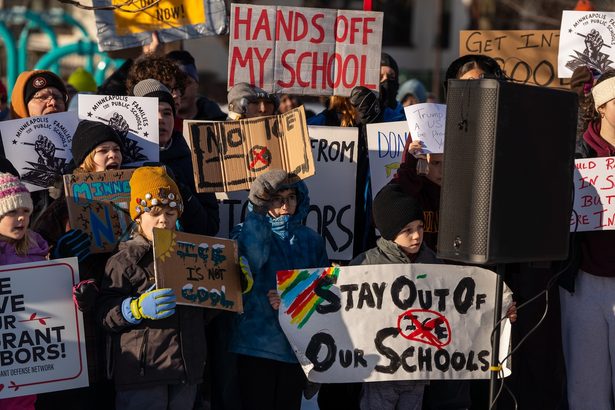
Union membership is mentioned in the indictment, as is the historic Jan. 23 general strike, which suggests that labor activism is part of why the Minneapolis 15 were singled out. Unions have played an especially large role in the movement against ICE’s occupation of Minneapolis, above and beyond that single-day strike. Unions like Unite HERE helped to transport vulnerable immigrant workers to and from work, and others, like CWA Local 7250 and SEIU Local 26, built mutual aid networks to support those who couldn’t work for fear of ICE arrest. The Minneapolis Federation of Educators had one of the most central roles, working with parents to prevent ICE arrests at schools by establishing hundreds of weekly watch shifts each week.
Minneapolis teachers, parents and children rally against ICE targeting schools. (Riley Bruce / Take Action MN)
Most movements that have faced extreme legal repression, from the Black Panthers to the New Left, have had to maintain long-term support for political prisoners. These efforts are necessary to help to ensure that no one is left behind, though they can require significant time and financial resources. But they also help the larger project survive, which in this case means maintaining the systems of mutual aid and direct action that activists are invested in.
“It would be tragic to see all the work we’ve done get hamstrung by this politically repressive move,” said Mac, echoing what other defendants have said: The best form of support is to continue to defend our communities.
“[We need to] keep on going and doing what we have been doing — organizing, developing decentralized local groups that can have each other’s backs, so that when something happens again, we have this protection — and to continue to get unions involved,” said Emily, in a point echoed by the defendants.
The committee is eyeing upcoming court dates over pretrial discovery motions that will determine how widely the state can cast its evidentiary net. Discovery can be punitive in the same way that the length and cost of a court case can. The process can be used to pull private conversations and information about dissidents into the public record. This can include conversations and internet activity that range from embarrassing to incriminating, often forcing activists to go through a painfully humiliating process of exposure that leads them open to further repression. Putting limits on that is a priority for the committee.
Support Us
Waging Nonviolence depends on reader support. Make a donation today!
With the federal government’s wildly outsized indictment and sweeping surveillance tactics, the outcome could be precedent-setting for what options federal authorities have when looking to infiltrate a particular locality’s anti-ICE network. Given that Trump has also used ICE as a kind of federal protest police, his federal allies need a legal victory that would allow Trump to target any city that defies him.
The only thing that will stop that, besides good legal counsel, is having the community behind them to remind prosecutors and judges that their actions are observable and have consequences ranging from protests to lawsuits and election losses. Trump’s attacks on civil liberties and democracy are sustained primarily where resistance wanes. While the neutrality of courts has held in some cases and bent to Trump’s will in others, what happens outside of the courtroom is just as important as what happens inside it.
Thank you for your interest in republishing this story. You are free to republish it as long as you follow these four requirements:
Credit Waging Nonviolence and link to the original. We prefer with a note at the top of the article. For example: This article was originally published on Waging Nonviolence.
Don’t sell our material or edit it, unless editing to reflect relative changes in time, location and editorial style.
Use photos or images only if you are certain they are in the creative commons or have received permission from us. To do so, email: contact@wagingnonviolence.org.
Include our Matomo tracking pixel by copy-and-pasting this HTML code into the article:
Copy and paste the following into your page to republish:
From police killings to genocide in Gaza, collective grieving practices have built lasting movement infrastructure and helped overcome alienation and burnout.
After the brutal January 2026 crackdown, teachers unions in Iran are not backing down on their demands for fair wages, free education and free expression.
After the collapse of state infrastructure and services amid war in Sudan, mutual aid networks stepped up to fill the gaps in health care, food and emergency services.
Peace and justice organizations, as well as universities, publish their own independent content on Waging Nonviolence. This Community section offers just a sample of their latest stories. Visit their individual pages to see more.
Get Waging Nonviolence delivered to your inbox
Sign up for our weekly newsletter to get the latest in people-powered news and analysis.
Donate
Waging Nonviolence is a nonprofit organization and all donations are tax deductible.
To donate by check, cryptocurrency or other method, see our Ways to Give page.

Brilliant and very helpful analysis. Thanks, Shane. By